

How to Make an App Like Thrive Market
How to Make an App Like Thrive Market
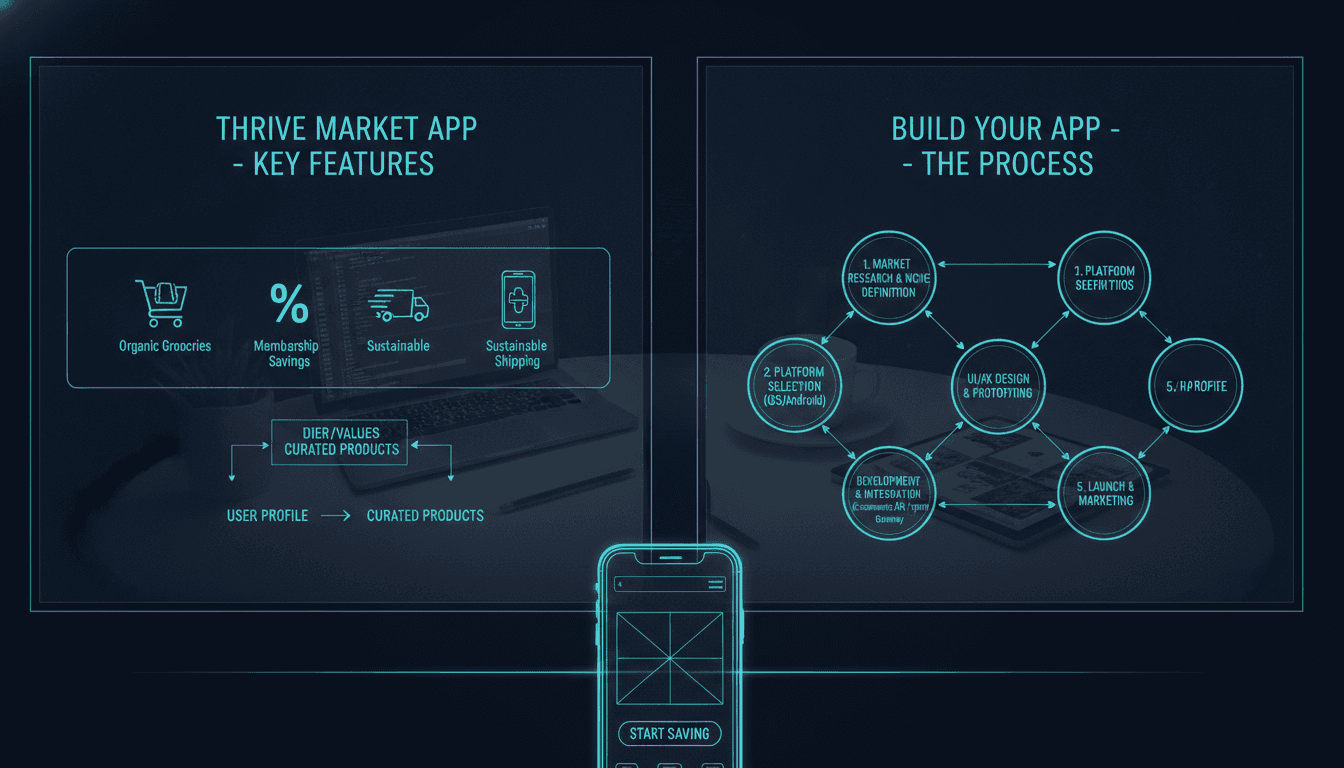
Thrive Market built a business by solving a very specific frustration: healthy, organic groceries were either too expensive or too hard to find. By combining a membership model with curated organic products and direct-to-door delivery, the company turned a niche shopping habit into a multi-million-member marketplace.
If you're planning to build something similar — a membership-based grocery or wellness commerce app — this guide walks through the product thinking, feature set, technology choices, and cost considerations involved.
For a closer look at a related topic, read our guide on How to Make an App Like Boxed.
What Makes Thrive Market Work
Before writing a line of code, it helps to understand why the model succeeds. Thrive Market isn't simply an online grocery store. It's a combination of four mechanics:
- Membership as the revenue engine. Annual or monthly fees subsidize wholesale-level pricing, which builds loyalty and produces predictable recurring income.
- Curation over catalog size. Instead of 100,000 SKUs, shoppers get a tightly edited selection filtered by diet and values (keto, paleo, gluten-free, vegan, non-GMO).
- Values-driven positioning. Sustainability commitments, carbon-neutral shipping, and social impact programs give the brand a reason to be chosen over Amazon.
- Private label margin. Own-brand products improve unit economics while reinforcing trust.
Your app needs to express all four of these, not just the shopping cart.
Core Feature Set
For Customers
Onboarding and diet profiling A short quiz at signup ("Are you avoiding gluten? Shopping for a family? Interested in sustainable home goods?") lets you personalize the catalog from session one. This single feature dramatically improves conversion because shoppers immediately see relevant products.
Membership management Free trial periods, tiered plans, annual vs. monthly billing, pause and cancel flows, and clear savings messaging ("You've saved $214 this year"). Showing accumulated savings is one of the strongest retention levers in this category.
Catalog browsing and smart search Category trees, dietary filter chips, ingredient-level search, allergen exclusions, and certification badges (USDA Organic, Fair Trade, Non-GMO Project Verified). Search should tolerate typos and understand synonyms — users type "coconut aminos" and "soy sauce alternative" to mean the same thing.
Product detail pages with transparency Full ingredient lists, nutrition panels, sourcing information, and third-party certifications. In the health-food space, transparency is the product.
Cart, subscriptions, and autoship Recurring orders for staples with flexible intervals, easy skip-and-swap, and a bundled shipping threshold. Subscriptions are how you move a customer from one purchase to a habit.
Checkout and payments Multiple payment methods, digital wallets, promo codes, gift cards, and — for U.S. grocery — SNAP/EBT eligibility handling where applicable.
Order tracking and post-purchase Real-time status, carrier integration, delivery notifications, easy returns, and re-order in one tap.
Content and community Recipes, wellness guides, and shoppable content. Editorial content drives organic traffic and increases basket size when recipes link directly to ingredient bundles.
For Admins and Operations
- Product and inventory management across multiple fulfillment centers
- Pricing, promotions, and membership plan configuration
- Order and returns management
- Warehouse and shipping integrations
- Customer support tooling with order context
- Analytics: cohort retention, LTV, churn, basket composition, margin by SKU
For Vendors (Optional Marketplace Layer)
If you plan to onboard third-party brands, add a vendor portal for catalog uploads, inventory sync, order visibility, and payout reporting.
For a closer look at a related topic, read our guide on How to Make an App Like Shipt.
Designing the Experience
Grocery apps live or die on friction. A few UX principles that matter disproportionately here:
- Make the value obvious within 30 seconds. Show member price vs. retail price side by side on every product card.
- Reduce repeat-purchase effort. "Buy it again" should be the first thing a returning member sees.
- Filter before you scroll. Diet filters belong at the top of every listing, persistent across sessions.
- Design for pantry-loading. Users buy 15–30 items per order, so bulk-add, quantity steppers, and a persistent cart summary are essential.
- Be honest about stock and delivery. Nothing erodes trust faster than a substituted or missing item with no warning.
Technology Stack
Mobile front end React Native or Flutter for a single codebase across iOS and Android, or Swift and Kotlin if you need deep native performance and platform-specific polish.
Web storefront Next.js or Nuxt for server-side rendering — critical, because recipe and product content is a major SEO channel in this space.
Back end Node.js (NestJS), Python (Django/FastAPI), or Go, structured as modular services: catalog, pricing, membership, cart, orders, fulfillment, and notifications. A microservices or modular-monolith approach lets the catalog and checkout paths scale independently.
Data layer PostgreSQL for transactional data, Redis for cart and session caching, Elasticsearch or Algolia for search and faceted filtering, and a data warehouse (BigQuery, Snowflake) for analytics.
Commerce infrastructure You can build the commerce core yourself or accelerate with headless platforms like Shopify Plus, Commercetools, or Medusa — then layer your custom membership and personalization logic on top.
Integrations Stripe or Braintree for payments and subscription billing, Avalara or TaxJar for tax, ShipStation/EasyPost/Shippo for carriers, a WMS or 3PL API for fulfillment, Twilio and SendGrid for messaging, and Segment plus Mixpanel or Amplitude for product analytics.
Cloud and DevOps AWS or GCP with containerized services, CI/CD pipelines, infrastructure-as-code, autoscaling for promotional traffic spikes, and observability through Datadog or an equivalent.
Adding Intelligence
AI is where a new entrant can genuinely differentiate:
- Personalized merchandising based on purchase history, diet profile, and seasonality
- Replenishment prediction that nudges users before they run out of coffee or detergent
- Smart substitutions when an item is out of stock, matched by ingredient profile rather than category
- Recipe-to-cart conversion where a meal plan becomes a populated basket in one tap
- Demand forecasting for inventory planning across fulfillment centers
- Support automation for order status, returns, and membership questions
Operations: The Part Most Teams Underestimate
A Thrive-like business is 40% software and 60% logistics. Before launch, you need clear answers on:
- Fulfillment model — own warehouse, 3PL partner, or dropship from brands
- Zone-based shipping and how free-shipping thresholds affect margin
- Cold chain if you're selling frozen or refrigerated goods (this significantly increases complexity and cost)
- Returns and damage policy for food items
- Compliance — FDA labeling rules, state-level food regulations, and organic certification claims
- Membership accounting for deferred revenue recognition
Software can't rescue broken unit economics. Model the contribution margin per order before you scale marketing.
Monetization Options
| Stream | Notes |
|---|---|
| Membership fees | Primary recurring revenue; test annual vs. monthly aggressively |
| Product margin | Strongest on private label |
| Subscription orders | Higher LTV, lower CAC per order |
| Brand partnerships | Sponsored placement and sampling programs |
| Referral programs | Low-cost acquisition in wellness communities |
Development Timeline and Cost
A realistic phased approach:
Phase 1 — Discovery and design (4–6 weeks) Market validation, product requirements, information architecture, UI/UX design system.
Phase 2 — MVP build (12–20 weeks) Catalog, search, cart, checkout, membership billing, order management, basic admin panel, iOS and Android apps.
Phase 3 — Launch and stabilize (4–6 weeks) QA, performance testing, payment and fulfillment integration testing, soft launch in a limited region.
Phase 4 — Scale (ongoing) Personalization, autoship, content platform, vendor portal, AI features, expanded geography.
Indicative ranges: a lean MVP typically lands between $60,000 and $120,000. A full-featured, multi-warehouse platform with AI personalization and a vendor marketplace generally runs $180,000 to $400,000+, depending on team location, integration depth, and operational complexity.
If this is relevant to your project, check out How to Make an App Like RideAmigos.
Go-to-Market Essentials
- Launch in a tight geographic footprint so fulfillment stays reliable
- Lead with a concrete savings promise, not vague wellness language
- Invest in SEO content early; recipes and buying guides compound over years
- Partner with dietitians, trainers, and niche creators rather than broad influencers
- Offer a risk-free trial with a frictionless cancel flow — it converts better and reduces chargebacks
Common Pitfalls
- Catalog bloat. Adding thousands of SKUs destroys the curation that made you appealing.
- Underpricing membership. If the fee doesn't cover the discount, you're buying revenue.
- Ignoring retention until month six. Grocery is a habit business; measure second-order rate from week one.
- Treating the app as a website wrapper. Native performance, offline cart, and push notifications materially affect repeat purchase.
- Skipping the admin tooling. Operations teams will be your heaviest users. Build for them.
Final Thoughts
Building an app like Thrive Market means building three things at once: a commerce platform, a subscription business, and a logistics operation. The software is very achievable with a modern stack — the differentiation comes from curation, personalization, and reliable delivery.
Start narrow. Pick a specific audience (new parents, keto shoppers, a single metro area), nail fulfillment for that group, and expand from proven unit economics. If you'd like help scoping an MVP, designing the architecture, or estimating a build for your specific market, our team is happy to talk it through.
Have a project in mind? Contact Sodio Technologies to discuss your requirements and explore the right technology solution for your business.
/// Work with us
Talk to the engineers who'd build it
You'll get a technical scope, timeline and cost estimate from the people doing the work, not an account manager. In-house team, no subcontracting, since 2016.