

How to Make an App Like Remente
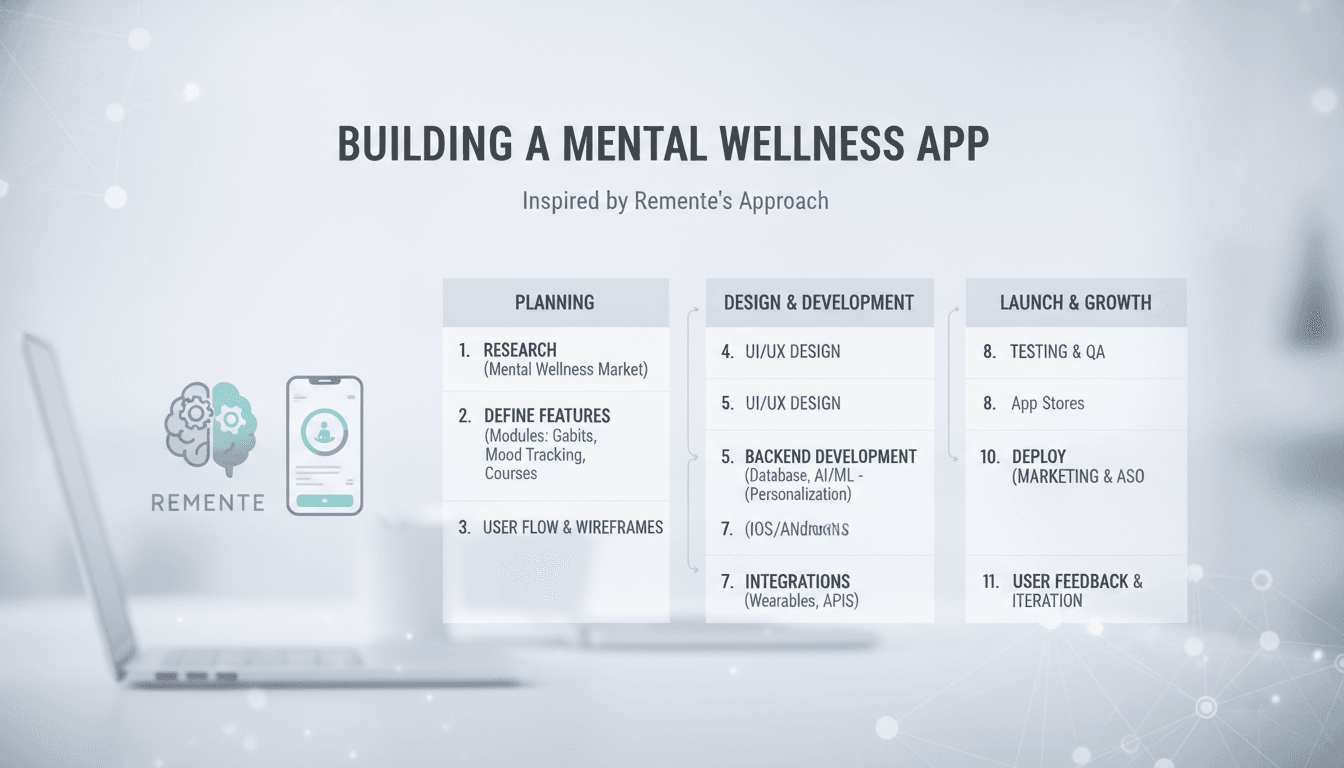
A practical breakdown of the architecture, feature set, and engineering decisions behind building a self-improvement and mental wellness app — from mood tracking and goal systems to personalisation logic and data privacy.
What Makes Remente's Feature Set Worth Studying?
Remente sits at an interesting intersection: part mood journal, part goal planner, part cognitive behavioural therapy (CBT) tool. It is not a simple habit tracker. The feature depth is what makes it worth analysing before you build something similar.
The core feature surface looks like this:
- Mood check-ins with emotional granularity (not just a 1–10 slider)
- Life wheel assessments across 8–10 life areas
- Goal setting with sub-tasks and progress tracking
- CBT-based courses and structured programmes
- Daily planning and journaling
- Push notification scheduling tied to user behaviour
Each of these is independently buildable. The hard part is making them work together without the app feeling fragmented. The data model has to carry context across all of them — a user's mood trend should inform their goal suggestions, and their journal entries should feed into their weekly reflection.
What Tech Stack Should You Use?
This depends on whether you are building for iOS only, Android only, or both. Remente ships on both platforms, and most wellness apps need that parity from day one.
Mobile Framework
React Native is the most common choice for teams that want shared logic across platforms without fully rebuilding in Kotlin and Swift. Flutter is the stronger pick if you prioritise UI performance and animation fidelity — the life wheel visualisation, for example, renders more smoothly with Flutter's Skia renderer than with React Native's bridge-based approach.
If your team already owns Swift and Kotlin experience and you are planning for a feature set that will push into device-native territory (HealthKit, CoreMotion, background processing), native development is still worth the cost.
Backend
Node.js with Express or NestJS handles the API layer well. For a wellness app at early scale, a monolithic service is fine — microservices add operational overhead that is rarely justified before 50,000 MAU.
PostgreSQL is the right primary database. The relational structure suits user goals, check-ins, and programme progress. You will likely add a time-series layer (TimescaleDB or InfluxDB) once mood data volumes grow and you need fast aggregation for trend queries.
Personalisation Engine
This is where most teams underinvest early and pay for it later. Remente's programme recommendations and daily reminders are driven by user behaviour signals. At minimum, you need:
- An event pipeline (Segment or a self-hosted Kafka topic) capturing every meaningful in-app action
- A basic recommendation model — collaborative filtering works well once you have a few thousand users; rule-based logic is fine before that
- A notification scheduling service that reads from user preference and behaviour data, not just fixed times
How Do You Handle Sensitive Mental Health Data?
This is not a checkbox. Mental health data is among the most sensitive categories under GDPR Article 9 and equivalent regulations in India (the DPDP Act, 2023) and California (CCPA/CPRA). Getting this wrong is expensive.
The engineering decisions that matter most:
Encryption at rest and in transit. AES-256 for stored data, TLS 1.3 for transport. This is baseline, not optional.
Data minimisation. Collect only what the feature requires. If your mood check-in needs a timestamp and an emotion label, do not store the user's location unless a feature explicitly needs it.
Consent flows. Your onboarding must capture granular, revocable consent. Storing a single boolean accepted_terms field is not sufficient. You need a consent log — what the user agreed to, at what version, and when.
Right to erasure. GDPR Article 17 requires that users can delete their data. Build this into the data model from the start. If you structure your schema without soft-delete and anonymisation logic, retrofitting it is painful.
Therapist or coach access. If you plan to introduce any human-in-the-loop feature where a professional views user data, you need a separate access control layer and audit logging.
/// Not sure where to start?
Get the architecture before you commit
Tell us what you're building and we'll map the technical approach, stack, and rough timeline. No cost, no obligation, no sales call required.
What Does the Goal and Progress Tracking System Actually Look Like?
The goal module is the most technically interesting part of a Remente-like app. It needs to handle hierarchy (goals have sub-tasks), time bounds (weekly vs. long-term goals), and state transitions (active, paused, completed, abandoned).
A clean schema looks like this:
| Entity | Key Fields |
|---|---|
| Goal | id, user_id, title, category, target_date, status |
| Milestone | id, goal_id, title, due_date, completed_at |
| Check-in | id, user_id, goal_id, mood_score, note, created_at |
| Life Area | id, user_id, area_name, score, updated_at |
The life wheel score updates need to be append-only so you can show trend data over time. Do not overwrite the score — store a new row with a timestamp and compute the latest on read.
Progress calculations should be server-side, not client-side. Putting business logic in the mobile client means you cannot fix bugs without a new app release. A thin client that calls a /goals/{id}/progress endpoint gives you the flexibility to iterate on the calculation without touching the app.
Notifications and Engagement Without Being Intrusive
Wellness apps live and die by day-7 and day-30 retention. Remente's approach leans on timely, contextual nudges rather than generic daily reminders.
The architecture for this is a scheduled job service (Celery, BullMQ, or AWS EventBridge depending on your stack) that runs decision logic per user at a configurable cadence. The decision logic checks:
- When the user last opened the app
- Whether they have an overdue check-in
- Whether they are mid-way through a course
- Their self-reported preferred notification time
Firebase Cloud Messaging (FCM) handles delivery for both Android and iOS. Do not use local notifications as a substitute for server-driven ones unless you are building fully offline-first. Server-driven notifications let you A/B test messaging without an app update.
Respect opt-outs strictly. A user who turns off notifications and still receives them will leave and leave a one-star review.
Conclusion
The architecture for an app like Remente is not unusual in isolation — it is the combination of a well-structured data model, a thoughtful personalisation layer, and genuine compliance with health data regulation that separates a product people trust from one they delete after a week.
Start with the data model. Get the schema right for goals, mood check-ins, and consent before you write a single screen. The UI is the easy part.
If you are evaluating build vs. outsource, the decision usually comes down to whether you have a mobile team that has built in the health or wellness space before. The compliance and data modelling work is where unfamiliar teams lose time.
FAQ
How long does it take to build an app like Remente? A feature-complete MVP covering mood tracking, goal setting, and push notifications typically takes 16–24 weeks with a team of one product manager, two mobile engineers, one backend engineer, and a designer. Adding CBT courses and a personalisation engine extends that to 32–40 weeks.
How much does it cost to build a wellness app like Remente? Cost depends heavily on location and seniority of the team. A mid-seniority team in India typically runs between ₹80–1.5 crore for a full-featured build. Teams in Western Europe or North America will see those numbers two to three times higher for equivalent output.
Do I need to comply with HIPAA if I build a mental wellness app? HIPAA applies if your app stores or transmits Protected Health Information (PHI) and you are working with covered entities such as hospitals or insurers. A standalone consumer wellness app that does not bill insurance and has no clinical staff typically falls outside HIPAA scope, but you should get a legal opinion specific to your use case.
What is the best database for storing mood tracking data over time? PostgreSQL with the TimescaleDB extension handles most wellness apps well up to tens of millions of rows. TimescaleDB's hypertable partitioning keeps time-range queries fast without requiring a separate infrastructure component. Migrate to a dedicated TSDB only when query latency becomes measurable.
Should I build the personalisation engine from day one? No. Ship rule-based logic first — if a user has not checked in for 48 hours, send a reminder. Collect event data from the start via a pipeline like Segment. Build the ML layer when you have at least 5,000 active users and real behavioural data to train on. Building a model before you have data is engineering theatre.
Have a project in mind? Contact Sodio Technologies to discuss your requirements and explore the right technology solution for your business.
/// Work with us
Talk to the engineers who'd build it
You'll get a technical scope, timeline and cost estimate from the people doing the work, not an account manager. In-house team, no subcontracting, since 2016.