

How to Make an App Like Sleep Cycle
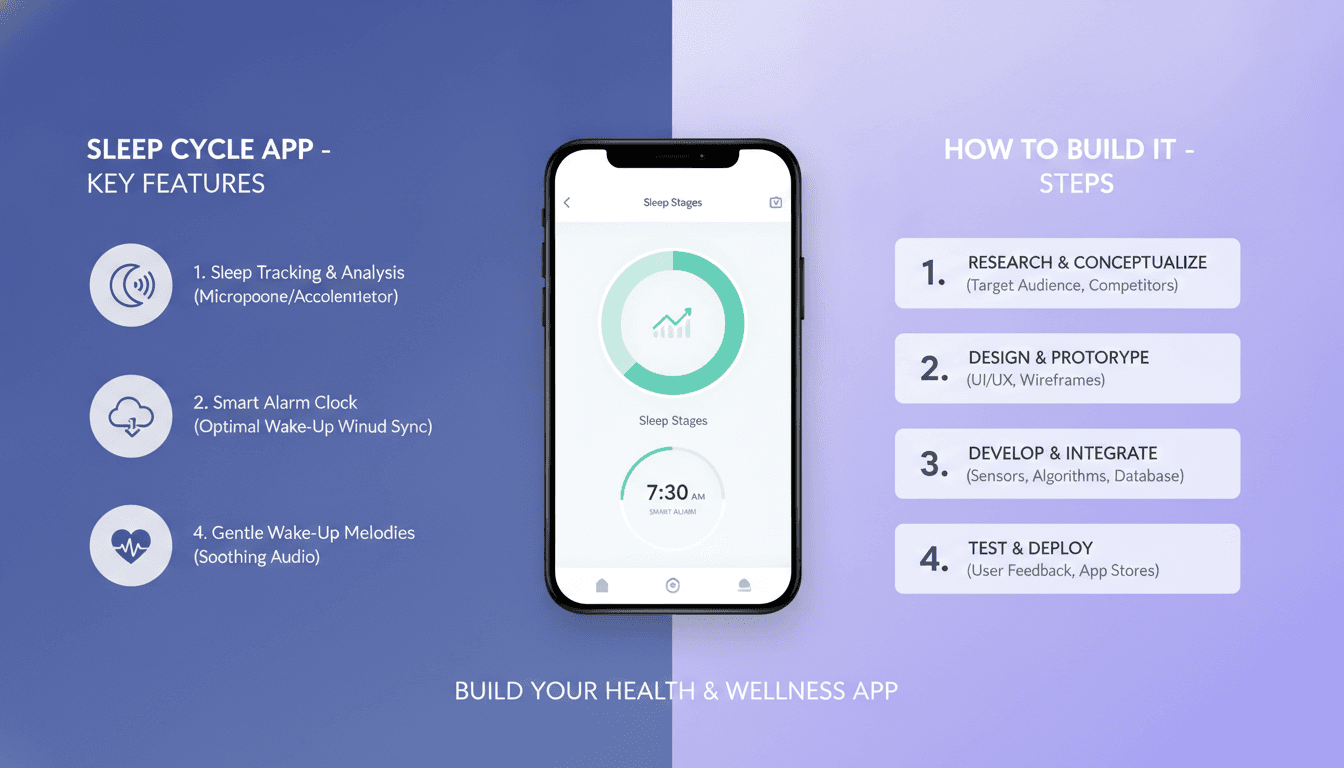
A practical breakdown of the architecture, data pipeline, and product decisions that go into building a sleep-tracking app — from sensor fusion to subscription monetisation.
What Does Sleep Cycle Actually Do Under the Hood?
Sleep Cycle's core promise is simple: track sleep quality and wake you at a light sleep phase within a 30-minute window. The mechanism behind it has shifted over the years. Early versions used the accelerometer exclusively, reading body movement through the mattress. Current versions use the microphone by default, analysing breathing patterns and movement sounds via short-time Fourier transform (STFT) on audio frames sampled at 44.1 kHz, processed on-device.
That on-device processing detail matters. Sleep Cycle does not stream raw audio to a server. It runs a lightweight signal classifier locally, extracts features, and only syncs aggregated sleep stage data. This is the architecture decision you need to make first: where does the inference happen?
On-device inference via Core ML (iOS) or TensorFlow Lite (Android) keeps latency near zero, avoids privacy complaints, and reduces backend load significantly. The trade-off is model size constraints and the inability to retrain on live user data without a federated learning setup. Cloud inference gives you flexibility but introduces a trust problem. For a sleep app, on-device wins.
How Do You Model Sleep Stages Without a Medical-Grade Device?
Consumer sleep apps cannot replicate polysomnography. You are not reading EEG or EOG signals. What you have is accelerometer data, audio, heart rate from a paired wearable (if present), and maybe barometric pressure. From that, you are trying to infer four states: awake, light sleep (N1/N2), deep sleep (N3), and REM.
The standard approach is a sliding-window classifier. You collect a 30-second epoch of sensor data, extract features, and run classification. Sleep Cycle has published that their model leans on audio features more than movement, which makes sense given that REM is characterised by reduced muscle tone (less movement) and specific breathing patterns rather than audio silence.
Feature Extraction
For audio, useful features include:
- MFCCs (Mel-frequency cepstral coefficients), typically 13 coefficients per frame
- Spectral centroid and rolloff
- Zero-crossing rate
- Short-term energy
For accelerometer, you want magnitude of the 3-axis vector, frequency-domain features via FFT, and inter-epoch delta (how much motion changed between windows).
Heart rate, if available via HealthKit or Wear OS APIs, gives you HRV and resting HR, which are strong signals for deep sleep and REM discrimination.
Classifier Choice
Gradient boosted trees (XGBoost, LightGBM) work well on tabular feature vectors and are fast to export to Core ML or TFLite. LSTM-based models handle the sequential nature of sleep staging better but are heavier. A reasonable middle path is a shallow LSTM with 2 layers and 64 hidden units, quantised to INT8, which fits comfortably under the 50 MB model size that starts to create App Store friction.
You will need labelled training data. The SHHS (Sleep Heart Health Study) and MESA datasets are publicly available and contain polysomnography recordings paired with actigraphy. Expect to spend significant engineering time on data preprocessing before you train anything.
Alarm Logic and the Wake Window Problem
The smart alarm is the product feature users actually feel. The logic is: given a target wake time T, start monitoring from T minus 30 minutes. If the classifier detects a light sleep or awake epoch, trigger the alarm. If no such epoch is detected, trigger at T regardless.
This sounds simple. The edge cases are not. Users who sleep through the wake window, users with sleep apnoea whose breathing patterns confuse the audio classifier, phones placed face-down that muffle audio, and shared beds where the classifier picks up a partner's breathing all create noise.
Build a confidence threshold into the wake decision. Only trigger early if the classifier returns a light-sleep probability above 0.75 for two consecutive epochs. Log the cases where you fall back to the hard alarm. That data tells you where your model is weakest.
/// Not sure where to start?
Get the architecture before you commit
Tell us what you're building and we'll map the technical approach, stack, and rough timeline. No cost, no obligation, no sales call required.
What Does the Backend Architecture Look Like?
The backend for a sleep app is lighter than most engineers expect, because the heavy lifting is on-device. What you do need:
| Component | Purpose | Reasonable Stack |
|---|---|---|
| Auth service | User identity, session tokens | Firebase Auth or Auth0 |
| Sync API | Upload nightly sleep records | REST or GraphQL, PostgreSQL |
| Analytics pipeline | Aggregate trends, weekly reports | Kafka + ClickHouse or BigQuery |
| Notification service | Smart alarm backup, tips | FCM + APNs |
| Subscription management | Paywall, trial, renewal | RevenueCat |
Sleep records are small. A single night is a few kilobytes of epoch-level data plus metadata. You are not moving large payloads. The interesting backend problem is the analytics layer: users want 30-night trends, sleep debt calculations, and correlations with lifestyle inputs (caffeine, exercise). These are aggregation queries that benefit from a columnar store.
RevenueCat is the practical choice for subscription management on mobile. Building your own receipt validation against the App Store and Google Play APIs is a maintenance burden that is not worth taking on unless you have platform-specific requirements.
How Should You Handle Privacy and Health Data Compliance?
Sleep data is sensitive. In the EU it may qualify as health data under GDPR Article 9, which requires explicit consent and stricter processing rules. In the US, HIPAA applies only if you are a covered entity or business associate, which most consumer apps are not, but state laws (California CCPA, for instance) still impose obligations.
Practical steps:
- Classify your data: what is collected, where it is stored, how long it is retained
- Audio: process on-device, do not persist raw recordings to disk or cloud
- Give users a genuine data export and deletion flow, not just a button that queues a request
- If you integrate HealthKit or Google Health Connect, follow Apple and Google's data use policies, which both restrict use of health data for advertising
Do not treat this as a legal checkbox exercise. Sleep apps have been flagged by regulators specifically because health data combined with audio recording reads as surveillance to users.
Can You Build This Without Training Your Own Model?
Yes, and for most teams it is the right starting point. You have two practical options short of training from scratch.
The first is using a pre-trained model from the research community. The YASA (Yet Another Spindle Algorithm) Python library provides a well-validated sleep staging algorithm you can use as a baseline. It is not designed for mobile deployment, so you would need to convert and quantise it.
The second is skipping sleep staging entirely for v1 and using movement-only heuristics. This is what most fitness trackers did before 2018. The accuracy is lower, but you can ship faster and validate the core product loop before investing in ML infrastructure.
The honest trade-off: if your differentiator is sleep stage accuracy, you need your own model trained on your own or licensed data eventually. If your differentiator is UX, content (sleep stories, wind-down routines), or ecosystem integrations, you can go further with a lighter technical foundation.
Conclusion
Building a sleep app like Sleep Cycle means making three hard decisions before you write product code: where inference runs, which sensor signals you trust most, and how much ML investment you want to make in v1. The architecture itself is manageable. A small iOS/Android team with ML experience can ship a working prototype in 12 to 16 weeks.
If you are at the point of deciding whether to build this in-house or with an external team, the bottleneck is usually not the app itself, it is access to labelled training data and mobile ML expertise. That is worth scoping carefully before you commit to either path.
FAQ
How accurate is consumer sleep tracking compared to clinical polysomnography? Consumer apps typically achieve 70 to 80% agreement with PSG on a four-stage classification (awake, light, deep, REM). Epoch-by-epoch agreement is lower, around 60 to 65%. Accuracy drops further with atypical sleepers or sleep disorders. These numbers come from peer-reviewed validation studies and should be disclosed to users.
What is the minimum viable sensor setup for a sleep app? A smartphone microphone and accelerometer are sufficient for a functional v1. Adding heart rate from a paired wearable improves REM detection meaningfully. You do not need proprietary hardware. Most commercial sleep apps, including Sleep Cycle, work with standard smartphone sensors.
How long does it take to build a sleep tracking app? A focused team of four to six engineers (two iOS/Android, one backend, one ML) can ship a usable product in 12 to 16 weeks. That assumes you are using a pre-trained or heuristic sleep model rather than training from scratch. Full ML pipeline development adds another 8 to 12 weeks depending on data availability.
Do you need HIPAA compliance for a consumer sleep app? Generally no, unless you are selling to healthcare providers or handling insurance data. Consumer wellness apps are typically not covered entities under HIPAA. However, GDPR applies in Europe if sleep data is classified as health data, and various US state privacy laws still require clear consent and data handling practices.
What monetisation model works best for sleep apps? Freemium with a subscription tier is the dominant model. Sleep Cycle charges approximately $40 per year for premium features. RevenueCat data across health and fitness apps suggests annual plans convert better than monthly for sleep apps, likely because users think in terms of habit formation over months rather than weeks.
Have a project in mind? Contact Sodio Technologies to discuss your requirements and explore the right technology solution for your business.
/// Work with us
Talk to the engineers who'd build it
You'll get a technical scope, timeline and cost estimate from the people doing the work, not an account manager. In-house team, no subcontracting, since 2016.