

How to Make an App Like Udemy
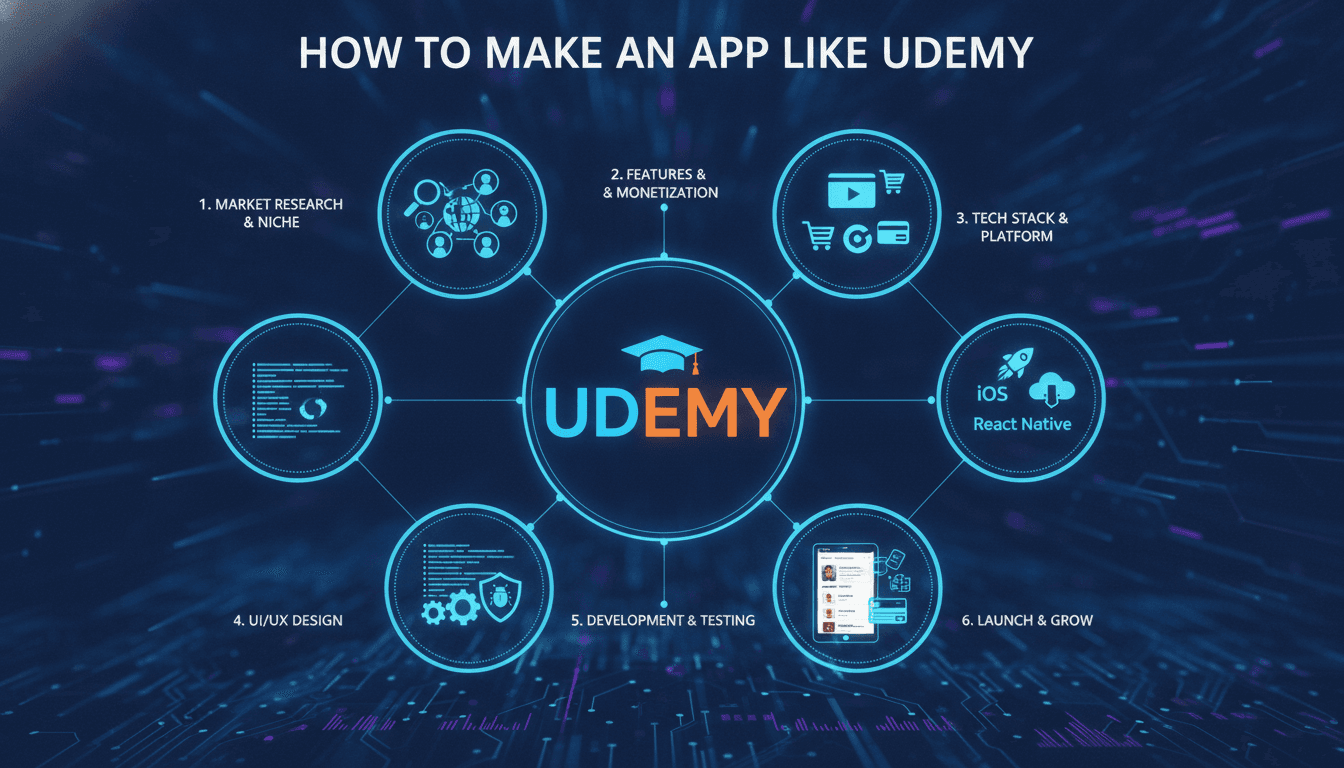
Building an e-learning platform at Udemy's scale is a genuinely hard engineering problem. The public-facing product looks simple — video, a course catalogue, payments — but the architecture underneath handles millions of concurrent streams, instructor payouts across 190+ countries, and a recommendation engine that has to work without exposing one student's behaviour to another. This post walks through what it actually takes to build that stack, where the hard decisions sit, and what you can skip if you're not Udemy yet.
What Does the Core Architecture Actually Look Like?
Start with the data model, because everything else follows from it. You have four primary entities: users (students and instructors), courses, content (video, documents, quizzes), and enrolments. The relationship between enrolments and content access is where most teams get it wrong early on — they couple access control to payment state, which breaks the moment you introduce coupons, free previews, organisational licences, or trial periods.
The cleaner pattern is a separate entitlement service. Payment creates an entitlement record; the content delivery layer checks entitlement, not payment status. Those two things look identical at MVP stage and diverge badly at scale.
Video Infrastructure
Video is the most expensive component to get right. You need three things: ingestion, transcoding, and delivery.
Ingestion is straightforward — a signed upload URL to S3 or GCS, then a queue trigger (SQS or Pub/Sub) to kick off transcoding. AWS Elemental MediaConvert or FFmpeg on a GPU instance both work. MediaConvert is cheaper at low volume and simpler to operate; FFmpeg gives you more control over codec parameters if you care about per-title encoding.
Transcode to HLS with adaptive bitrate. Minimum four renditions: 360p, 480p, 720p, 1080p. Store the manifests and segments in S3 behind CloudFront or another CDN with signed URLs. Signed URLs matter because you need to prevent content sharing — a URL that expires in 6 hours is not airtight, but it stops casual distribution.
DRM is a different conversation. Widevine L1/L3 and FairPlay cover the major platforms but add meaningful complexity to your player layer and key server. For a v1 build targeting web-only, skip DRM and use signed URLs with session binding. Add DRM when you have a native mobile app and instructors are asking about piracy.
Search and Discovery
Udemy's catalogue has over 210,000 courses. At that scale, search is a product feature, not an ops concern. Below 10,000 courses, PostgreSQL full-text search with tsvector is genuinely sufficient. Above that, move to Elasticsearch or OpenSearch. Index course title, description, instructor name, and tags. Add a boosting function that weights average rating and enrolment count — without it, new courses with good content never surface.
Recommendations are a separate system. Collaborative filtering (what students like you finished) works once you have enrolment data. Before that, editorial curation and category browsing carry most of the load.
How Do You Handle Payments and Instructor Payouts?
This is the piece most engineering teams underestimate. Stripe handles the student-facing payment cleanly — Stripe Checkout or Payment Intents, webhooks to update enrolment state, Stripe Radar for fraud. The hard part is the marketplace split and instructor payouts.
Udemy takes a platform fee (varies by whether the student came through Udemy's own marketing or the instructor's coupon), then pays out instructors monthly. You need to model this correctly from day one:
| Scenario | Platform cut | Instructor cut |
|---|---|---|
| Organic discovery (platform-driven) | 50–75% | 25–50% |
| Instructor's own coupon/referral | 3% | 97% |
| Enterprise/B2B licence | Negotiated | Negotiated |
Stripe Connect (Express or Custom accounts) handles multi-party payouts well. Express accounts are faster to set up but give instructors a Stripe-hosted dashboard; Custom accounts let you own the full UX but increase your compliance burden because you become the merchant of record in more jurisdictions.
Cross-border payouts trigger tax withholding requirements. US instructors need a W-9; non-US instructors need a W-8BEN. Stripe Collect Tax and similar tools automate some of this, but you will still need a tax advisor to confirm your withholding logic before you go live.
/// Not sure where to start?
Get the architecture before you commit
Tell us what you're building and we'll map the technical approach, stack, and rough timeline. No cost, no obligation, no sales call required.
What Does the Admin and Instructor Experience Need to Cover?
The instructor portal is often treated as an afterthought. That's a mistake. Instructor retention drives content quality, and content quality drives student retention. The instructor portal needs at minimum:
- A curriculum builder with drag-and-drop section reordering (react-beautiful-dnd or dnd-kit work well)
- A video upload interface with progress feedback and transcoding status
- Revenue dashboards showing gross sales, net after platform fee, and payout history
- Q&A and review moderation tools
- Coupon and pricing management
The admin layer sits on top of this and adds course approval workflows, content moderation flags, and platform-wide analytics. Build the admin panel with a tool like React Admin or Retool for speed; replace it with a custom build only when the operational complexity justifies it.
Mobile: Native vs Cross-Platform
If you're building for iOS and Android simultaneously, Flutter is the practical choice for a v1. One codebase, good video player support via the video_player package (with HLS), and a single team. The trade-off is that DRM integration is harder than with native SDKs, and offline download with DRM (a feature Udemy supports) requires platform-native code via method channels anyway.
React Native is an alternative if your team is stronger in JavaScript, but ExoPlayer and AVPlayer integration for HLS with DRM is messier via the JS bridge than in Flutter.
Native Swift/Kotlin makes sense when you have the team size to maintain two codebases and need fine-grained control over background download behaviour and DRM licence handling.
Where Does AI Fit in an E-Learning Platform?
The obvious answer is recommendation and search personalisation. The less obvious answers are more interesting.
Automated transcription and caption generation using OpenAI Whisper (or AWS Transcribe) is now table-stakes. Whisper large-v3 runs on a single A10G GPU and produces transcripts accurate enough to use directly for most English-language content. Transcripts unlock search inside video, which Udemy calls "lecture search" — students can find the exact moment a concept is explained.
AI-generated course outlines and quiz questions are useful for instructor tooling. GPT-4o with a structured output schema can take a course transcript and return a JSON object with suggested section titles, learning objectives, and multiple-choice questions. Instructors edit rather than write from scratch, which reduces the time-to-publish significantly.
Cheat detection on quizzes and assignments is an open problem. Embedding-based similarity between submissions catches copy-paste but not paraphrasing. This is an area where the technology is still catching up to the pedagogy.
Conclusion
The architecture for an Udemy-style platform is well-understood at this point. The real decisions are about sequencing: what to build first, where to use managed services versus custom code, and where to accept technical debt because the product hasn't validated the feature yet.
If you're at the planning stage, start with the entitlement model and the video pipeline. Get those right and the rest of the product can iterate on top of them. Get them wrong and you're refactoring the foundation while trying to grow.
At Sodio, we've built these systems across multiple verticals. If you want to talk through your specific stack decisions, reach out.
FAQ
How long does it take to build an MVP e-learning platform? A functional MVP with video upload, a course catalogue, student enrolment, and Stripe payments typically takes 12 to 16 weeks with a team of four engineers. That assumes you're using managed services for video transcoding and skipping DRM, offline downloads, and a native mobile app in the first version.
What's the most expensive part of running an e-learning platform at scale? Video delivery, by a significant margin. CDN egress and transcoding costs scale directly with content hours and concurrent viewers. At Udemy's scale (roughly 67 million students), CDN costs run into millions of dollars annually. Per-title encoding and aggressive caching policies are the main levers for controlling this.
Do you need a custom LMS or can you build on an existing one? Existing LMS platforms like Moodle or Teachable work for straightforward use cases. If you need a marketplace model with instructor payouts, custom recommendation logic, or deep mobile integration, you'll hit their limits quickly. A custom build makes sense when your business model or UX requirements don't fit the standard LMS assumptions.
How do you prevent course content from being pirated? Signed CDN URLs with short expiry windows stop casual sharing. Widevine and FairPlay DRM prevent screen capture on supported browsers and native apps. Neither is a complete solution — determined users can always find workarounds. The practical goal is raising the cost of piracy high enough that it's not worth the effort for most users.
What database should you use for an e-learning platform? PostgreSQL handles the relational data well: users, courses, enrolments, reviews, and transactions. Use Redis for session management and caching frequently accessed course metadata. If your catalogue grows past 50,000 courses and search performance degrades, add OpenSearch as a dedicated search index rather than trying to optimise PostgreSQL full-text search further.
Have a project in mind? Contact Sodio Technologies to discuss your requirements and explore the right technology solution for your business.
/// Work with us
Talk to the engineers who'd build it
You'll get a technical scope, timeline and cost estimate from the people doing the work, not an account manager. In-house team, no subcontracting, since 2016.