

How to Make an App Like Skillshare
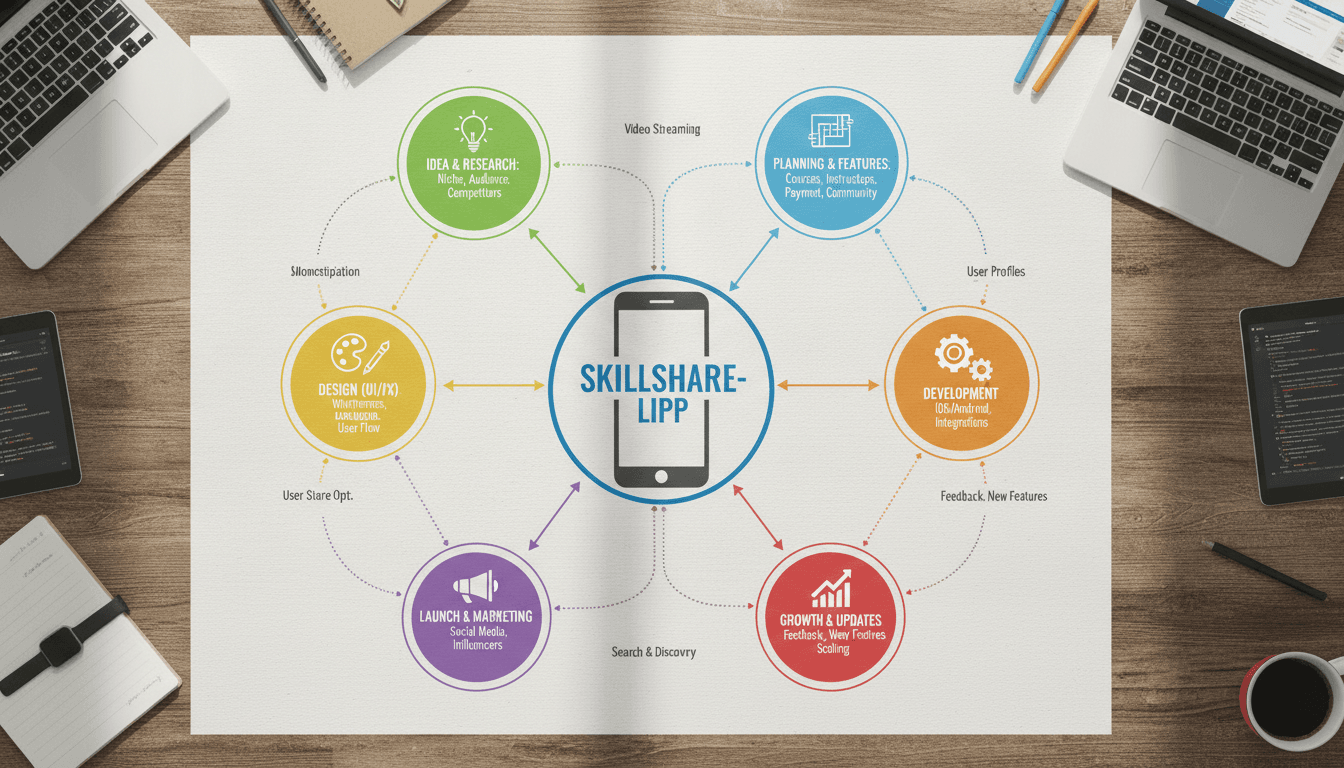
How to Make an App Like Skillshare
The online learning market has exploded over the past decade, and platforms like Skillshare have proven that people are willing to pay for bite-sized, community-driven education. If you're considering building your own e-learning marketplace, this guide walks you through everything from core features to tech stack decisions and monetisation.
What Makes Skillshare Work
Before writing a single line of code, it's worth understanding why Skillshare succeeded where many learning platforms stalled.
Skillshare isn't a university. It's a creator marketplace. Instructors are practising professionals — illustrators, filmmakers, marketers — who publish short, project-based classes. Learners pay a flat subscription for unlimited access rather than buying individual courses. Teachers earn based on how many minutes of their content gets watched.
That model creates three things you'll need to replicate:
- A low barrier to publishing, so your catalogue grows without you commissioning content
- A subscription economy, which smooths revenue and encourages browsing
- A community layer, where student projects and feedback keep people coming back
If your app only delivers video, you've built a video player. The marketplace dynamics are the product.
Step 1: Validate Your Niche
Competing head-on with Skillshare, Udemy, and Coursera is a difficult opening move. The more successful launches in this space narrow their focus:
- Vertical niches — photography only, coding only, culinary arts only
- Regional markets — local-language content for underserved geographies
- Professional certification — courses tied to real credentials in nursing, accounting, or trades
- B2B corporate training — selling seats to companies instead of individuals
Talk to twenty potential instructors and fifty potential learners before you build. If instructors aren't excited to publish, you'll launch with an empty shelf.
Step 2: Map Your Core Feature Set
A Skillshare-style platform has three distinct user types, each needing their own experience.
For Learners
- Onboarding and interest selection to power initial recommendations
- Course discovery with search, categories, curated collections, and trending lists
- Video player with adjustable playback speed, subtitles, offline download, and resume-where-you-left-off
- Class projects where learners upload their work and receive peer feedback
- Progress tracking, streaks, and completion badges
- Reviews and ratings
- Watchlists and saved classes
- Subscription management with free trial handling
For Instructors
- Course builder with drag-and-drop lesson ordering and video upload
- Resource attachments — PDFs, templates, project files
- Analytics dashboard showing minutes watched, enrolments, drop-off points, and earnings
- Payout management with tax documentation
- Student Q&A and discussion moderation
- Promotional tools — referral links, coupon codes, teacher profile pages
For Admins
- Content moderation and approval queues
- User management and dispute handling
- Revenue reporting and instructor payout calculation
- Category and taxonomy management
- Push notification and email campaign tools
- Fraud detection for watch-time gaming
Step 3: Design the Experience
E-learning apps live or die on how easy it is to start watching. A few UX principles worth respecting:
Reduce time-to-first-value. A new user should be watching a lesson within thirty seconds of opening the app. Let them preview content before hitting the paywall.
Design for interrupted sessions. People watch on commutes and lunch breaks. Auto-save progress aggressively, and make "Continue Learning" the most prominent element on the home screen.
Make the catalogue feel curated, not infinite. Endless scroll creates decision paralysis. Hand-picked collections, learning paths, and "staff picks" convert far better than a raw search box.
Respect offline. Downloaded classes with encrypted local storage are a genuine differentiator in markets with patchy connectivity.
Step 4: Choose Your Tech Stack
Mobile
- React Native or Flutter for cross-platform delivery from one codebase — ideal if budget is tight and your feature set is standard
- Swift and Kotlin for native builds when you need maximum video performance, advanced DRM, or deep platform integration
Backend
- Node.js, Python (Django/FastAPI), or Go for API services
- PostgreSQL for relational data — users, courses, enrolments, transactions
- Redis for session caching and leaderboards
- Elasticsearch for course search and filtering
A microservices approach makes sense once you scale: separate services for authentication, catalogue, video processing, payments, and notifications can be deployed and scaled independently.
Video Infrastructure
This is where most budgets get consumed. You'll need:
- Transcoding into adaptive bitrate formats (HLS/DASH) so playback adjusts to network conditions
- A CDN — CloudFront, Cloudflare, or Fastly — to serve content globally with low latency
- DRM or token-based protection (Widevine, FairPlay) to stop content theft
- Object storage such as S3 for masters and derivatives
Managed services like Mux, Cloudflare Stream, or AWS Elemental MediaConvert will get you to market far faster than rolling your own pipeline.
Related reading: How to Make an App Like MasterClass.
Payments
Stripe or Braintree handle subscriptions, proration, and dunning well. For instructor payouts, Stripe Connect or PayPal Payouts manage the multi-party money movement and compliance overhead. Remember that Apple and Google take a cut of in-app digital purchases — factor that 15–30% into your unit economics early.
If this is relevant to your project, check out How to Make an App Like Udemy.
Step 5: Build the Recommendation Engine
Personalisation drives retention. You can stage this:
- Rules-based at launch — surface content by declared interests, popularity, and recency
- Collaborative filtering once you have enough behavioural data — "learners who watched this also watched"
- Machine learning models that blend watch history, completion rates, skill level, and session context
Don't over-engineer at launch. A well-merchandised home screen beats a mediocre algorithm on a thin catalogue.
Step 6: Monetisation Models
- Subscription — monthly or annual all-access, Skillshare's core model. Predictable revenue, but demands constant content freshness.
- Freemium — free tier with limited classes, paid tier for the full library and offline downloads
- Pay-per-course — Udemy's approach. Higher friction, but better for expensive certification content.
- B2B team plans — seat-based licensing with admin dashboards and reporting. Often the highest-margin channel.
- Certificates — charge for verified completion credentials
Most mature platforms run a hybrid. Start with one, prove it, then layer.
Step 7: Instructor Revenue Sharing
Your payout formula is a strategic decision, not an accounting detail. Skillshare pays teachers from a royalty pool based on minutes watched by premium members. Alternatives include flat revenue splits per sale, or fixed fees for commissioned content.
Whatever you choose, make it transparent and predictable. Instructors are your supply side, and they'll leave for platforms where they can forecast income.
For a closer look at a related topic, read our guide on How to Make an App Like Pluralsight.
Step 8: Development Timeline and Cost
A realistic breakdown for an MVP:
| Phase | Duration |
|---|---|
| Discovery and UX research | 2–3 weeks |
| UI/UX design | 4–6 weeks |
| Backend and API development | 8–12 weeks |
| Mobile app development | 10–14 weeks |
| Video pipeline integration | 3–4 weeks |
| QA and testing | 4 weeks |
| Launch and stabilisation | 2 weeks |
Expect four to six months for a solid MVP with a lean feature set. Costs vary enormously by region and team composition, but a cross-platform MVP typically lands somewhere between $60,000 and $150,000, with full-featured native builds running considerably higher. Ongoing video hosting, CDN, and transcoding costs scale with usage and should be modelled from day one.
Step 9: Launch Strategy
Seed the supply side first. Recruit 30–50 instructors and help them produce quality content before opening to learners. An empty marketplace converts nobody.
Launch narrow. One category, one region, one language. Depth beats breadth early.
Instrument everything. Track activation rate, trial-to-paid conversion, first-week retention, course completion, and instructor churn. These numbers tell you what to build next.
Lean on your instructors for distribution. Creators bring their own audiences. Give them referral incentives and co-marketing support.
Common Pitfalls to Avoid
- Underestimating video costs. Transcoding and bandwidth can quietly become your largest operating expense.
- Ignoring content quality control. One wave of low-effort courses can permanently damage trust.
- Building every feature at once. Live classes, AI tutors, and gamification can wait. Get the core loop right.
- Neglecting accessibility. Captions, screen reader support, and adjustable text aren't optional — they're often legally required.
- Forgetting compliance. GDPR, CCPA, COPPA (if minors are involved), and accessibility standards all apply.
Final Thoughts
Building an app like Skillshare is genuinely achievable, but the hard part isn't the technology — it's the marketplace. Video streaming, subscriptions, and course builders are well-trodden engineering problems with mature tooling. Convincing great instructors to publish and learners to keep showing up is the real work.
Start with a sharply defined niche, ship a focused MVP, obsess over your first hundred instructors, and expand from a position of strength. The platforms that win in e-learning are the ones that treat content supply as their primary product challenge, not an afterthought.
Have a project in mind? Contact Sodio Technologies to discuss your requirements and explore the right technology solution for your business.
/// Work with us
Talk to the engineers who'd build it
You'll get a technical scope, timeline and cost estimate from the people doing the work, not an account manager. In-house team, no subcontracting, since 2016.