

Industrial Automation: Improving Manufacturing Efficiency
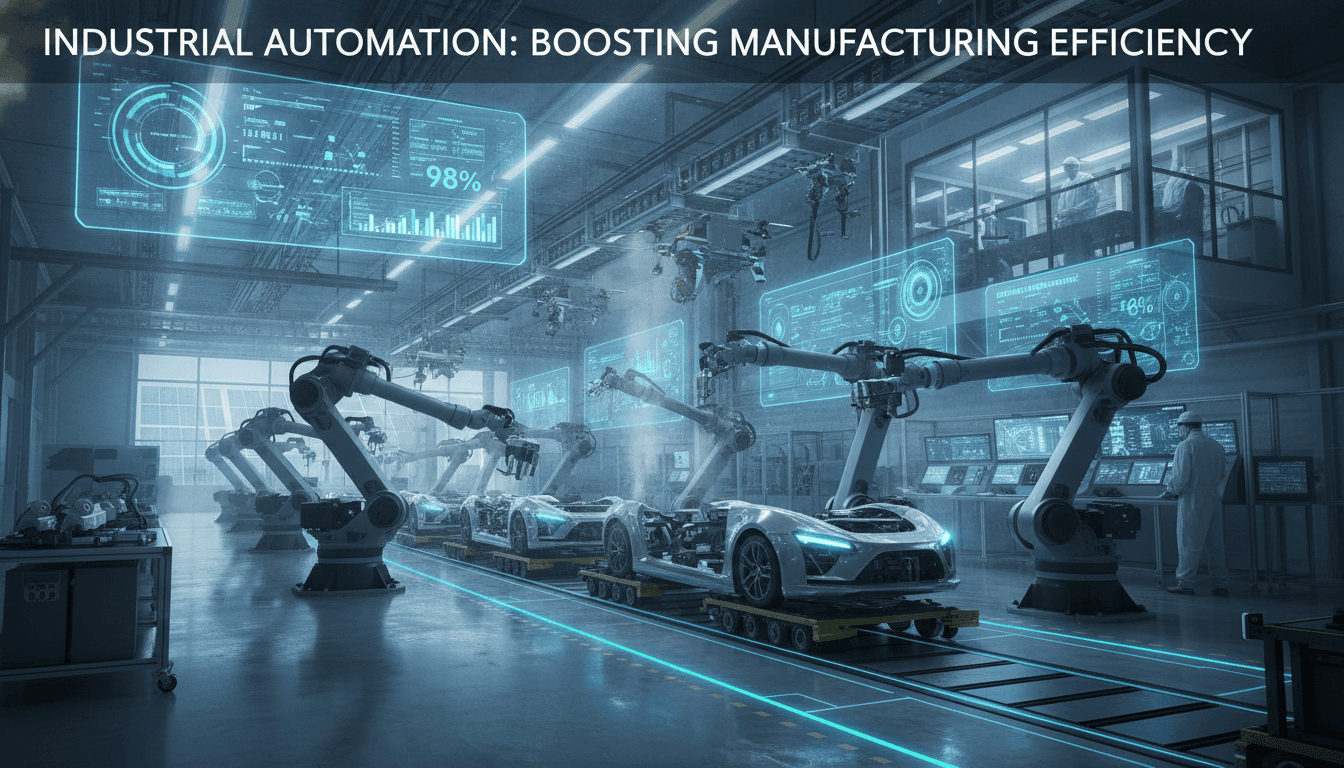
A practical look at where industrial automation actually moves the needle in manufacturing, what it costs to get wrong, and how to think about the build versus integrate decision.
What Does "Industrial Automation" Actually Cover?
The term gets used loosely, so it's worth being precise. Industrial automation in manufacturing spans three broad layers: physical automation (robots, CNC machines, conveyor control), process automation (PLC and SCADA systems orchestrating production sequences), and data automation (MES, ERP integration, real-time analytics pipelines). Most of the interesting engineering problems sit at the seams between these layers.
The hardware side has been mature for decades. A FANUC or KUKA arm doing pick-and-place is not a new idea. What has changed is the cost and accessibility of the software layer sitting above that hardware. OPC-UA, the IEC 62541 standard for industrial interoperability, has made it significantly easier to pull real-time data out of PLCs without custom firmware hacks. MQTT brokers running on edge hardware have become a standard pattern for getting machine telemetry to the cloud without punishing latency.
The decision a manufacturing CTO faces today is rarely "should we automate?" It is "how deeply should we integrate our automation layer with our data infrastructure, and who builds that integration?"
Where Does Automation Actually Improve Efficiency?
Efficiency gains in manufacturing come from four places: throughput, yield, downtime reduction, and labour reallocation. Automation affects all four, but not equally.
Throughput improvements are the most visible. A robotic welding cell can operate at consistent cycle times that a human operator cannot sustain over an eight-hour shift. The gains here are real but often overstated in vendor pitches. Actual throughput improvement depends heavily on upstream material flow and downstream quality gates. Automating a bottleneck that is not the constraint (in the Theory of Constraints sense) produces no net throughput gain at all.
Yield is where software automation earns its keep. Vision-based inspection systems running on NVIDIA Jetson hardware or equivalent edge accelerators can inspect 100% of units at line speed, where manual sampling inspects perhaps 5-10%. Defect escape rates in high-volume electronics manufacturing have dropped from ranges of 500-1000 PPM to under 50 PPM in deployments that pair camera inspection with closed-loop feedback to upstream process parameters.
Downtime reduction through predictive maintenance is the area generating the most engineering interest right now. The basic model is straightforward: collect vibration, temperature, and current-draw data from motors and bearings, train an anomaly detection model, trigger maintenance before failure. The difficulty is in the data pipeline, not the model. Getting clean, labelled failure data out of legacy PLCs is the hard part.
Labour reallocation deserves honest treatment. Automation does not eliminate headcount in most mid-volume manufacturing contexts. It shifts people from repetitive manual tasks to quality oversight, exception handling, and process engineering roles. This is genuinely valuable, but it requires retraining investment that rarely shows up in the initial business case.
What Does a Realistic Integration Architecture Look Like?
A typical greenfield deployment at a mid-size manufacturer will have the following stack:
| Layer | Common Technology | Key Consideration |
|---|---|---|
| Machine control | Siemens S7 / Allen-Bradley PLCs | Protocol support: OPC-UA, Modbus, PROFINET |
| Edge compute | Advantech or Beckhoff IPCs | Latency tolerance, environment rating |
| Data broker | EMQX or HiveMQ (MQTT) | Message throughput, QoS guarantees |
| Historian / time-series store | InfluxDB or TimescaleDB | Retention policy, query performance |
| Analytics / ML | Python 3.11+, scikit-learn, PyTorch | Model retraining cadence |
| ERP integration | SAP or Oracle via REST / IDoc | Master data synchronisation |
| Visualisation | Grafana or custom React dashboards | Operator versus management views |
The brownfield case is harder. Legacy PLCs running ladder logic that nobody has touched in fifteen years often lack OPC-UA support. You have two options: add an OPC-UA gateway (Kepware is the most common choice) or instrument at the electrical level using current transformers and vibration sensors wired to an edge device that bypasses the PLC entirely. The second approach is slower to deploy but gives you independence from the PLC vendor.
/// Not sure where to start?
Get the architecture before you commit
Tell us what you're building and we'll map the technical approach, stack, and rough timeline. No cost, no obligation, no sales call required.
Should You Build the Software Layer In-House or Bring in a Partner?
This is the question that matters most for a technical leader, and the honest answer depends on your team's current capability and your timeline.
The case for building in-house
If your engineering team already has Python and time-series data skills, and your machine vendors provide decent OPC-UA or REST APIs, the integration work is not exotic. The main risks are underestimating the industrial networking complexity (IT/OT network segmentation is genuinely tricky) and the time cost of becoming familiar with PLC programming environments if you need to make changes at the machine level.
Build in-house if you have six or more months of runway before you need production results, and if owning the full stack is strategically important to you.
The case for a specialist partner
The areas where external help pays off fastest are OT security (IEC 62443 compliance, network segmentation between IT and OT zones), protocol translation from legacy systems, and setting up a reliable data pipeline before you start building ML models on top of it. Getting the plumbing wrong means your anomaly detection model is training on garbage.
A specialist partner who has done ten similar integrations will compress the learning curve significantly. The trade-off is dependency and cost. If the partner writes the PLC ladder logic and does not document it, you own a system you cannot maintain.
What Are the Real Risks, and How Do You Manage Them?
Three failure modes account for the majority of industrial automation projects that underdeliver.
The first is scope creep at the OT layer. PLC code changes require production downtime for testing and rollback. Every change to machine behaviour is expensive to validate. Keep the automation scope conservative and move complexity into the software layer above the PLC where you can deploy without stopping the line.
The second is data quality. A sensor reading that drifts by 2% because of a calibration issue will silently corrupt your predictive model over months. Build data quality monitoring into the pipeline from day one. InfluxDB tasks or TimescaleDB continuous aggregates can flag statistical anomalies in incoming sensor streams before they reach your ML layer.
The third is change management. Operators who have run a line for a decade have process knowledge that is not in any system. Involve them in the design of dashboards and alert thresholds. An operator who does not trust the predictive maintenance alert will ignore it.
Conclusion
The efficiency gains from manufacturing automation are real, but they are engineering problems, not procurement problems. The hardware is largely commoditised. The value is in the integration layer, the data pipeline, and the feedback loops you build between data and process.
If you are scoping an automation project, start with a single machine or production cell, instrument it properly, and get clean data flowing before you commit to a broader rollout. Proving the data pipeline on a small scope costs a fraction of debugging it at scale.
If you want to talk through where your current architecture has gaps, get in touch with the Sodio engineering team. We have worked across discrete manufacturing, electronics assembly, and process industries, and we are direct about where we can help and where you are better off doing it yourself.
FAQ
What is the difference between a PLC and a SCADA system? A PLC (Programmable Logic Controller) executes real-time machine control logic, typically with scan cycles under 10 milliseconds. A SCADA system sits above one or more PLCs, providing supervisory monitoring, data logging, and operator interfaces. They operate at different timescales and serve different purposes. Most automation deployments need both.
How long does a typical industrial automation integration project take? A focused integration covering one production line, from OT network assessment through to a live analytics dashboard, typically takes 12 to 20 weeks. Projects that also include custom ML model development for predictive maintenance add another 8 to 12 weeks, depending on how much labelled historical failure data is available.
Do I need to replace my existing PLCs to get better data out of them? Usually not. Tools like Kepware KEPServerEX or Matrikon OPC Server can act as protocol gateways, translating proprietary PLC protocols into OPC-UA or MQTT without modifying the PLC programme. This is the standard approach for brownfield sites. Full PLC replacement only makes sense if the hardware is end-of-life or lacks the I/O capacity you need.
Is edge computing necessary, or can I send everything to the cloud? It depends on your latency requirements and network reliability. Closed-loop feedback, where a sensor reading triggers an immediate machine action, must stay on-premise. Historian workloads, dashboards, and batch ML training can run in the cloud without issue. Most industrial deployments run a hybrid: an edge historian for low-latency access and a cloud data lake for longer-term analytics.
What does IEC 62443 actually require for manufacturing automation systems? IEC 62443 is a family of standards for industrial cybersecurity. At a practical level it requires you to segment your OT network from your corporate IT network using conduits and zones, enforce least-privilege access on all industrial devices, maintain an asset inventory, and have documented incident response procedures. Compliance level 2 (the most common target) also requires multi-factor authentication on any remote access to the OT network.
Have a project in mind? Contact Sodio Technologies to discuss your requirements and explore the right technology solution for your business.
/// Work with us
Talk to the engineers who'd build it
You'll get a technical scope, timeline and cost estimate from the people doing the work, not an account manager. In-house team, no subcontracting, since 2016.