

Manufacturing Execution Systems (MES): Enhancing Productivity
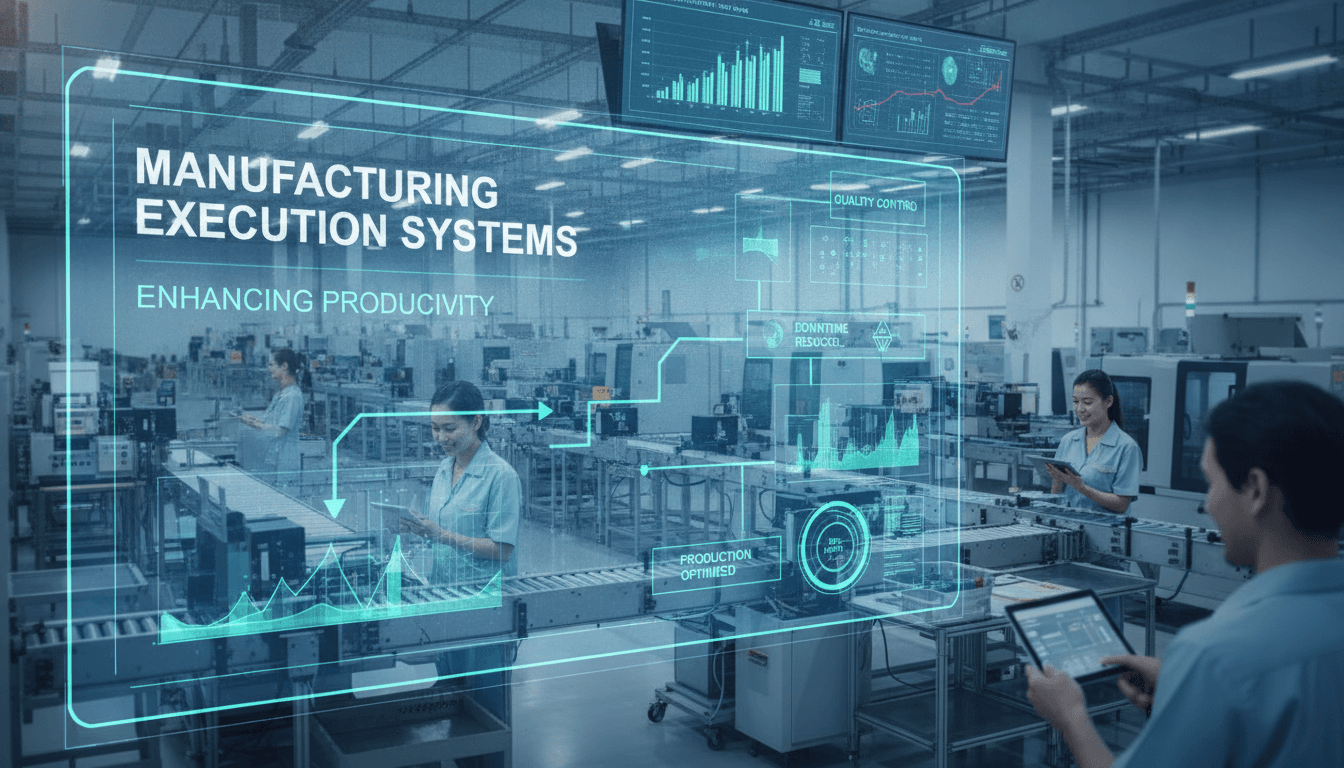
Manufacturing floors generate enormous amounts of data every shift. Most of it disappears. MES changes that — but only if you pick the right architecture, integrate it properly, and resist the urge to over-engineer it from day one.
What Does an MES Actually Do at the Data Layer?
A Manufacturing Execution System sits between your ERP (SAP, Oracle, Microsoft Dynamics) and your shop floor equipment. The ERP holds production orders, bills of materials, and planned schedules. The machines hold real-time signals. Without something in between, a planner refreshing a spreadsheet is your integration layer.
MES closes that gap. It receives work orders from the ERP, dispatches them to operators or automated lines, collects execution data (cycle times, scrap counts, downtime codes, material consumption), and pushes completion records back up. That feedback loop is the core value proposition.
The standards that matter here are ISA-95 (IEC 62264), which defines the functional hierarchy, and ISA-88, which covers batch process control. If your vendor or integration team can't speak ISA-95 fluently, that's a red flag.
What Data Does MES Capture?
At minimum, a well-configured MES tracks:
- Work-in-progress location and status at each work centre
- Actual vs. planned cycle time per operation
- Material lot traceability (critical for pharma, food, aerospace)
- Equipment OEE broken down into Availability, Performance, and Quality
- Operator sign-offs and electronic work instructions
The quality of this data depends entirely on how your shop floor signals are collected. If you're reading from PLCs via OPC-UA, you get millisecond-resolution data. If you're relying on manual operator entry at end-of-shift, you get approximations. Both are valid starting points; the architecture decision should match your current state, not your aspirational state.
How Does MES Integration With ERP Actually Work?
This is where most implementations stall. The ERP side is usually SAP PP (Production Planning) or a equivalent module. The MES needs to consume production orders and push confirmations. In SAP, that's typically done via IDocs, BAPIs, or, in newer implementations, SAP Manufacturing Integration and Intelligence (SAP MII) or SAP Digital Manufacturing (previously SAP DMC).
For non-SAP environments, REST APIs and message brokers like Apache Kafka or RabbitMQ are standard. Kafka is the right choice when you need high-throughput, durable event streams, and you want multiple downstream consumers (analytics, quality systems, WMS) reading the same production events without coupling. RabbitMQ works fine for lower-volume, point-to-point confirmations.
A common mistake is treating the ERP-MES boundary as a simple request-response interface. Production floors are event-driven. A machine goes down. A batch fails QC. A material shortage halts a line. These are events, not responses to queries. Design your integration accordingly.
On-Premise vs. Cloud MES
| Factor | On-Premise MES | Cloud MES (SaaS) |
|---|---|---|
| Latency to shop floor | Sub-10ms possible | 50–200ms typical, varies by network |
| Implementation time | 6–18 months | 3–9 months |
| Customisation depth | High (source access or APIs) | Limited to vendor-exposed config |
| Upgrade burden | On your team | Vendor-managed |
| Fit for air-gapped environments | Yes | No |
| Total cost (5-year) | Higher upfront, lower per-unit at scale | Lower upfront, accumulates with volume |
For discrete manufacturing with complex routings and tight process control requirements, on-premise or private-cloud deployments still dominate. For high-mix, low-volume job shops that need fast deployment, SaaS MES products like Tulip, Sight Machine, or Rockwell's FactoryTalk have become genuinely viable.
/// Not sure where to start?
Get the architecture before you commit
Tell us what you're building and we'll map the technical approach, stack, and rough timeline. No cost, no obligation, no sales call required.
Does MES Actually Improve OEE, or Is That Marketing?
OEE (Overall Equipment Effectiveness) is the product of Availability, Performance, and Quality. World-class OEE is generally cited at 85% for discrete manufacturing. Most factories running without automated data collection report OEE between 40–60%, though that number is often more optimistic than reality because manual reporting papers over downtime.
MES improves OEE in two ways: measurement accuracy and response speed.
First, you find out your actual OEE, which is almost always lower than you thought. That's uncomfortable but necessary. A factory that believed it was running at 72% OEE has, in practice, found after MES deployment that it was closer to 54%. The 18-point gap was hidden in unrecorded micro-stoppages and shift changeover losses.
Second, with real-time downtime alerts and Pareto analysis of loss codes, maintenance and production teams can act on the right problems. Anecdotally, manufacturers who instrument properly and run structured improvement cycles typically see 8–15% OEE gains in the first 12 months. That figure varies heavily by industry, baseline, and whether the organisation actually uses the data.
MES does not improve OEE by itself. The data is the input to a decision-making process. If your improvement culture isn't there, the dashboards become wallpaper.
What Does a Realistic MES Rollout Look Like?
Phasing matters more than feature completeness. A common failure mode is scoping the full ISA-95 Level 3 suite from day one: work order management, labour tracking, quality management, genealogy, maintenance integration. That's 18 months of implementation before production sees any value.
A more defensible approach:
- Start with one production line, not the whole plant.
- Instrument that line with OPC-UA-connected PLC reads and one operator touchpoint for work order confirmation.
- Run for 90 days. Validate data quality against manual records.
- Expand scope and lines based on what the data actually shows, not the original business case.
The technology stack for a greenfield MES build at a mid-size manufacturer typically includes: an MES platform (Aveva, Siemens Opcenter, Rockwell FactoryTalk, or open-source options like Sepasoft on Ignition), an OPC-UA server aggregating PLC signals, a time-series database (InfluxDB or TimescaleDB) for high-frequency machine data, and a relational store (PostgreSQL) for transactional records.
Ignition by Inductive Automation deserves specific mention for mid-market manufacturers. It's a SCADA/MES platform that runs on standard JVM infrastructure, licences by server rather than per-tag or per-user, and has a mature module ecosystem. It's not the right fit for highly regulated environments that need IEC 62443-certified deployments, but for general discrete and process manufacturing, it shortens implementation time substantially.
Conclusion
An MES is fundamentally a data infrastructure investment. The productivity gains are real, but they follow from measurement accuracy and operational discipline, not from the software itself. If you're evaluating MES, the most important question is not which platform to choose. It's whether your integration points (ERP, PLC layer, quality systems) are clean enough to feed it honest data.
Start with one line. Get the data right. Let the improvement opportunities surface before you design them in.
If you're working through an architecture decision on MES integration or shop floor data infrastructure, Sodio has built in this space and is happy to talk through the specifics with your team.
FAQ
What's the difference between SCADA and MES? SCADA (Supervisory Control and Data Acquisition) monitors and controls equipment at the machine level, typically in real time. MES operates one level up, managing production orders, labour, materials, and quality across a facility. In practice they overlap, and platforms like Ignition deliberately bridge both layers.
Can MES work without ERP integration? Yes, but you lose a significant part of the value. Without ERP integration, you're manually entering work orders into MES and manually reconciling completions back to your planning system. That creates duplicate data entry and reconciliation errors. It's a reasonable starting point but should be treated as a transitional state, not a design target.
How long does a typical MES implementation take? For a single production line with basic work order management and OEE tracking, three to six months is realistic. Full plant rollouts covering multiple lines, quality management, and genealogy traceability typically run 12 to 24 months. The main variables are data quality at the source, ERP integration complexity, and change management readiness.
What industries benefit most from MES? Automotive, pharmaceuticals, food and beverage, semiconductor, and aerospace are the heaviest MES adopters, largely because traceability and regulatory compliance force the investment. Discrete manufacturers with high product mix and short run lengths often see the fastest payback because scheduling and work order management are their biggest pain points.
Is open-source MES viable for production use? It depends on your internal capability. Platforms built on Ignition with Sepasoft MES modules are commercially supported but highly configurable. Fully open-source options like OpenMES or LibrERP manufacturing modules exist but require substantial internal development resource to maintain. For most manufacturers without dedicated MES engineering staff, a supported commercial platform with open APIs is the more practical choice.
Have a project in mind? Contact Sodio Technologies to discuss your requirements and explore the right technology solution for your business.
/// Work with us
Talk to the engineers who'd build it
You'll get a technical scope, timeline and cost estimate from the people doing the work, not an account manager. In-house team, no subcontracting, since 2016.