

IoT in Agriculture: Enhancing Efficiency and Productivity
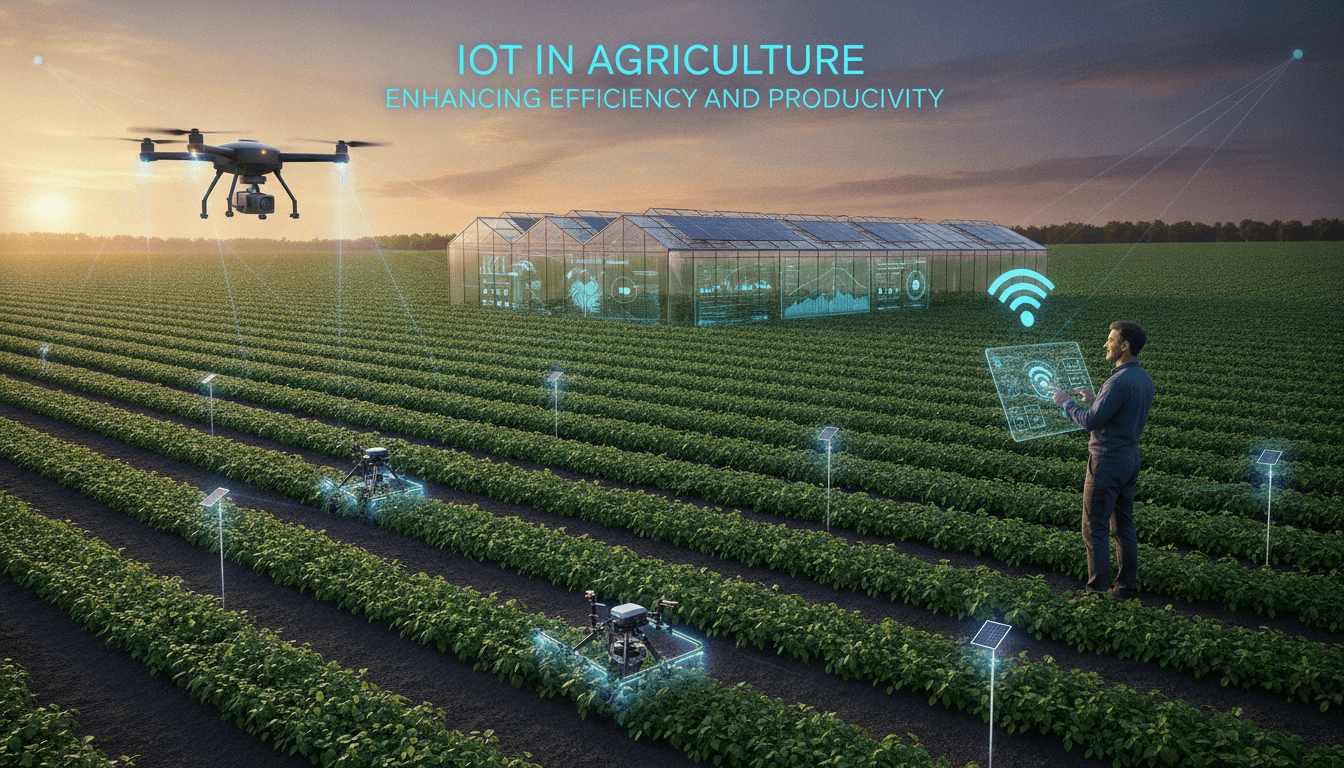
IoT deployments in agriculture have moved well past pilot projects. Farms across India, the EU, and North America are running sensor networks at scale, and the data coming off them is genuinely changing how agronomic decisions get made. This post covers the architecture, the trade-offs, and the parts that tend to break in production.
What Does an IoT Stack Actually Look Like on a Farm?
Most people picture a few soil sensors and a dashboard. The real picture is messier and more interesting.
A production agri-IoT deployment typically has four layers:
- Edge devices: soil moisture probes (capacitance-based, not tensiometers, because tensiometers need maintenance), weather stations, drone-mounted multispectral cameras, irrigation valve controllers, and livestock wearables.
- Local gateway: a ruggedised Linux box, often running a Raspberry Pi CM4 or an industrial equivalent, handling local protocol translation and buffering. This matters because cellular connectivity on farms is intermittent.
- Connectivity layer: LoRaWAN is the dominant choice for wide-area sensor coverage at low power. A single LoRaWAN gateway running on the 865–867 MHz IN865 band in India can cover 2–5 km line-of-sight. NB-IoT is the alternative when you need guaranteed delivery and have carrier coverage. Zigbee works for dense, short-range deployments like greenhouse racks.
- Cloud/backend: MQTT broker (Mosquitto or HiveMQ), time-series storage (InfluxDB or TimescaleDB on Postgres), and an analytics layer. Most teams we've seen overcomplicate this initially and then simplify back.
The gateway buffering piece is underrated. When you lose connectivity for 6 hours, you need to decide in advance how to handle backfill. Circular buffers work if you only care about recent state. If every reading matters, you need a local write-ahead log and a sync protocol that handles duplicate delivery correctly.
Sensor Selection Trade-offs
Capacitance soil moisture sensors cost roughly ₹800–2,500 per unit and are accurate enough for irrigation scheduling. They drift over time in saline soils, which is common in parts of Rajasthan and Gujarat. Tensiometers are more accurate but need refilling every 2–4 weeks, which kills any low-maintenance deployment.
For crop health monitoring, NDVI (Normalised Difference Vegetation Index) computed from multispectral imagery is the standard. You need at least red and near-infrared bands. Consumer drones with RGB cameras won't give you NDVI; you need a sensor like the MicaSense RedEdge or the Parrot Sequoia, which run ₹2–6 lakh.
How Do You Handle Data at the Volume Farms Actually Generate?
A 500-acre farm with soil sensors every 2 acres, a weather station, and a drone doing weekly flights generates somewhere around 4–8 GB of raw data per month. That sounds manageable. It isn't, once you add historical data across seasons and try to run ML inference against it.
The common mistake is storing everything at full resolution forever. Time-series downsampling is your friend. InfluxDB's continuous queries or TimescaleDB's time_bucket function let you roll up 1-minute readings into hourly averages after 7 days and daily averages after 90 days. You lose the ability to reconstruct minute-level history, but for crop science that trade-off is almost always acceptable.
Drone imagery is the harder problem. A single MicaSense flight over 500 acres produces 3,000–8,000 images. Orthomosaic stitching (typically done with Pix4D or OpenDroneMap) produces a single georeferenced raster, but that raster can be 2–10 GB per flight. Object storage (S3 or GCS) with lifecycle rules to move older flights to Glacier or Nearline is the standard approach. Keep the stitched outputs. Discard the raw frames after stitching unless your pipeline requires reprocessing.
/// Not sure where to start?
Get the architecture before you commit
Tell us what you're building and we'll map the technical approach, stack, and rough timeline. No cost, no obligation, no sales call required.
Can Machine Learning Add Real Value, or Is It Overhyped Here?
The honest answer is: it depends on what problem you're actually trying to solve.
Irrigation scheduling based on soil moisture plus evapotranspiration models is well-solved with classical control loops. You don't need ML for this. A simple rule engine driven by sensor thresholds and ET₀ estimates from the FAO-56 Penman-Monteith equation outperforms a poorly-trained model.
Where ML earns its place:
- Disease detection from imagery: Convolutional models trained on PlantVillage or custom-collected datasets can detect early-stage fungal or bacterial infections with 85–92% accuracy in controlled conditions. Real-field accuracy drops, often to 70–80%, because lighting, occlusion, and soil contamination in images are messier than training data.
- Yield prediction: Regression models using NDVI time-series, historical weather, and variety data can forecast yield 4–6 weeks out with meaningful accuracy. The FAO's AquaCrop model is a strong baseline before you reach for a neural network.
- Livestock anomaly detection: Accelerometer data from ear tags can detect lameness and oestrus. Rule-based thresholds work for basic cases; sequence models (LSTM or simple Transformer) add value when you have labelled historical data.
The prerequisite for all of this is clean, labelled data. Most farms don't have it. Budget for data collection and labelling before you budget for model training.
Deployment Reality
Running inference on the cloud works when connectivity is reliable. For real-time decisions like irrigation valve control, you want inference at the edge. ONNX Runtime on a Raspberry Pi 4 can run a quantised MobileNetV3 at 15–30 fps, which is sufficient for camera-based detection. TensorFlow Lite is the alternative if you're already in the TF ecosystem.
What's the Actual ROI, and How Do You Measure It?
This is the question that determines whether a deployment gets funded for year two.
| Metric | Typical Improvement | Notes |
|---|---|---|
| Water usage | 20–40% reduction | Figures from ICRISAT and IWMI studies on precision irrigation in South Asia |
| Fertiliser input | 10–25% reduction | Requires soil nutrient sensing, not just moisture |
| Labour hours for monitoring | 30–50% reduction | Depends heavily on farm size and prior practices |
| Crop loss from disease | 15–30% reduction | Only when early detection triggers timely intervention |
These numbers come from published research and field trials, not vendor marketing. Your actual numbers will vary based on baseline farm practices, crop type, and whether the farmer actually acts on the alerts the system generates.
The last point is worth dwelling on. The biggest failure mode in agri-IoT is alert fatigue. A system that sends 40 notifications a day trains users to ignore all of them. Design your alert logic conservatively. Start with three alert types, tune thresholds for 60 days, then expand.
Building In-House vs. Working with a Partner
If your core business is the software platform, build in-house. If your core business is agriculture or agri-finance, the IoT stack is infrastructure, not differentiation.
The decision points:
- Do you have engineers who have shipped LoRaWAN deployments, not just read about them? Field deployment has non-obvious failure modes: RF interference from irrigation pumps, vandalism, sensor drift, and firmware OTA failure on intermittent connections.
- Can you maintain the stack for 5 years? Farmers don't tolerate downtime well. A system that works for one season and then degrades is worse than no system.
- Do you have agronomists in-house, or do you need them? The sensor data is only useful if someone with domain knowledge validates that the thresholds and models make agronomic sense.
If the answer to any of these is uncertain, partnering for the initial deployment makes sense, with a clear knowledge-transfer plan so your team owns it by year two.
Conclusion
Agri-IoT works. The technology is mature enough that the risks are now mostly operational: sensor calibration, connectivity gaps, alert design, and data governance. Start with a narrow use case (irrigation scheduling is the easiest win), instrument it properly, and measure the outcome before expanding.
If you're scoping a deployment and want to talk through the architecture, the Sodio engineering team has worked on IoT projects across industries. Reach out with your specific constraints and we'll give you an honest assessment of what makes sense.
FAQ
What connectivity protocol is best for farm IoT sensors? LoRaWAN is the most practical for wide-area coverage at low power and cost. It covers 2–5 km line-of-sight on a single gateway. NB-IoT is better when you need guaranteed message delivery and have reliable carrier coverage in the area. Zigbee works for dense, short-range deployments like greenhouses.
How much data does a farm IoT system generate? A 500-acre deployment with soil sensors, a weather station, and weekly drone flights produces roughly 4–8 GB of raw data per month. Drone imagery dominates that figure. Time-series downsampling and cloud object storage with lifecycle rules keep long-term storage costs manageable.
Do I need machine learning for precision agriculture? Not always. Irrigation scheduling with sensor thresholds and the FAO-56 ET₀ equation outperforms a poorly-trained model. ML adds clear value for disease detection from imagery and yield forecasting, but only when you have sufficient labelled training data collected from your specific crops and conditions.
What is the typical ROI timeline for agri-IoT? Most deployments see measurable water and labour savings within the first season. Full ROI recovery varies by crop value, farm size, and baseline practices, but studies from ICRISAT and IWMI put water savings at 20–40% and fertiliser savings at 10–25%, which are significant inputs in high-cost cropping systems.
What is the biggest reason agri-IoT deployments fail? Alert fatigue. Systems that generate too many notifications train users to ignore them. The second most common failure is connectivity assumptions that don't hold in the field. Designing for intermittent connectivity from day one, with local buffering and conservative alert logic, prevents both issues.
Have a project in mind? Contact Sodio Technologies to discuss your requirements and explore the right technology solution for your business.
/// Work with us
Talk to the engineers who'd build it
You'll get a technical scope, timeline and cost estimate from the people doing the work, not an account manager. In-house team, no subcontracting, since 2016.