

Most MVPs Fail on Scope, Not Engineering
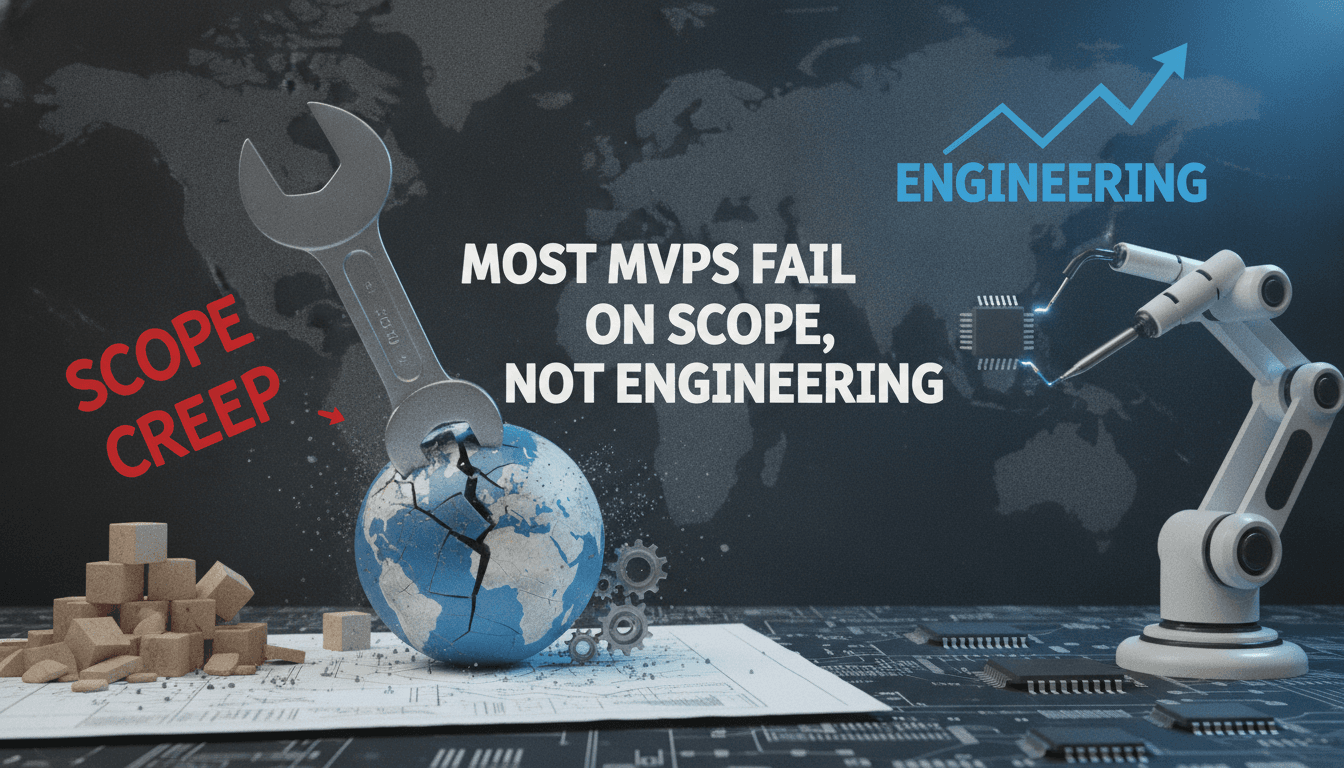
Most product teams ship late, over budget, or both. The usual post-mortem blames the engineers. Nine times out of ten, the engineering was fine. The scope wasn't.
This is a pattern that repeats across early-stage products regardless of the stack, the team size, or the budget. Understanding why it happens — and what to do about it — is more useful than any framework for sprint planning.
What "Scope Failure" Actually Looks Like
Scope failure is not the same as feature creep, though they're related. Feature creep is additive: you keep bolting things on. Scope failure is structural: the product you agreed to build in month one is fundamentally different from what you're building in month three, and nobody explicitly made that call.
The symptoms are recognisable:
- The backlog grows faster than it shrinks
- Engineering estimates keep getting revised upward
- The "MVP" has a payments module, an admin dashboard, a reporting suite, and two integration layers before a single user has logged in
- Conversations about launch date get replaced by conversations about "the next milestone"
None of these are engineering problems. They're definition problems. The engineers are building exactly what they're being asked to build. The ask keeps changing, or was never precise enough to begin with.
Why Does This Keep Happening to Technical Founders?
Technical founders are actually more susceptible to this than non-technical ones, because they can see solutions clearly. When a stakeholder raises a need, the instinct is to solve it, and solving it feels cheaper than deferring it because "we're already in this part of the codebase."
That instinct is almost always wrong.
The hidden cost of building a feature before you've validated the need for it isn't the engineering hours. It's the rigidity it introduces. Every pre-validated feature is a constraint on the product's ability to change direction. At MVP stage, the ability to change direction is the most valuable thing you have.
There's a well-cited Standish Group finding that roughly 64% of software features are rarely or never used. That number is from the CHAOS Report and it's been consistent across their surveys for over a decade. Building to that proportion of your spec is waste by definition.
The framing that works better: an MVP is a falsifiability instrument. You're not building a product with fewer features. You're building the smallest thing that can prove or disprove a specific hypothesis about user behaviour.
/// Not sure where to start?
Get the architecture before you commit
Tell us what you're building and we'll map the technical approach, stack, and rough timeline. No cost, no obligation, no sales call required.
How to Scope an MVP That Actually Ships
The useful exercise is not a MoSCoW prioritisation session. Those tend to produce long lists of "must-haves" that are negotiated down from "everything." The conversation you need is different.
Start with the riskiest assumption in your business model and work backwards. Ask: what is the single thing that, if it turns out to be wrong, makes this entire product pointless? That's what your MVP needs to test. Everything else is optional until that assumption is validated.
Then apply a constraint that's hard to argue with: time-box the MVP to a fixed number of weeks and a fixed team. Whatever fits within that box, built to production quality, is your MVP. Features that don't fit get cut. Not deferred to v1.1. Cut.
The difference between "cut" and "deferred"
"Deferred to v1.1" is a category where features go to die slowly while consuming planning bandwidth. The product team keeps revisiting them, the engineering team half-designs for them, and they ship six months late or not at all.
"Cut" means you are explicitly deciding this feature is not necessary to validate the core hypothesis. You might build it later. You might not. You're not designing the architecture around it now.
This distinction matters because it changes how you architect the system. A deferred feature produces hedged code: abstractions that aren't needed yet, extension points nobody will use, database schemas with columns that stay null for a year. Cut features produce clean code.
What a well-scoped MVP spec looks like
A solid MVP spec has four components:
- The specific user behaviour you're trying to produce or measure
- The constraints you will not compromise on (usually: security, data integrity, core UX flow)
- An explicit list of what you are not building, with a one-line rationale for each item
- A definition of done that is observable, not subjective
The fourth point is the one most specs skip. "User can sign up and post a listing" is observable. "User has a great onboarding experience" is not.
What Good Engineering Looks Like When Scope Is Tight
When scope is genuinely fixed, the engineering problem shifts. The question is no longer "how do we build all of this" but "what is the minimum architectural surface area that supports these specific behaviours without boxing us in."
That usually means:
- Favour managed services over self-hosted infrastructure. AWS RDS over running Postgres yourself. Vercel or Render over a bespoke CI/CD pipeline. You can reclaim control later when you have load patterns to design against.
- Resist internal API design until you have at least two consumers. One consumer is a monolith waiting to happen. That's fine for an MVP.
- Pick boring technology for the core data layer. Postgres handles more than most MVPs will ever throw at it. Introducing a graph database or an event-sourced architecture at MVP stage because it might be useful later is a scope problem wearing an engineering hat.
- Write tests for the user-facing flows, not for everything. 100% coverage on an MVP is a signal that someone is optimising for the wrong thing.
The trade-off is honest: this approach produces a codebase that will need refactoring. That's the correct outcome. A codebase that ships and teaches you something real is worth more than a codebase that's architected for a product you haven't validated yet.
Comparing Scoping Approaches
| Approach | Time to first user | Architectural flexibility | Risk |
|---|---|---|---|
| Full-spec build | High (4–9 months typical) | Low — decisions baked in early | Building the wrong product well |
| Feature-prioritised MVP | Medium (2–4 months) | Medium | Scope creep via "must-haves" |
| Hypothesis-driven MVP | Low (4–10 weeks) | High — minimal pre-committed surface | Under-building and missing critical flows |
| No-code / low-code prototype | Very low (1–3 weeks) | Very low | Technical ceiling hit early |
There's no universally correct row. The hypothesis-driven approach is the right choice if your biggest risk is building the wrong thing. If you're in a regulated space with compliance requirements that can't be deferred, the full-spec build is sometimes unavoidable. Honest scoping means acknowledging which situation you're in.
Conclusion
The decision that determines whether your MVP succeeds happens before a single line of code is written. It's the decision about what you're not building, and why.
Get that in writing, get stakeholder sign-off on the cut list, and give it to engineering. If the cut list causes discomfort, that's the right signal. Discomfort at scope-definition time is cheap. Discomfort at month four, when you're carrying 80,000 lines of code and still haven't shipped, is expensive.
If you're currently in scope discussions for a product build, start by writing down the three things you've decided not to build. If you can't name them, the scoping work isn't done yet.
FAQ
Does a tight MVP scope mean lower code quality? No. Scope and quality are independent variables. A tight scope means fewer features, not worse engineering. The codebase for a well-scoped MVP should be production-grade within its defined boundaries. What you're trading off is coverage, not standards. Cutting features is not the same as cutting corners.
How do you handle stakeholders who keep adding to the MVP scope? Keep the hypothesis visible. Every addition should be tested against the question: does this feature help us validate or invalidate our core assumption faster? If the answer is no, it doesn't belong in the MVP. Stakeholders add scope when the definition of success is vague. Sharpen the definition.
When is it right to build more than the minimum? When the "minimum" creates a misleading signal. If your MVP is so stripped down that users reject it for reasons unrelated to your core hypothesis, you've under-built. This is common in B2B products where a certain level of polish is a prerequisite for an enterprise user to take the product seriously enough to evaluate it honestly.
Should MVP architecture account for scale? Design for the load you expect in the next six months, with a clear upgrade path for the six months after that. Designing for year-three load at MVP stage is premature optimisation. Designing with no thought for scale is negligence. The practical middle ground: choose technologies with known scaling paths (Postgres, Redis, S3-compatible object storage) so the refactor, when it comes, is a known quantity.
What's the biggest mistake teams make after a successful MVP launch? Treating the MVP codebase as the foundation for v1. It isn't. The MVP's job was to validate a hypothesis. Once it's done that job, the correct move is often a deliberate rewrite of the core flows with what you've learned. Teams that skip this step carry MVP-era shortcuts into a production product and pay for it for years.
Have a project in mind? Contact Sodio Technologies to discuss your requirements and explore the right technology solution for your business.
/// Work with us
Talk to the engineers who'd build it
You'll get a technical scope, timeline and cost estimate from the people doing the work, not an account manager. In-house team, no subcontracting, since 2016.