

Waste Management Solutions: Promoting Efficiency
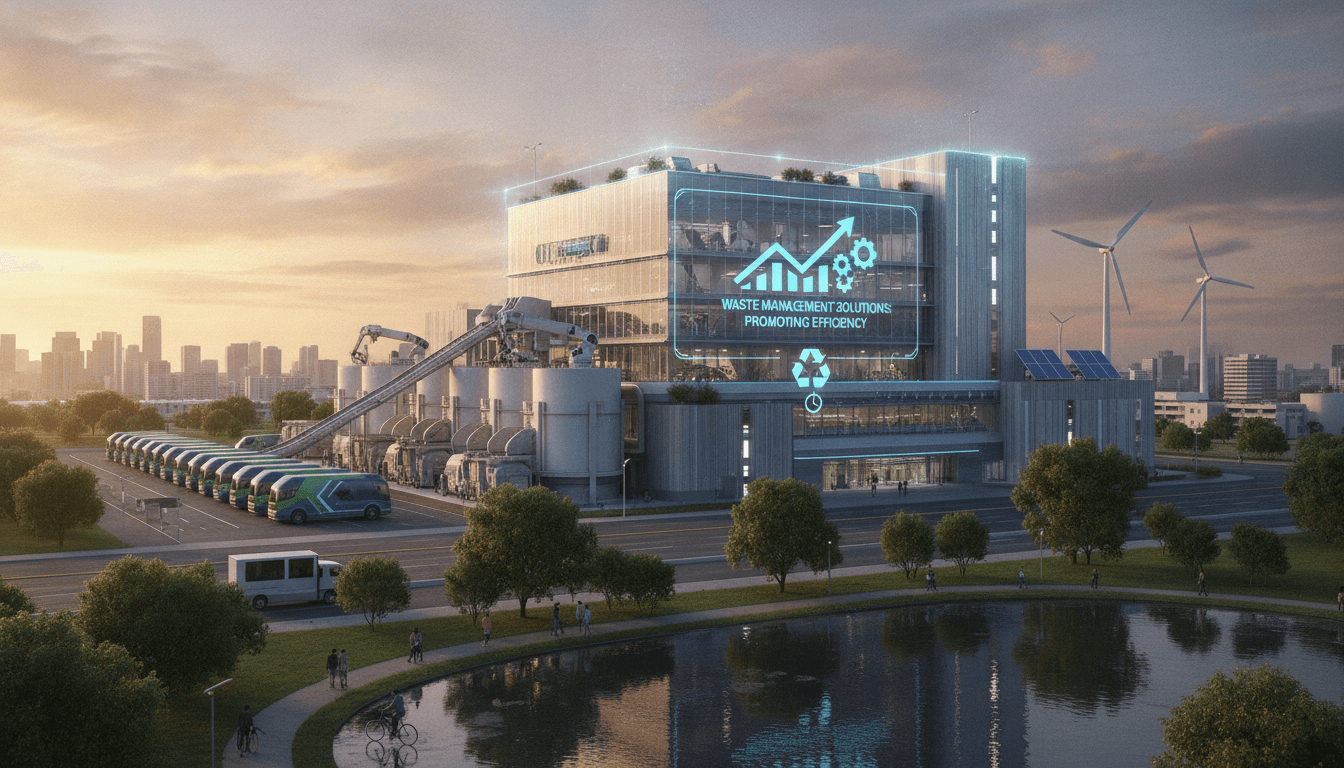
Waste management is quietly becoming one of the more interesting engineering problems in the environmental sector. The systems are operationally complex, the data is messy, and the cost of inefficiency compounds daily — both financially and environmentally.
What Does a Modern Waste Management System Actually Look Like?
The old model is straightforward: trucks run fixed routes, drivers record weights manually, and billing follows a spreadsheet. Most municipalities and private operators still run some version of this. The problem is that fixed routes ignore variable fill rates, manual recording introduces errors, and billing disputes pile up.
A modern system replaces those fixed assumptions with sensor data and dynamic decision-making.
IoT Sensors and Fill-Level Monitoring
Ultrasonic and infrared sensors mounted inside bins report fill levels over NB-IoT or LoRaWAN networks. NB-IoT suits dense urban deployments where cellular coverage exists. LoRaWAN works better in peri-urban or industrial zones where you need kilometres of range on minimal power.
The data cadence matters. Polling every 15 minutes is sufficient for most commercial bins. High-traffic locations like stadium bins during events may need 5-minute intervals. The sensors themselves typically run on primary lithium cells lasting 3–5 years, which reduces maintenance overhead considerably.
Fill-level data feeds into a central platform. That platform decides whether a bin should be on tomorrow's collection route.
Dynamic Route Optimisation
Static routes waste fuel. A truck covering a fixed 40-bin circuit where 15 bins are at 20% capacity is burning diesel unnecessarily. Dynamic routing solves this by only dispatching to bins above a configurable threshold — typically 70–80% fill.
Google OR-Tools and open-source VRP solvers handle the routing mathematics. For fleets of 20 or more vehicles, constraint-based solvers outperform greedy heuristics in solution quality, though they take longer to compute. For real-time re-routing mid-shift, lighter heuristics with local search work better because latency matters.
The measurable gains from dynamic routing in published studies range from 15% to 30% reduction in collection kilometres driven. Fuel savings follow proportionally. Staff hours drop because trucks are doing fewer, fuller runs.
How Do You Handle the Data Pipeline at Scale?
The data volume from a mid-sized city deployment can reach millions of sensor readings per day. That requires thinking carefully about ingestion, storage, and query patterns from the start.
MQTT is the standard protocol for sensor-to-broker communication. Eclipse Mosquitto or HiveMQ work for moderate scale. Beyond roughly 50,000 concurrent connections, you need a clustered broker or a managed service like AWS IoT Core. TimescaleDB is a sensible choice for the time-series storage layer — it extends PostgreSQL, which means your operations team doesn't need to learn a new query language.
Data retention policy is a real engineering decision. Raw sensor readings at 15-minute intervals for 10,000 bins generate about 350 million rows per year. Retaining all of it indefinitely is expensive. A tiered approach — full resolution for 90 days, hourly aggregates for 2 years, daily aggregates indefinitely — handles most reporting and anomaly detection requirements without unbounded storage growth.
Anomaly Detection and Predictive Maintenance
Sensor failure modes are predictable. A bin reporting exactly 0% fill for 72 consecutive hours is almost certainly a sensor fault. A bin that jumps from 10% to 95% in one reading has likely been hit by a large one-time deposit or the sensor has shifted position.
Simple threshold rules catch obvious faults. For subtler degradation, an isolation forest model trained on the sensor's historical pattern flags anomalies without needing labelled fault data. This matters because labelled fault logs are rarely available in waste operations.
Predictive maintenance on vehicles is a separate problem. CAN bus data from trucks — engine temperature, brake wear, idle time — feeds into a maintenance model that predicts service needs before breakdowns occur. This is standard telematics work, but integrating it with route data lets you schedule preventive maintenance during low-demand windows rather than on a fixed calendar.
/// Not sure where to start?
Get the architecture before you commit
Tell us what you're building and we'll map the technical approach, stack, and rough timeline. No cost, no obligation, no sales call required.
What Are the Trade-offs of Building This In-House?
Building a full waste management platform internally gives you control over the data model and the ability to adapt quickly. It also means owning a significant surface area of infrastructure that is not your core business.
The sensor integration layer alone requires handling firmware versioning, network protocol diversity, and device provisioning at scale. That is specialised work. If your team hasn't done embedded or IoT systems before, the learning curve is steep and the early mistakes are expensive.
| Approach | Strengths | Weaknesses |
|---|---|---|
| Full in-house build | Full data control, custom logic, no vendor lock-in | High initial cost, requires IoT + backend + ML skills |
| SaaS platform (e.g. Sensoneo, Bigbelly) | Fast deployment, proven hardware | Limited customisation, ongoing licence costs, data portability risks |
| Hybrid (custom software, off-shelf hardware) | Balances control and speed | Integration complexity, hardware vendor dependency |
The hybrid approach is often the most practical. Use certified sensor hardware from established manufacturers. Build your own data pipeline, routing engine, and reporting layer. This gives you ownership of the logic without having to solve radio frequency certification and hardware supply chain problems.
If customisation depth is low — you just need bin monitoring and basic reporting — a SaaS platform is the honest answer. Building a custom system only makes sense when you have genuinely differentiated requirements: custom billing logic, integration with a legacy ERP, multi-tenant architecture for a managed services business.
Reporting, Compliance, and the Audit Trail
Waste operations are regulated. Disposal manifests, hazardous waste tracking, and carbon reporting all require an auditable record. This is not an afterthought.
Every collection event should write an immutable record: bin ID, vehicle ID, driver ID, timestamp, GPS coordinate, and weight if a vehicle-mounted weighbridge is present. PostgreSQL with append-only tables and row-level security handles this adequately for most jurisdictions. For operations where regulatory dispute resolution is common, a blockchain-anchored audit log — writing a Merkle root of each day's records to a public chain — provides third-party verifiability without storing sensitive data on-chain.
Weight-based billing requires tamper-evident data. If a client disputes a charge, you need to reconstruct exactly what was collected, when, and how it was measured. A well-designed audit trail makes that a 10-minute task. A poorly designed one makes it a legal problem.
Conclusion
The core engineering work here is straightforward: sensors, a time-series database, a routing engine, and a clean API layer. The hard part is integrating those pieces reliably across a fragmented hardware ecosystem and making sure the data is trustworthy enough to act on.
If you are designing a waste management platform, start with the data model. Decide what a "collection event" is and what fields it must carry before you write a line of application code. Everything else — routing, billing, reporting, compliance — is downstream of that decision.
If you want to talk through the architecture, the Sodio team has built systems in adjacent operational domains and can give you an honest assessment of where the complexity sits.
FAQ
What sensors are most commonly used for smart bin monitoring? Ultrasonic fill-level sensors are the most widely deployed. They measure the distance from the sensor to the waste surface and calculate fill percentage. Infrared sensors work in some configurations but are more sensitive to dust and condensation. Most commercial units transmit over NB-IoT or LoRaWAN and run on lithium primary cells for 3–5 years.
How much fuel can dynamic routing actually save? Published field deployments report reductions of 15–30% in total kilometres driven once dynamic routing replaces fixed schedules. The actual saving depends heavily on baseline route efficiency and the fill-rate variability of the bins in your network. High-variability urban environments tend to see larger gains.
Is a custom-built platform worth it over a SaaS waste management tool? Only if your requirements genuinely diverge from what SaaS platforms offer. Sensoneo and Bigbelly cover standard bin monitoring and basic routing well. Custom builds make sense when you need deep ERP integration, non-standard billing logic, or a multi-tenant architecture for serving multiple clients from one platform.
What database technology works best for sensor time-series data? TimescaleDB is a strong default choice. It extends PostgreSQL with time-series optimisations, supports continuous aggregates, and lets you use standard SQL tooling. InfluxDB is an alternative with better write throughput at extreme scale, but it introduces a separate query language and operational complexity that most waste management deployments don't need.
How do you handle sensor data that looks wrong? Start with deterministic rules: readings stuck at 0% or 100% for extended periods, impossible fill-rate jumps between readings, and gaps in transmission. Layer an isolation forest anomaly detection model on top for subtler drift. Flag suspect readings rather than discarding them. You need the original data if a fault is later disputed or if you want to retrain your detection model.
Have a project in mind? Contact Sodio Technologies to discuss your requirements and explore the right technology solution for your business.
/// Work with us
Talk to the engineers who'd build it
You'll get a technical scope, timeline and cost estimate from the people doing the work, not an account manager. In-house team, no subcontracting, since 2016.