

How to Make an App Like 11pets
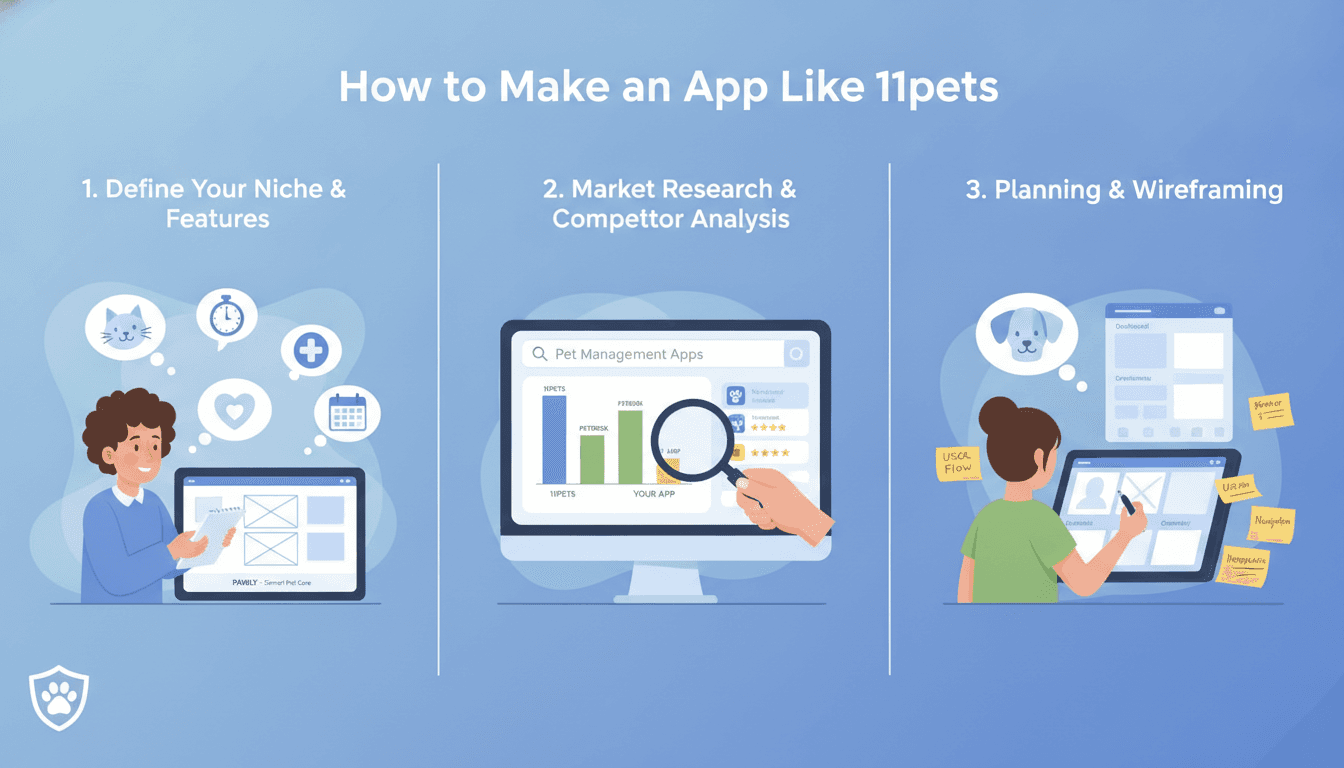
A practical breakdown of the architecture, feature set, and cost drivers behind a pet care app — written for teams who want to build something that actually works in production, not just on a demo screen.
What Does 11pets Actually Do Under the Hood?
11pets is a pet management app that covers health records, vaccination schedules, medication reminders, vet visit logs, and multi-pet profiles. It also supports document storage and has a sharing model that lets groomers or vets access a pet's record without owning the account.
We cover a closely related subject in How to Make an App Like PetCoach.
That last bit is the interesting engineering problem. Most pet apps are simple CRUD wrappers. 11pets adds a permissioned-access layer on top of profile data, which changes your data model significantly.
If you're building a competitor or an adjacent product, here's what that actually means for your stack.
Core Feature Set and the Real Complexity Behind Each One
It's tempting to think of this as a simple CRUD app with push notifications. It isn't.
Health Records and Document Storage
Users upload vaccination certificates, vet prescriptions, and lab reports. That means you need:
- A storage layer (S3 or GCS) with per-file access control
- A metadata store that maps documents to pets, owners, and optionally to third-party viewers
- PDF rendering on mobile (PDFKit on iOS, iText or PdfBox on Android)
Document versioning matters here. Vets update records. You need an audit trail, not just the latest file.
Medication and Appointment Reminders
This looks simple until you think about time zones, recurring schedules (every 12 hours for 10 days), and what happens when a user misses a dose. You need a scheduling engine that can handle cron-style recurrence with state tracking per reminder instance.
For a closer look at a related topic, read our guide on How to Make an App Like PetDesk.
Firebase Cloud Messaging handles the delivery layer fine. The complexity is in the business logic that generates, tracks, and reschedules reminder events. Build this as a separate service, not inside your main API.
Permissioned Sharing
This is the hardest part to get right. A pet owner shares a profile with a vet clinic. The clinic can read vaccination records but not medication history. The owner can revoke access at any time.
Related reading: How to Make an App Like Pet First Aid.
That's a relationship-level access control model. Role-based access control (RBAC) isn't granular enough. You need attribute-based access control (ABAC) or a purpose-built permission table that encodes: (subject, object, action, expiry). Casbin is a reasonable open-source policy engine for this if you're on Node.js or Go. AWS Cedar is worth evaluating if you're already in the AWS ecosystem.
Multi-Pet Profiles
Technically straightforward. One user, multiple pet entities, each with their own record tree. Use a foreign key from pet to user, not the other way around. The UI complexity is higher than the backend complexity here.
What Tech Stack Should You Build On?
There's no single right answer, but here's how we'd approach it for a team that wants maintainable code at scale.
| Layer | Recommended Choice | Why |
|---|---|---|
| Mobile | Flutter | Single codebase, strong widget library, good enough performance for this use case |
| API | Node.js (Fastify) or Go | Low latency, easy async handling for notifications |
| Database | PostgreSQL | Relational data model suits the permission and record structure |
| File storage | AWS S3 | Mature, cheap, fine-grained IAM policies |
| Push notifications | Firebase Cloud Messaging | Cross-platform, reliable, free at most scales |
| Auth | Auth0 or Supabase Auth | Don't build this yourself |
| Scheduling | Bull (Redis-backed) or Temporal | Bull for simpler flows, Temporal if reminders get complex |
Flutter is the right call here specifically because the feature set doesn't require native APIs beyond push notifications and camera access. You're not doing ARKit or CoreMotion. The savings on maintaining two codebases are real.
If your target market is enterprise vet clinics, build a web dashboard too. Vets don't manage records on phones.
/// Not sure where to start?
Get the architecture before you commit
Tell us what you're building and we'll map the technical approach, stack, and rough timeline. No cost, no obligation, no sales call required.
How Much Does It Cost to Build an App Like 11pets?
Costs depend on team location, scope, and how much you cut from v1. Here's a realistic breakdown for a mid-scope build.
| Component | Estimated Hours |
|---|---|
| Flutter app (iOS + Android) | 600–800 |
| Backend API + database | 350–500 |
| Admin/vet web dashboard | 200–300 |
| Scheduling and notification service | 100–150 |
| Auth and permission system | 80–120 |
| DevOps, CI/CD, staging setup | 80–100 |
| QA and testing | 150–200 |
| Total | 1,560–2,170 hours |
At a blended rate of $35–50/hour for an experienced team in India, you're looking at $54,600–$108,500. At European or US rates, multiply by 2.5–3x.
The range is wide because permissioned sharing and scheduling complexity are the two biggest unknowns until you've scoped them properly. If you skip the sharing model for v1, you cut 20–30% of backend complexity.
What Are the Most Common Mistakes Teams Make Building This?
Four that come up repeatedly:
Underestimating the permission model. Teams start with simple ownership checks, then bolt on sharing as an afterthought. The data model ends up broken. Design the access control layer before you write a single API endpoint.
Building reminders as a feature rather than a service. Reminder logic embedded in your main API will cause problems. Background jobs get killed, state gets lost, and debugging is painful. Temporal or a Bull queue running independently is worth the setup time.
Ignoring offline mode. Pet owners travel. Vets are in areas with poor connectivity. If the app needs a network connection to display a vaccination record, it will fail at the worst possible moment. SQLite via Drift (Flutter) handles local caching cleanly.
Skipping data export from day one. Regulators in several markets (notably the EU under GDPR) require that users can export all their data in a machine-readable format. Build the export endpoint in v1, not as a retrofit.
Conclusion
Building a pet care app at 11pets' level of functionality is a 6–9 month project for a competent team of four to six people. The mobile UI is the easy part. The permission model, offline behaviour, and scheduling service are where projects run into trouble.
If you're at the stage of scoping this out, start with a detailed data model for your permission layer and your reminder state machine. Those two decisions shape everything else.
Reach out to the team at Sodio if you want a technical scoping session before you commit to a build plan.
FAQ
How long does it take to build an app like 11pets? A realistic timeline for a full-featured pet care app with health records, reminders, and permissioned sharing is 6–9 months with a team of 4–6 people. Cutting the sharing model and web dashboard from v1 brings that closer to 4–5 months. Timeline depends heavily on how much QA and iteration you build into the process.
Do I need separate iOS and Android apps, or can I use one codebase? For a feature set like 11pets, a single Flutter codebase is entirely adequate. You're not using hardware APIs that require native code. A shared codebase reduces maintenance overhead significantly and lets a smaller team move faster without sacrificing meaningful performance or UX quality.
What database should I use for a pet health records app? PostgreSQL is the right default. The data is highly relational: users own pets, pets have records, records have documents, and permissions link users to other users' pets. A document database like MongoDB makes the permission queries awkward. PostgreSQL's JSONB column type handles any semi-structured metadata without giving up relational integrity.
How do I handle GDPR for a pet app? Even though pet data isn't personal data under GDPR, user account data and any information about the owner is. You need a clear privacy policy, a data export endpoint (Article 20 portability right), and a deletion flow that cascades properly across all tables and removes files from storage. Build these in v1; retrofitting them is expensive.
Can I monetise a pet care app through subscriptions? Yes, and it's the model that works. Offer a free tier with one pet profile and limited document storage (around 100 MB), then charge £2.99–£4.99/month for unlimited pets, document storage, and sharing features. In-app purchases through Apple and Google take 15–30%, so factor that into your unit economics from the start.
Have a project in mind? Contact Sodio Technologies to discuss your requirements and explore the right technology solution for your business.
/// Work with us
Talk to the engineers who'd build it
You'll get a technical scope, timeline and cost estimate from the people doing the work, not an account manager. In-house team, no subcontracting, since 2016.