

How to Make an App Like PetDesk
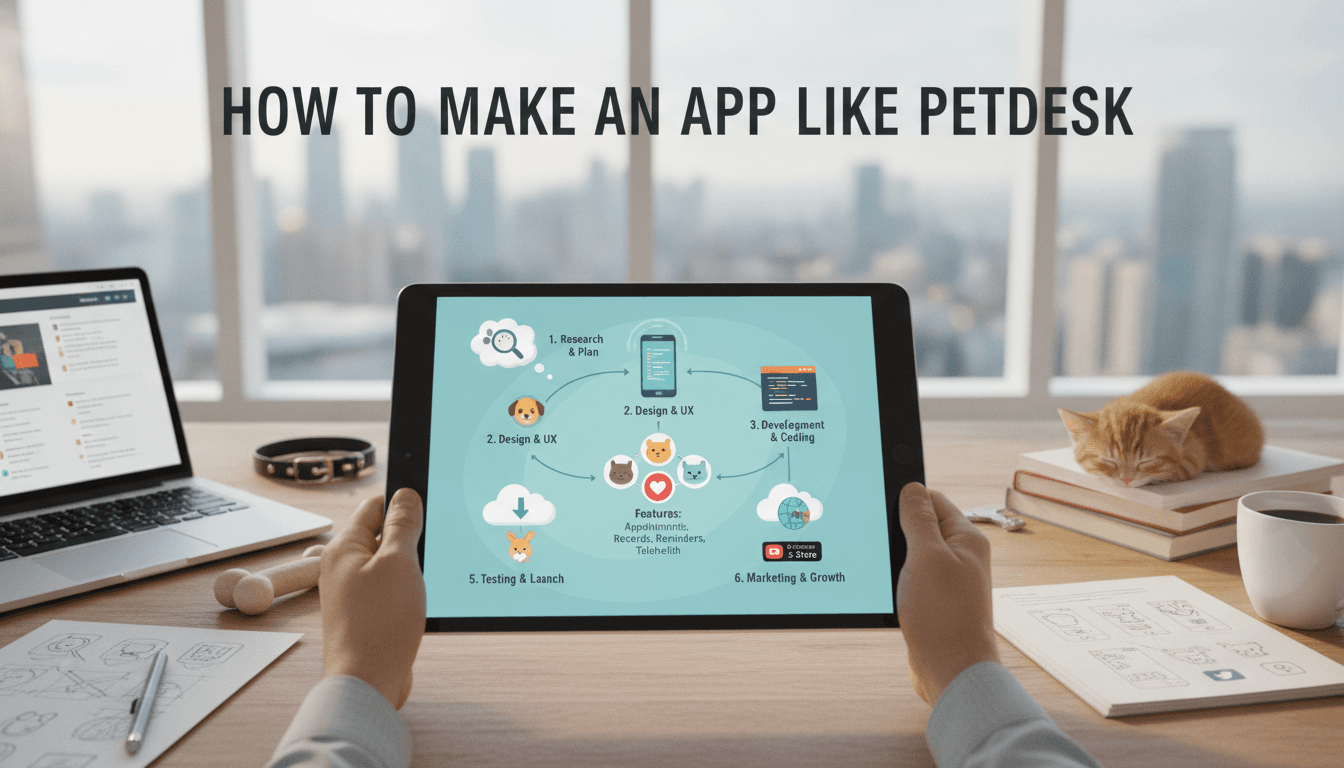
Building a pet care management app like PetDesk means wiring together appointment scheduling, reminders, health records, and two-way communication into a product that veterinary practices actually want to use daily. This post covers the architecture decisions, feature set, and cost variables you'll need to plan that build.
What Does PetDesk Actually Do Under the Hood?
PetDesk is, at its core, a practice management companion. It sits alongside (not inside) a clinic's primary Practice Information Management System (PIMS) like Avimark, Cornerstone, or ezyVet, and it handles the client-facing layer: appointment requests, automated reminders via SMS and push, digital health records visible to pet owners, and two-way messaging between clinic staff and clients.
The technical architecture is a hybrid. A mobile client (iOS and Android) talks to a backend API. That backend integrates with PIMS via HL7 or vendor-specific APIs, depending on the system. Reminder logic runs as a scheduled job service, not inline with requests. Messaging is typically built on top of something like Twilio for SMS, with in-app chat layered separately.
To explore this further, see How to Make an App Like 11pets.
This matters because if you're building a PetDesk-style product, you're not building one system. You're building at least four: the mobile apps, the backend API, an integration layer for PIMS, and an async job engine for reminders. Plan for that from day one.
Core Features You Need to Get Right
Appointment Scheduling
This is the most complex piece. Clinics do not want a generic calendar. They need:
- Resource-based scheduling (doctor availability, exam room availability, equipment availability)
- Appointment type rules (a wellness visit is 30 minutes, a dental procedure blocks a room for 90 minutes)
- Request vs. confirmation flow (many clinics approve requests manually before they're confirmed)
The request-confirmation split is important. Do not build a fully self-serve booking flow and expect clinics to trust it without a trial period. Most will want to review requests first, at least initially.
Reminders and Notifications
Automated reminders are the feature clinics pay for most willingly. A typical reminder sequence is: 72 hours before appointment (email or push), 24 hours before (SMS), and a post-visit follow-up 48 hours after.
You need a job queue here, not a cron tab. Use something like Sidekiq with Redis or BullMQ on Node, and make the jobs idempotent. Clinics will change appointment times, and you cannot send duplicate reminders when a reschedule triggers a re-enqueue.
For a closer look at a related topic, read our guide on How to Make an App Like PetCoach.
Health Records and Vaccination Tracking
Pet owners want to see vaccination history, upcoming due dates, and prescription information. This data lives in the PIMS. Your job is to read it, present it cleanly, and where the PIMS allows it, write back (e.g., recording that a vaccine was administered at a home visit).
Build a data model that treats PIMS data as the source of truth and your app's copy as a read cache with a defined TTL. Do not let the app become the system of record unless you're building a full PIMS replacement, which is a different product entirely.
Two-Way Messaging
SMS-based two-way messaging through Twilio costs roughly $0.0075 per message segment in the US. At scale, this adds up. Design the messaging flow so routine confirmations use templated messages (cheaper, faster, no staff involvement), and free-text conversations are flagged for a staff member to handle.
In-app chat is an alternative. It costs less per message but requires the pet owner to have the app installed. Most practices find a combination works best: SMS for reminders, in-app for ongoing conversations.
To explore this further, see How to Make an App Like Pet First Aid.
/// Not sure where to start?
Get the architecture before you commit
Tell us what you're building and we'll map the technical approach, stack, and rough timeline. No cost, no obligation, no sales call required.
What Does the Tech Stack Look Like?
There is no single right answer, but here is what a pragmatic stack looks like for a v1:
| Layer | Recommended Choice | Why |
|---|---|---|
| Mobile | React Native | Single codebase, large talent pool, good native module support |
| Backend API | Node.js (Express or Fastify) or Ruby on Rails | Fast to build, mature ecosystem |
| Database | PostgreSQL | Relational data fits appointment and record models well |
| Job Queue | BullMQ (Node) or Sidekiq (Rails) | Battle-tested, good observability |
| SMS/Voice | Twilio | Widest PIMS integration documentation |
| Push Notifications | Firebase Cloud Messaging (FCM) | Free, reliable at scale |
| PIMS Integration | Per-vendor (see below) | No universal standard |
React Native is the right choice here specifically because PetDesk-type apps do not need heavy platform-native UI. The screens are forms, calendars, and lists. You will not lose meaningfully on user experience, and you will spend significantly less building two separate native apps.
PIMS Integration Is the Hard Part
There is no single standard for PIMS APIs. Avimark uses an ODBC-level database integration. Cornerstone has a limited HL7 interface. ezyVet has a REST API that is relatively well-documented. Covetrus Pulse has its own SDK.
You will spend 30 to 40 percent of your backend engineering time here if you want to support more than two or three PIMS out of the gate. Budget for it honestly. If you're targeting a specific market segment, find out which PIMS your target clinics use and prioritise those two integrations first.
How Long Does It Take to Build, and What Does It Cost?
A focused v1 covering scheduling, reminders, health record viewing, and SMS messaging takes roughly 5 to 6 months with a team of five: one product manager, two backend engineers, one mobile engineer (React Native), and one QA engineer.
That timeline assumes you are not building PIMS integrations from scratch. Add 6 to 10 weeks per PIMS integration depending on documentation quality.
Cost in Bengaluru-based engineering rates runs between $60,000 and $110,000 USD for v1, depending on team seniority and scope creep. US or European rates are 2.5 to 3x that figure.
The variables that expand scope most commonly are: clinic onboarding tooling (you need a way for clinics to configure the app), multi-location support, and white-labelling (some buyers want the app branded to their practice, not a third-party product).
When Building This Yourself Is the Wrong Call
If you're a veterinary practice buying software, you are not building this. The build-vs-buy calculation is straightforward: a SaaS subscription for a product like PetDesk runs $300 to $500 per month per clinic location. Building a comparable product costs $80,000 to $150,000 and then requires ongoing maintenance.
If you are building a product to sell to veterinary practices, the economics flip. The market has roughly 30,000 veterinary practices in the US alone. Even at $300 per month per clinic, a 500-clinic customer base generates $1.8 million ARR. That justifies a serious engineering investment.
The risk is that PetDesk, Vetstoria, and a few others already have PIMS partnerships that took years to build. Competing on integration breadth from day one is not realistic. Compete on a specific niche: emergency clinics, exotic animal practices, mobile veterinary services. Pick a segment where the incumbents have weak coverage.
Conclusion
Building an app like PetDesk is a solvable engineering problem. The complexity is in the PIMS integrations and the reminder pipeline, not the mobile app itself. Plan your integrations before you write a line of mobile code, choose your first two PIMS targets based on your market, and build the job queue correctly from the start.
If you want to talk through the architecture or get an estimate for a specific feature set, reach out to the Sodio team. We can scope a v1 in a week.
FAQ
How long does it take to build a pet care app like PetDesk? A focused v1 covering scheduling, reminders, health records, and SMS messaging takes 5 to 6 months with a team of five. PIMS integrations add 6 to 10 weeks per system on top of that. The timeline is realistic if scope is controlled and PIMS targets are decided before development starts.
What is the most expensive part of building a PetDesk-style app? PIMS integrations consistently consume the most backend engineering time, typically 30 to 40 percent of total backend effort. There is no universal API standard across veterinary practice management systems, so each integration is a bespoke project with its own documentation quality and quirks.
Should I build with React Native or native iOS and Android? React Native is the right choice for this type of app. The UI is primarily forms, calendars, and messaging screens, none of which require platform-specific capabilities that would justify two separate codebases. You save significant time and cost without a meaningful user experience trade-off.
How do reminders work technically in a pet care app? Reminders run as jobs in an async queue (BullMQ or Sidekiq are common choices) rather than as inline API responses. Jobs must be idempotent to handle reschedules without sending duplicate messages. A typical sequence is 72-hour, 24-hour, and 48-hour post-visit reminders delivered via SMS (Twilio) or push (FCM).
Is the veterinary practice management app market worth entering? With roughly 30,000 veterinary practices in the US, even modest market penetration generates substantial ARR. The barrier is existing PIMS partnerships held by incumbents like PetDesk and Vetstoria. A new entrant has the best chance by targeting a specific niche (emergency clinics, exotic animal practices, mobile vets) rather than competing across the full market from launch.
Have a project in mind? Contact Sodio Technologies to discuss your requirements and explore the right technology solution for your business.
/// Work with us
Talk to the engineers who'd build it
You'll get a technical scope, timeline and cost estimate from the people doing the work, not an account manager. In-house team, no subcontracting, since 2016.