

How to Make an App Like Pet First Aid
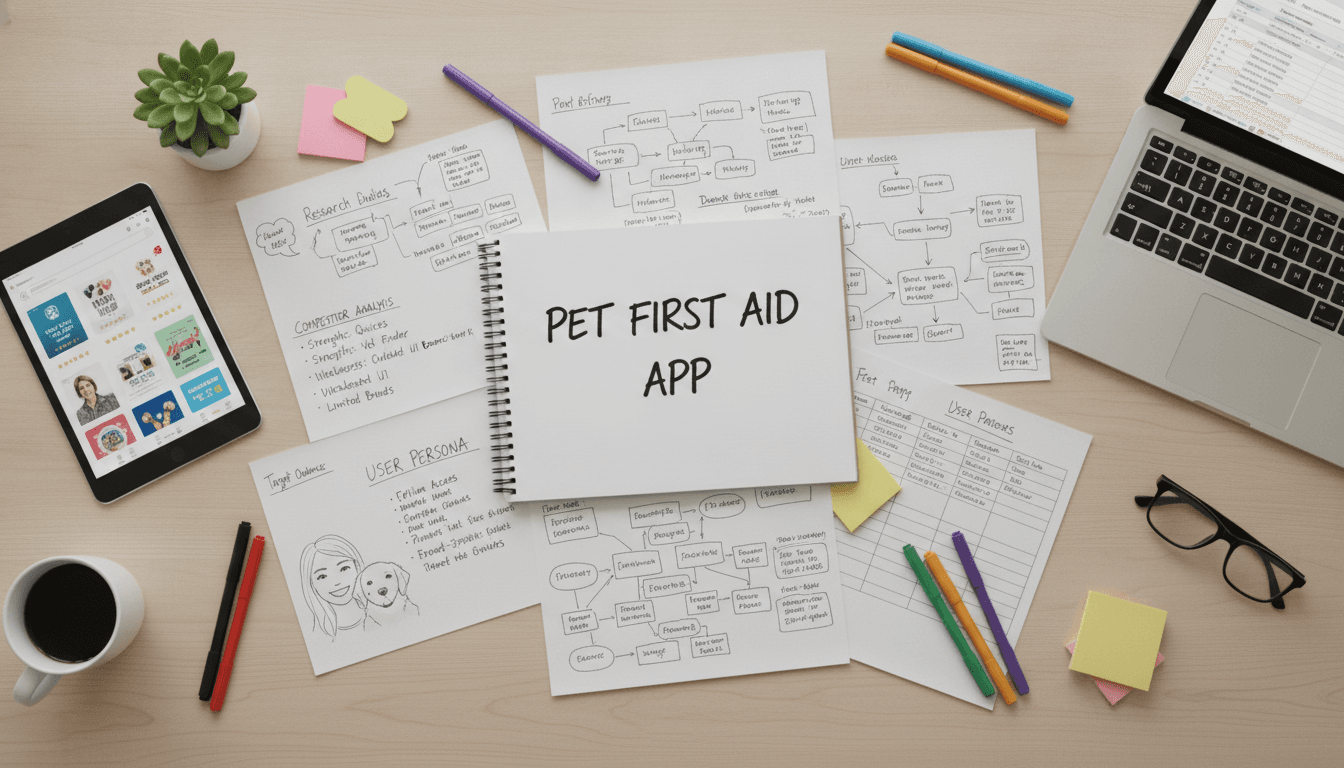
Building a pet first aid app sits at the intersection of clinical accuracy, real-time guidance, and mobile UX constraints. Get any one of those wrong and the app either harms animals or gets abandoned after the first panic-driven search.
This post walks through the core architecture, the content decisions, and the technical trade-offs you'll face. It assumes you've built mobile apps before and are evaluating the scope of this specific problem.
What Makes a Pet First Aid App Technically Different?
Most health-adjacent apps surface static content. Pet first aid apps need to do something harder: guide a distressed user through a time-critical procedure with one hand, while they're possibly holding an injured animal with the other.
That constraint changes almost every design and engineering decision.
The content must be scannable in under three seconds per step. The navigation must work with one thumb. The app must function offline, because emergencies don't wait for Wi-Fi. And critically, the guidance must be veterinarian-validated — not crowd-sourced, not LLM-hallucinated.
You may also find our article on How to Make an App Like PetCoach useful.
That last point is worth sitting with. If you are using any generative AI layer for content, you need a licensed vet to review every output path before it reaches a user. That is not optional. It is a liability question.
Core Feature Set: What the App Actually Needs
Before touching a framework, map the user flows. There are broadly four modes a user enters:
- Emergency mode: "My dog is choking right now." Step-by-step, timed, illustrated.
- Reference mode: Browsing symptoms, learning procedures when calm.
- Vet locator mode: Finding the nearest emergency vet clinic with real-time open/closed status.
- Profile mode: Storing pet details, vaccination records, medication lists.
Emergency mode is the hardest to build well. It needs large tap targets (minimum 44x44 pts on iOS), high-contrast visuals, audio narration as an option, and zero dead ends. A user must never hit a loading spinner during a choking episode.
The vet locator requires integrating with Google Places API or a similar service. You'll need to filter by "veterinarian" category and ideally cross-reference with a dataset like the AVMA directory or a regional equivalent. Hours data from Places API is often stale, so building a report/flag mechanism is worth the effort.
You may also find our article on How to Make an App Like 11pets useful.
How Should You Structure the Content Layer?
The content architecture is where most teams underinvest.
A flat CMS with markdown files works at small scale but breaks when you need to version content by species (dog vs cat vs rabbit), by age group (puppy vs adult), and by severity tier (call a vet vs go now vs do this immediately). That's a three-dimensional matrix, and it compounds fast.
A structured content model in something like Contentful or Sanity gives you typed fields, revision history, and a review workflow. You can gate publication behind a veterinary sign-off stage. That workflow is worth building even if your content team is small, because it creates an audit trail when regulators or insurers ask questions.
To explore this further, see How to Make an App Like PetDesk.
For a 1.0, a reasonable schema looks like this:
| Field | Type | Notes |
|---|---|---|
| condition_name | String | e.g. "Suspected heatstroke" |
| species | Enum | dog, cat, rabbit, bird, other |
| severity | Enum | monitor, vet_soon, emergency |
| steps | Array of Step | Each step has text, image, audio_url, duration_seconds |
| contraindications | Array of String | What NOT to do |
| vet_note | String | Reviewed by, date |
Audio is often skipped in v1 and regretted. Record it. A user with their hands full needs narration.
/// Not sure where to start?
Get the architecture before you commit
Tell us what you're building and we'll map the technical approach, stack, and rough timeline. No cost, no obligation, no sales call required.
What Tech Stack Should You Build On?
React Native with Expo is the practical choice for most teams building this for the first time. You get a single codebase, access to the Expo Camera and MediaLibrary APIs, and enough of the native layer exposed to handle offline storage with WatermelonDB or SQLite via expo-sqlite.
Flutter is worth considering if your team already knows Dart. The widget rendering model gives you more predictable UI performance on lower-end Android devices, which matters given that pet owners skew toward a wide range of hardware.
Going fully native (Swift/Kotlin) is only justified if you need deep integration with iOS HealthKit equivalents or platform-specific Bluetooth features (some pet wearables use BLE). For most pet first aid apps, it's excess cost without commensurate gain.
Offline-First Architecture
This is non-negotiable. The entire emergency procedure library must be available without a network connection.
Use a sync-on-open pattern: fetch the latest content bundle when the app launches on a good connection, store it locally, serve from local storage always. Delta syncs using ETags or content hashes keep bandwidth low. A full content bundle for 200 conditions with images compressed to WebP at 80% quality typically lands under 40MB, which is acceptable.
Push notifications for content updates (new procedure added, safety recall) work well here as a prompt to re-sync, rather than as a delivery mechanism.
Location and Maps
For the vet locator, Google Maps SDK on both platforms with the Places API (New) is the most complete option. Budget approximately $0.017 per Place Details call. At modest scale this is negligible, but cache aggressively. Store clinic data locally per postcode/PIN area and refresh every 24 hours.
What Does the Backend Actually Need to Do?
Less than you might think, at least initially.
A Node.js or Python FastAPI backend handling these responsibilities covers most of the scope:
- Content delivery (serving the sync bundle, versioned by app build)
- User authentication (email + social sign-in via Firebase Auth or Supabase Auth)
- Pet profile storage
- Analytics events (anonymised, for understanding which procedures get viewed most)
- Push notification dispatch via FCM/APNs
A PostgreSQL database is sufficient. You do not need a graph database or a vector store for v1. If you add symptom-checking (described below), that changes.
Should You Add a Symptom Checker?
A symptom checker, where a user inputs observed symptoms and gets a suggested condition, is a common feature request and a significant scope increase.
Building a rules-based decision tree for the top 30 conditions is achievable and auditable. An LLM-based checker is faster to build but requires extensive guardrails, a clear disclaimer that it is not a diagnosis, and ongoing vet review. The UK's PDSA and the US's ASPCA both publish symptom guidance that can inform a rules-based model.
Start with the decision tree. Add probabilistic or ML-based ranking later when you have real usage data to train on.
How Long Does It Take and What Does It Cost?
A realistic timeline for a cross-platform app with the features above:
| Phase | Duration | Notes |
|---|---|---|
| Discovery + content modelling | 3–4 weeks | Involves vet consultant time |
| Design (UX + UI) | 4–6 weeks | Emergency flows need usability testing |
| Development (MVP) | 12–16 weeks | React Native, backend, CMS setup |
| Veterinary content review | 4–6 weeks | Runs in parallel with dev |
| QA + beta | 3–4 weeks | Include stress testing with one-handed use |
| App store submission | 1–2 weeks | Apple's review for health apps can take longer |
Total: roughly 6 to 9 months from kickoff to a store-ready app.
Budget-wise, a team of two mobile engineers, one backend engineer, one designer, and a part-time vet consultant will run between $80,000 and $150,000 USD for the MVP, depending on location and seniority. That does not include ongoing content maintenance, which is a real operational cost that many first-time founders ignore.
Conclusion
The technical side of a pet first aid app is tractable. The hard parts are the content governance model and the UX for distressed users. Get the offline-first architecture right from day one, invest in a structured CMS with a vet review workflow, and resist the urge to add a symptom checker until you have validation data.
If you're scoping this out and want a second opinion on the architecture or a realistic project estimate, reach out to the team at Sodio directly.
FAQ
How do I ensure the medical content in a pet first aid app is accurate? Partner with a licensed veterinarian from the start, not as a final reviewer. Build a structured CMS with a mandatory sign-off field before any condition or procedure can be published. Version every piece of content and log who approved it and when. Inaccurate guidance in a medical-adjacent app is both a reputational and legal risk.
Does a pet first aid app need to work offline? Yes, unconditionally. Emergencies happen in basements, rural areas, and car parks with no signal. The entire procedure library must be stored locally. Use a sync-on-open pattern with compressed WebP images and delta updates. A full content bundle for around 200 conditions typically stays under 40MB if images are optimised.
React Native or Flutter for this type of app? React Native with Expo is the lower-friction choice for most teams, especially if you need web parity later. Flutter gives you better rendering consistency on a wide range of Android devices. If your team has no prior experience with either, React Native has a larger talent pool and more relevant third-party libraries for maps, offline storage, and push notifications.
Should I include a symptom checker in version one? Probably not. A rules-based decision tree covering your top 30 conditions is achievable and auditable. An LLM-based checker is faster to prototype but introduces content reliability risks that require significant guardrails and ongoing vet oversight. Collect real usage data first, then decide whether an ML layer adds genuine value.
What are the app store considerations for a health-related pet app? Apple's App Store Review Guidelines (specifically guideline 5.1.3 for health data) apply if you collect any health-related user data, even for pets. Apple's review timeline for apps in the health category can run longer than average. Build that into your launch plan. Both stores will want a clear disclaimer that the app does not replace professional veterinary advice.
Have a project in mind? Contact Sodio Technologies to discuss your requirements and explore the right technology solution for your business.
/// Work with us
Talk to the engineers who'd build it
You'll get a technical scope, timeline and cost estimate from the people doing the work, not an account manager. In-house team, no subcontracting, since 2016.