

How to Make an App Like PetCoach
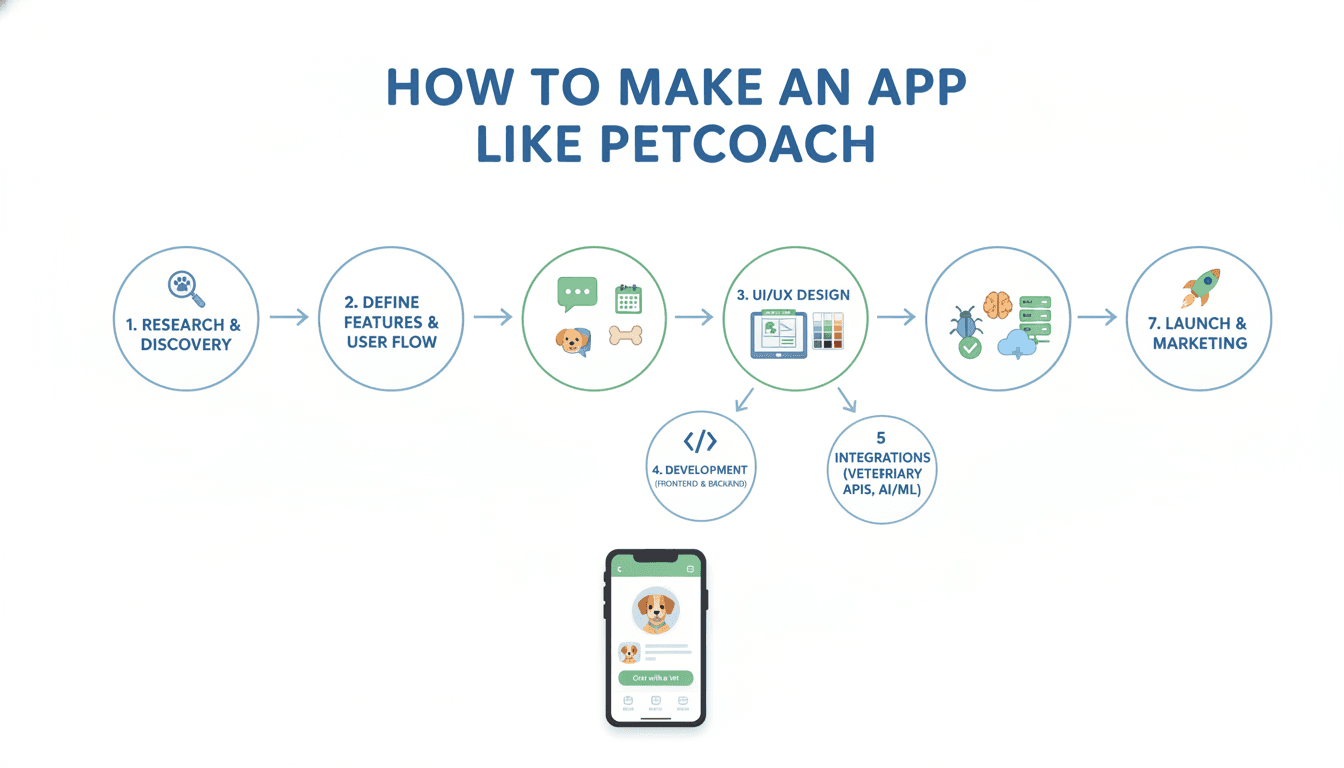
Building a pet care advisory app is more involved than it looks. The surface layer — chat interface, vet Q&A, appointment booking — is straightforward. What trips teams up is the layer underneath: how you handle unstructured medical queries, how you manage liability around AI-generated advice, and how you keep the experience coherent across pet owners who range from first-time puppy owners to people managing chronic conditions in senior animals.
This post walks through the architecture, the real decisions, and the trade-offs you'll face if you're building something in this space.
What Does an App Like PetCoach Actually Do?
PetCoach, which Petco acquired in 2017, is fundamentally a triage and advisory layer between pet owners and licensed veterinarians. The core loop is: owner asks a question, a vet or AI model responds, the response either resolves the query or escalates to a paid consultation.
Related reading: How to Make an App Like Pet First Aid.
That sounds simple. In practice you're dealing with:
- Asynchronous Q&A with response SLAs (PetCoach targets responses within a few hours)
- Real-time chat for paid sessions
- Pet profiles that carry medical history, breed, age, weight, and current medications
- Content matching that surfaces relevant articles alongside live answers
- Escalation paths to in-clinic appointments or telehealth video sessions
The pet profile is the most underestimated part. It is the context that makes advice useful. Without it, every answer is generic. With it, you can detect that a 12-year-old Labrador asking about joint pain is a very different case from a 2-year-old one.
How Do You Handle AI in a Medically Adjacent Domain?
This is where most teams either overcorrect or undercorrect.
The overcorrection: treat the app as a pure information retrieval tool, refuse to draw any conclusions, and add disclaimers to every response. Users churn fast. The advice is no better than a Google search.
We cover a closely related subject in How to Make an App Like 11pets.
The undercorrection: let an LLM answer freely without guardrails. This is a liability problem. In several jurisdictions, giving specific medical advice without a licensed professional in the loop constitutes the practice of veterinary medicine.
The architecture that actually works sits between those two extremes.
Retrieval-Augmented Generation With a Curated Corpus
Use RAG (retrieval-augmented generation) with a corpus that has been reviewed and approved by licensed vets. The LLM generates a response, but it is grounded in documents your team controls. GPT-4o or Claude 3.5 Sonnet both work here. The choice matters less than the quality of the retrieval corpus.
The retrieval layer uses a vector database — Pinecone, Weaviate, or pgvector if you're already on PostgreSQL. Chunk size of around 512 tokens with 10–15% overlap tends to perform well for medical Q&A, though you'll tune this against your own eval set.
Confidence Scoring and Escalation
Every AI-generated response should carry a confidence signal. Below a threshold, the system flags the query for vet review before sending. Above it, it sends with a soft disclosure. This is not about covering yourself legally (though it helps); it is about giving users accurate information about when they need a real professional.
Build a feedback loop. If a vet overrides an AI answer, log it. Fine-tune or add to the retrieval corpus. Over time, the override rate drops.
Tone and Scope Guardrails
System prompts need to be explicit about what the model should not do: prescribe specific medications, give dosages, or diagnose conditions definitively. This is a prompt engineering task, not a filter. Filters are brittle. A well-constructed system prompt that explains the legal and professional context to the model performs better.
/// Not sure where to start?
Get the architecture before you commit
Tell us what you're building and we'll map the technical approach, stack, and rough timeline. No cost, no obligation, no sales call required.
What Does the Technical Stack Look Like?
The core services break down like this:
| Layer | Options | Notes |
|---|---|---|
| Mobile | Flutter or React Native | Flutter if you want a single codebase with native feel; React Native if your team is JS-heavy |
| API | Node.js (Express/Fastify) or Python (FastAPI) | Python is natural if your AI team is already there |
| Auth | Auth0 or Firebase Auth | Both handle social login + JWT well |
| Database | PostgreSQL (primary) + Redis (cache/sessions) | pgvector extension handles embeddings if you don't want a separate vector DB |
| AI/LLM | OpenAI GPT-4o or Anthropic Claude 3.5 | API-first; fine-tuning optional |
| Vector DB | pgvector or Pinecone | pgvector reduces infrastructure; Pinecone scales better past ~10M vectors |
| Video (telehealth) | Daily.co or Twilio Video | Daily.co has lower per-minute pricing at scale |
| Payments | Stripe | Subscription + per-session billing |
| Notifications | Firebase Cloud Messaging + APNs | Standard push stack |
You do not need Kubernetes on day one. A well-configured setup on AWS ECS or Railway will handle your first 50,000 users. Plan for horizontal scaling on the AI inference layer specifically — that is where you will hit costs and latency first.
Pet Profile Data Model
This is worth designing carefully upfront because it affects everything else.
A pet record carries: species, breed, date of birth, weight (with a history of measurements), sex, neuter status, known conditions, current medications (with dosage and frequency), vaccination records, and a list of past Q&A sessions. The session list is what lets you build longitudinal context into AI responses.
Store medications as structured data, not free text. Free text is fast to build and painful to query. A simple schema with medication name, dose, unit, frequency, start date, and end date pays for itself within the first sprint.
How Should You Handle Vet Onboarding and Quality?
If you're including human vets in the loop (which you should, at least for escalations), the onboarding process matters for quality and compliance.
License verification is the baseline. In India, that means verifying registration with the state Veterinary Council. In the US, it's the AVMA or state board. Build an admin workflow for this; do not try to automate it in v1.
Pay structure affects answer quality. Per-answer flat fees produce faster but shallower responses. A hybrid model (base rate plus a quality bonus tied to user rating) tends to produce better outcomes. Build the rating mechanism in from the start, even if you don't use the data immediately.
Response time SLAs should be surfaced to users at the point they submit a question. "A vet will respond within 4 hours" is more useful than a vague "soon." It sets expectations and reduces support tickets.
How Much Does It Cost to Build?
A reasonable v1 with AI Q&A, human vet escalation, pet profiles, and subscription billing sits in the 1,200–2,000 hours range depending on mobile platform choices and the depth of the AI layer.
The ongoing cost structure is dominated by three things: LLM API calls (GPT-4o is currently $5 per million input tokens and $15 per million output tokens as of mid-2025), vet payments, and cloud infrastructure. LLM costs scale with query volume; the other two scale with active users. Model your unit economics early and build the analytics to track cost-per-session from day one.
If you're targeting India, consider whether you need Hindi or regional language support. Multilingual Q&A changes the retrieval and generation pipeline meaningfully — you either maintain separate corpora or use a multilingual embedding model like multilingual-e5-large.
If this is relevant to your project, check out How to Make an App Like PetDesk.
Conclusion
The technical build here is not the hard part. RAG pipelines, pet profile schemas, and video calling APIs are all well-understood. The hard part is the editorial and operational layer: who reviews AI output, how you handle escalations, and how you keep vet quality consistent at scale.
Start with a narrow scope. A single species (dogs or cats) with a curated corpus of 500–1,000 reviewed articles, a simple pet profile, and an async Q&A loop is a shippable v1. Add real-time consultation, telehealth video, and multilingual support in subsequent phases once you have real query data to shape the product.
If you are at the point of deciding whether to build this internally or with an external team, the decision usually comes down to your AI and mobile depth in-house. The AI pipeline in particular requires someone who has built RAG systems in production before, not just experimented with them.
FAQ
How long does it take to build a pet care app like PetCoach? A focused v1 covering AI Q&A, pet profiles, human vet escalation, and subscription billing typically takes 5 to 7 months with a team of 4 to 6 engineers. Timeline stretches if you add telehealth video, multilingual support, or deep EHR integrations in the first release.
Do you need licensed vets involved, or can AI handle everything? AI can handle a large volume of general queries reliably. But for anything involving symptoms, medications, or conditions, you need a licensed vet in the escalation path. In most jurisdictions, AI-only diagnosis of animal illness sits in a legally grey area. Human review is both a quality and a compliance requirement.
What is the biggest technical risk in building this type of app? The AI confidence calibration. If the system is overconfident, it gives bad advice and you have a liability problem. If it is underconfident, every query escalates to a vet and your unit economics collapse. Getting the threshold right requires a proper evaluation set and a feedback loop from vet overrides.
How do you handle data privacy for pet health records? Pet health records are not covered by HIPAA (which applies to humans), but you should still treat them with equivalent care. Encrypt at rest using AES-256, enforce TLS 1.3 in transit, and implement role-based access so vets only see records relevant to their assigned queries. GDPR applies if you're serving EU users regardless of species.
Can you build this as a web app instead of a mobile app? Yes, and for B2B use cases (clinics managing client communications) a web app often makes more sense. For consumer-facing pet owner tools, mobile dominates engagement. A pragmatic approach is a React or Next.js web app first, then a React Native mobile app that shares business logic, avoiding a full separate build.
Have a project in mind? Contact Sodio Technologies to discuss your requirements and explore the right technology solution for your business.
/// Work with us
Talk to the engineers who'd build it
You'll get a technical scope, timeline and cost estimate from the people doing the work, not an account manager. In-house team, no subcontracting, since 2016.