

How to Make an App Like CleaningPros
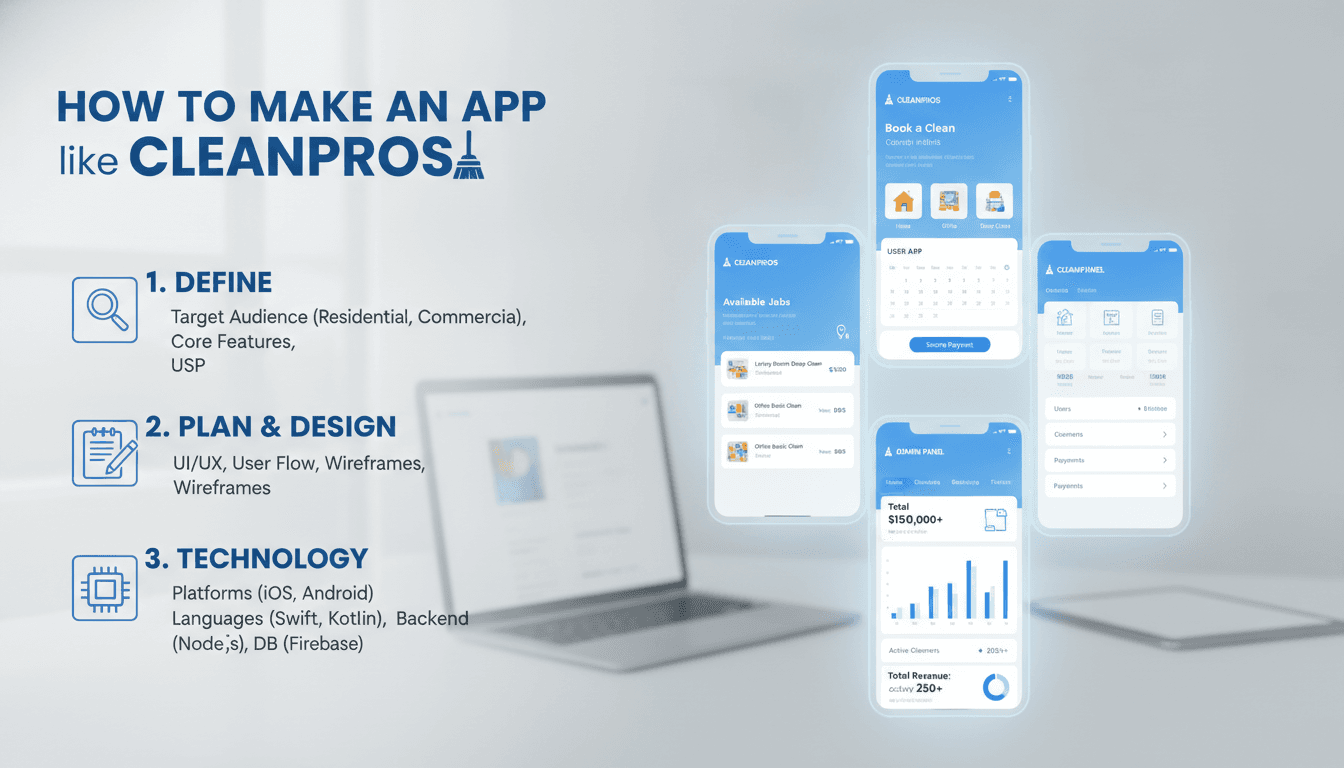
How to Make an App Like CleaningPros
The on-demand cleaning industry has quietly become one of the most reliable segments of the gig economy. While ride-hailing and food delivery grabbed the headlines, apps like CleaningPros built durable businesses by solving a genuinely painful problem: finding a trustworthy cleaner, at a time that works, without a dozen phone calls.
If you're considering building something similar, this guide walks through what the product actually needs to do, how to architect it, what it costs, and where most first-time builders get stuck.
Related reading: How to Make an App Like Handy.
What CleaningPros-Style Apps Actually Do
At a surface level, these platforms look simple — book a cleaner, they show up, you pay. Underneath, you're operating a three-sided system:
- Customers who need a space cleaned, with specific requirements and tight scheduling windows
- Cleaning professionals (individuals or small crews) who need steady, well-routed work
- Platform operations that handle vetting, pricing, dispute resolution, and quality control
Most failed attempts in this space underestimate the third group. The app is not the hard part — supply management is.
Core Feature Set
Customer-Facing Features
Onboarding and address management
Keep signup minimal: phone or social login, then collect address details as part of the first booking. Store multiple properties per account — many users book for a home and a rental or office.
Service configuration
Customers need to specify property size, number of bedrooms and bathrooms, service type (standard, deep clean, move-out, post-construction), and add-ons like interior windows, oven cleaning, or laundry. This configuration drives your pricing engine directly.
Transparent, instant pricing
Show a firm price before checkout. Hidden fees and "we'll confirm later" quotes are the single biggest cause of drop-off in this category.
Scheduling and recurrence
One-off bookings matter, but the business model lives on recurring plans — weekly, biweekly, monthly. Build recurrence as a first-class concept, not a bolt-on. Recurring customers should keep the same cleaner whenever possible.
Cleaner profiles and matching
Show ratings, jobs completed, background-check status, and specialties. Let customers favourite or block specific professionals.
Live tracking and status updates
"On the way," "arrived," "in progress," "completed" — with ETA and push notifications. Reduces support tickets dramatically.
Checklists and photo proof
Pre- and post-service photos protect both sides in disputes and give customers confidence when they're not home.
Payments and tipping
Saved cards, wallet support, tipping at completion, and automatic charging for recurring bookings. Authorise at booking, capture at completion.
Reviews and rebooking
Make rebooking the same cleaner a one-tap action from the review screen.
Professional-Facing Features
Verification workflow
Document upload, ID checks, background-check integration, insurance certificates, and skill tagging. Gate job access until verification completes.
Availability calendar
Recurring availability blocks plus one-off exceptions. This feeds your matching engine.
Job offers and acceptance
Push job offers with pay, location, duration, and requirements up front. Set acceptance windows so unclaimed jobs cascade to the next cleaner.
Navigation and route awareness
Deep-link to Google Maps or Apple Maps. If you support multiple jobs per day, show the day's route.
In-app checklist execution
Task-by-task completion with photo capture where required. This becomes your quality audit trail.
Earnings dashboard and payouts
Per-job breakdown, weekly totals, tips, and payout schedule. Ambiguity around pay is the fastest way to lose good cleaners.
Supplies and equipment tracking
Optional, but useful if you supply materials or reimburse costs.
Admin and Operations Panel
This is where the real work happens:
- Booking pipeline with manual intervention tools
- Supply and demand heatmaps by zone and time slot
- Dynamic pricing and surge configuration
- Cleaner performance scoring and automatic deactivation thresholds
- Dispute and refund workflows
- Promo codes, referral programmes, and subscription management
- Payout reconciliation and commission reporting
Technical Architecture
Recommended Stack
| Layer | Options |
|---|---|
| Mobile apps | Flutter or React Native for cross-platform; native Swift/Kotlin if you need deep hardware integration |
| Backend | Node.js (NestJS), Python (Django/FastAPI), or Go for high-throughput matching |
| Database | PostgreSQL with PostGIS for geospatial queries |
| Caching / queues | Redis for session and availability caching, RabbitMQ or SQS for job dispatch |
| Real-time | WebSockets or Firebase for live tracking and status |
| Payments | Stripe Connect or Adyen for MarketPay — essential for split payouts |
| Notifications | Firebase Cloud Messaging, Twilio for SMS fallback |
| Maps | Google Maps Platform or Mapbox |
| Infrastructure | AWS or GCP, containerised, with managed database services |
Why PostGIS Matters
Your most frequent expensive query is "which verified, available, well-rated cleaners are within X km of this address during this time window, and can they reach it given their existing bookings?" That's a geospatial query joined against availability and booking tables. Get this wrong and your matching becomes the bottleneck as you scale.
Related reading: How to Make an App Like Tidy.
Microservices vs Monolith
Start with a modular monolith. Split out services only when you feel real pain — typically the matching engine and notification service are the first candidates, since they have different scaling profiles from the rest of the system.
For a closer look at a related topic, read our guide on How to Make an App Like Helpling.
The Matching and Dispatch Engine
This is your competitive moat. A naive implementation offers jobs to the nearest available cleaner. A good implementation optimises for:
- Travel efficiency — cluster a cleaner's jobs geographically to reduce unpaid transit time
- Continuity — prioritise the cleaner who served this customer before
- Fairness — distribute high-value jobs so top performers don't hoard and newcomers don't starve
- Reliability — weight by historical acceptance and completion rates
- Fit — match specialties (pet-friendly, eco products, deep-clean certified) to requirements
Implement this as a scoring function, not a rules cascade. Score every eligible candidate, sort, then offer in waves. Log every decision so you can tune weights against real outcomes.
Pricing Logic
Cleaning pricing is more nuanced than per-hour billing:
- Base rate driven by property size and service type
- Add-on modifiers for specific tasks
- Duration estimation used both for pricing and for scheduling the cleaner's day
- Zone multipliers reflecting local labour costs
- Time multipliers for weekends, evenings, and holidays
- Subscription discounts for recurring commitments
- First-booking promotions with clear expiry terms
Build this as a configurable rules engine in the admin panel. You will change pricing constantly in your first year, and you don't want a deployment for every adjustment.
Trust and Safety
This category involves strangers entering homes. Trust is the product.
- Background checks via a third-party provider, re-run annually
- Identity verification with selfie-to-ID matching
- Liability insurance, either platform-provided or verified per cleaner
- In-app masked calling so phone numbers are never exposed
- SOS button and emergency contact flow for cleaners
- Photo-documented before/after states
- Clear damage-claim process with defined resolution timelines
- Two-way reviews, with moderation for retaliatory ratings
Development Roadmap and Cost
Phase 1 — MVP (10–14 weeks)
Customer app, cleaner app, basic admin, single city, manual dispatch fallback, instant pricing, card payments, one-off and weekly recurring bookings.
Typical cost: $45,000–$80,000
Phase 2 — Automation (8–12 weeks)
Automated matching engine, live tracking, checklists with photo proof, subscription management, referral programme, cleaner earnings dashboard.
Typical cost: $35,000–$60,000
Phase 3 — Scale (ongoing)
Multi-city and multi-currency, dynamic pricing, route optimisation, B2B and commercial accounts, demand forecasting, advanced analytics.
Typical cost: $50,000+ depending on scope
These ranges assume a competent offshore or nearshore team. Comparable work with a US or Western European agency typically runs two to three times higher.
Business Model Options
- Commission — 20–30% of booking value; the industry default
- Subscription for customers — monthly fee for discounted rates and priority booking
- Subscription for cleaners — flat fee for platform access with lower or zero commission
- Lead generation — charge per introduction rather than per booking
- Hybrid — lower commission plus optional paid visibility boosts for cleaners
Commission is easiest to launch with. Subscriptions produce far better retention and predictable revenue once you have density.
Mistakes to Avoid
Launching in too many cities at once. On-demand marketplaces need liquidity. One dense neighbourhood with reliable coverage beats five cities with thin supply.
Recruiting customers before supply. A booking you can't fill costs you that customer permanently. Build a cleaner roster first, then market to demand.
Underestimating operations. Even the best software needs humans handling no-shows, disputes, and edge cases. Budget for an ops team from day one.
Treating recurring bookings as an afterthought. The unit economics only work with repeat customers. If your data model can't cleanly represent a recurring series with per-instance exceptions, you'll be rewriting it within months.
Ignoring cleaner economics. If professionals can't earn meaningfully more than they would independently, they'll churn and take clients off-platform with them.
Getting Started
Begin with a tightly scoped MVP in one service area. Validate three things before spending on scale: that customers will pay your price point, that cleaners will accept your commission, and that repeat booking rates clear 40% within ninety days. If those hold, you have a business worth investing in properly.
The technology is well-understood and entirely buildable. The differentiator is operational discipline and how well your matching engine serves both sides of the marketplace.
Have a project in mind? Contact Sodio Technologies to discuss your requirements and explore the right technology solution for your business.
/// Work with us
Talk to the engineers who'd build it
You'll get a technical scope, timeline and cost estimate from the people doing the work, not an account manager. In-house team, no subcontracting, since 2016.