

How to Make an App Like Tidy
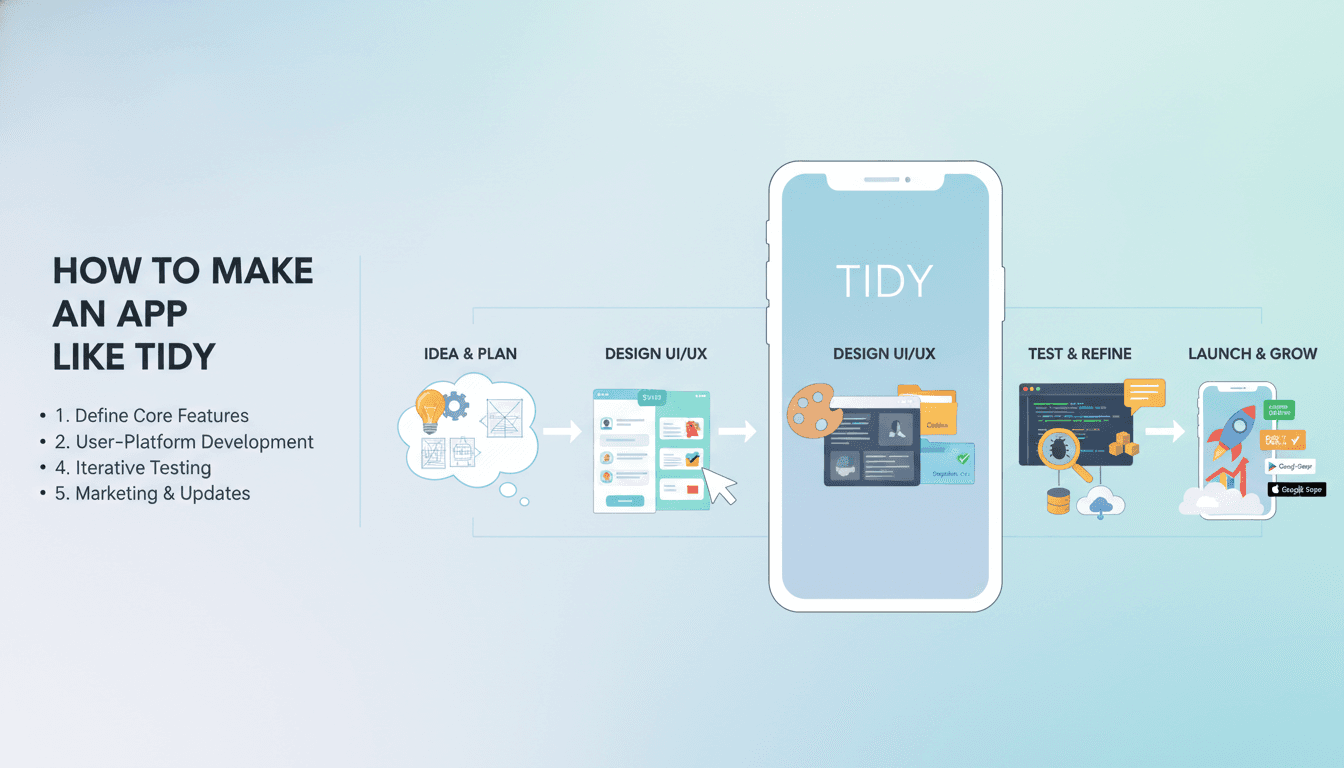
How to Make an App Like Tidy
The home services market has quietly become one of the most reliable digital business models of the last decade. People no longer want to call three cleaners, compare quotes over the phone, and hope someone shows up. They want to open an app, pick a time, and get on with their day. Tidy built a business on exactly that expectation — an on-demand cleaning and home maintenance platform that connects homeowners and property managers with vetted professionals, automates scheduling, and handles payment without anyone picking up the phone.
If you're planning to build something similar, this guide walks through what the product actually needs to do, how to architect it, what it costs, and where most teams get it wrong.
You may also find our article on How to Make an App Like CleaningPros useful.
What Tidy Actually Is (and Why It Works)
Tidy is a marketplace, but calling it "Uber for cleaning" undersells the mechanics. The platform succeeds because it solves three problems at once:
- For customers: transparent pricing, flexible scheduling, and consistency — the same pro can be requested again, and standards are documented.
- For cleaning professionals: a steady stream of jobs without marketing spend, plus tooling to manage their own schedule and rates.
- For property managers: automation at scale — turnovers triggered by booking calendars, checklists enforced by photo proof, and reporting across dozens of units.
That third audience is the quiet growth engine. Short-term rental hosts and property managers book far more frequently than individual homeowners, and they're much less price-sensitive when reliability is on the line.
Core Feature Set
Break the product into three connected applications: a customer app, a professional app, and an admin panel. They share a backend but have very different priorities.
For a closer look at a related topic, read our guide on How to Make an App Like Handy.
Customer App
Onboarding and property setup. Address, square footage, number of bedrooms and bathrooms, pets, parking instructions, entry method (lockbox code, smart lock, doorman). This data drives pricing and job duration estimates, so collect it once and reuse it forever.
Instant quoting. The user should see a price before they commit. Base your estimate on property attributes plus service type, then adjust for add-ons like inside-the-fridge, laundry, or window cleaning.
Scheduling. One-off bookings, recurring plans (weekly, biweekly, monthly), and same-day availability. Recurring bookings are the revenue backbone — build them properly from day one rather than bolting them on.
Pro matching and preferences. Let users favorite professionals, block ones they didn't click with, and request the same person for recurring jobs. This single feature does more for retention than almost anything else.
Job tracking. Confirmation, en-route notification, arrival check-in, live status, completion with photos.
Payments and tipping. Card on file, automatic charge on completion, optional tip, receipts, and subscription billing for recurring plans.
Customizable checklists. Users define what "clean" means for their home — a differentiator Tidy leans on heavily. Support per-room task lists with photo requirements.
Reviews and issue resolution. A structured flow for reporting problems, requesting a re-clean, or claiming damage. Don't route complaints into a generic support inbox.
Professional App
Application and vetting flow. Identity verification, background check integration, insurance documentation, and skills assessment. Nothing kills a marketplace faster than one bad actor and no paper trail.
Job marketplace. Available jobs filtered by distance, pay, and time window. Give pros the ability to set service areas, minimum rates, and blackout dates.
Calendar and route view. Pros working four jobs a day care deeply about travel time between them. Show jobs on a map with realistic gaps.
In-job workflow. Check in with geolocation, work through the checklist, upload before-and-after photos, mark tasks complete, check out.
Earnings dashboard. Per-job breakdown, weekly totals, tips, payout schedule, and downloadable tax summaries.
Ratings and standing. Transparent metrics on acceptance rate, on-time percentage, and customer scores — with clear consequences and paths to improve.
Admin Panel
Dispatch overrides, dispute resolution, pro onboarding review, dynamic pricing controls, fraud flags, promo code management, and analytics across supply and demand by geography. Build this earlier than feels necessary; operations teams will be living inside it.
Technical Architecture
Recommended Stack
Mobile: React Native or Flutter gives you two apps from one codebase, which matters when you're shipping both a customer and a pro app. If your job workflow relies heavily on background location and camera performance, budget for native modules.
Backend: Node.js with NestJS, or Python with Django, both work well. Structure it as modular services rather than one monolith — booking, matching, payments, notifications, and reviews all evolve at different speeds.
Database: PostgreSQL for transactional data (bookings, users, payments), Redis for caching availability and session state, and PostGIS for geospatial queries when matching pros to jobs by radius.
Real-time: WebSockets or Firebase for live job status, chat between customer and pro, and dispatch updates.
Third-party services:
- Stripe Connect for marketplace payments and pro payouts
- Checkr or Sterling for background checks
- Google Maps Platform or Mapbox for geocoding, routing, and ETAs
- Twilio for SMS and masked calling between parties
- AWS S3 or Cloudflare R2 for job photos
The Matching Engine
This is the hardest technical piece and the one that determines whether your unit economics work. A naive "notify everyone nearby" approach floods pros with irrelevant jobs and burns out your supply side.
A better model scores each available pro against a job using weighted factors:
- Distance from their previous or next scheduled job
- Historical rating and reliability score
- Whether the customer has favorited or blocked them
- Skill match for specialized services
- Current utilization — favor pros with gaps to fill
Offer the job to the top-scored pro with a short acceptance window, then cascade down. Cache availability aggressively; recomputing the full pool on every request will not scale.
Pricing Logic
Start with a transparent formula: base rate by property size, plus add-ons, plus adjustments for demand and travel. Surge pricing works in ride-hailing because trips are immediate — in home services, where bookings are made days in advance, aggressive surge feels like a bait-and-switch. Use gentler demand-based adjustment and show the breakdown.
If this is relevant to your project, check out How to Make an App Like Helpling.
Solving the Cold Start Problem
Every marketplace faces the same trap: customers won't book without available pros, and pros won't join without jobs. Practical ways through it:
Launch hyper-locally. One neighborhood, not one city. Density of supply within a small radius makes fulfillment reliable and travel times short.
Recruit supply first. Onboard 30 to 50 vetted pros in your launch zone before you spend a dollar on customer acquisition.
Guarantee early earnings. Pay pros for held availability during the first few weeks even if jobs don't fill. It's cheaper than losing them.
Target property managers early. A single short-term rental manager with 20 units generates more volume than 50 individual homeowners, and they'll tell you exactly what your product is missing.
Trust and Safety
This is a business where a stranger is alone in someone's home. Trust isn't a feature, it's the product.
- Mandatory background checks with periodic re-screening
- Identity verification with selfie match at onboarding
- Insurance coverage and a documented claims process
- Photo documentation as standard for every job
- Masked phone numbers so contact details are never exposed
- In-app emergency contact and incident reporting
- Clear, enforced policies for off-platform booking, which erodes marketplace value fast
Monetization
Commission. The default — take 20 to 30 percent of each job. Simple, scales with volume, but pros feel it every time.
Subscription for customers. Discounted rates and priority scheduling for a monthly fee. Improves retention and smooths revenue.
SaaS for pros. Charge cleaning businesses a monthly fee for scheduling, invoicing, and client management tools, with lower or zero commission. Tidy leans into this model, and it converts independent pros into long-term platform residents.
B2B accounts. Property management contracts with volume pricing and consolidated invoicing.
Add-on marketplace. Supplies, equipment, and specialty services with a margin.
Most mature platforms run a hybrid. Start with commission, layer subscriptions once you have retention data.
Development Timeline and Cost
A realistic MVP covering customer app, pro app, basic admin, payments, and matching:
| Phase | Duration | Scope |
|---|---|---|
| Discovery and design | 4–6 weeks | Research, user flows, UI design, technical spec |
| MVP build | 12–16 weeks | Both apps, core backend, admin basics |
| Testing and pilot | 4–6 weeks | QA, closed beta in one neighborhood |
| Launch and iterate | Ongoing | Scaling, feature expansion, second market |
Expect roughly $70,000 to $150,000 for a well-built MVP with a competent team, depending on region and scope. A full-featured platform with advanced routing, subscriptions, B2B tooling, and polished operations software runs $200,000 and up. Ongoing costs — infrastructure, background checks, payment processing, support — typically land at 15 to 25 percent of initial build cost annually.
Metrics That Matter
Vanity downloads mean nothing here. Track:
- Fill rate: percentage of booked jobs successfully matched to a pro
- Repeat booking rate: the clearest signal of product-market fit
- Recurring plan conversion: one-off to subscription
- Pro retention at 90 days: supply churn is expensive
- On-time arrival rate and completion rate
- Customer acquisition cost vs. lifetime value, segmented by consumer and property manager
- Take rate after refunds, re-cleans, and support cost
Common Mistakes
Launching in too many cities. Thin supply everywhere is worse than deep supply in one place.
Treating pros as interchangeable. Your best professionals drive the majority of repeat bookings. Build features that reward and retain them specifically.
Underinvesting in the admin panel. Operations will be manual for longer than you expect. Give your team good tools.
Ignoring the property manager segment. It's higher volume, more predictable, and less price-sensitive than consumers.
Racing to the bottom on price. Competing on price attracts customers who churn and pros who leave. Compete on reliability.
Getting Started
Validate before you build. Run a manual pilot in one neighborhood using spreadsheets, a booking form, and SMS coordination. You'll learn more about job duration, pricing accuracy, and pro behavior in six weeks of manual operation than in six months of planning — and that knowledge shapes a much better product.
Then build the MVP around what you learned, launch narrow, and expand only when your fill rate and repeat booking numbers say the model works. An app like Tidy isn't hard to build. Making the marketplace behind it liquid, reliable, and trustworthy is the real work.
Have a project in mind? Contact Sodio Technologies to discuss your requirements and explore the right technology solution for your business.
/// Work with us
Talk to the engineers who'd build it
You'll get a technical scope, timeline and cost estimate from the people doing the work, not an account manager. In-house team, no subcontracting, since 2016.