

How to Make an App Like Handy
How to Make an App Like Handy
The home services industry has quietly become one of the most lucrative segments of the on-demand economy. Handy (now part of Angi) proved that people will happily book a cleaner, a furniture assembler, or a handyman from their phone the same way they order dinner. If you're considering building something similar, this guide walks through the product thinking, feature set, technology decisions, and business realities of launching a home services marketplace.
Understanding What Handy Actually Is
Handy is a two-sided marketplace. On one side are customers who need a task done in their home — cleaning, TV mounting, plumbing, electrical work, furniture assembly. On the other side are vetted independent professionals who want a steady flow of paid jobs without spending money on advertising.
The app itself is essentially a matching and trust engine. It takes a vague human need ("my sink is leaking"), converts it into a structured, priced job, finds a qualified pro who is available and nearby, handles payment, and guarantees the outcome. Everything you build should serve one of those five functions.
If this is relevant to your project, check out How to Make an App Like Tidy.
This matters because many founders approach home services as a "booking app." It isn't. Booking is the easy part. Supply acquisition, quality control, and pricing accuracy are where these businesses are won or lost.
Validating Your Niche Before You Build
Handy launched broad, but most successful newer entrants start narrow. Consider focusing on:
- A single service vertical — cleaning only, or only appliance repair. Deeper expertise means better pricing models and easier pro recruitment.
- A single metro area — marketplaces are local businesses wearing a national costume. Liquidity in one city beats thin coverage in twenty.
- A specific customer segment — property managers, landlords, short-term rental hosts, or senior households have distinct, repeatable needs.
- A B2B angle — recurring commercial cleaning contracts have far better retention economics than one-off consumer jobs.
Spend time doing manual concierge testing first. Take bookings by phone or web form, dispatch pros yourself, and learn where the friction sits. You will discover pricing edge cases and quality issues that no amount of wireframing reveals.
Core Feature Set
Customer App
Onboarding and address setup Keep signup light — phone or social auth, then capture the service address early since it drives availability and pricing.
Service catalog and structured booking flow Rather than free-text requests, guide users through a decision tree: service type → property details (bedrooms, bathrooms, square footage) → add-ons (inside fridge, laundry, windows) → date and time. Each answer refines the quote and the required skill profile.
Transparent, instant pricing Handy's biggest early differentiator was showing a firm price before booking. That requires a pricing engine keyed on service type, job scope, duration estimates, zone-level labor rates, and demand multipliers.
Scheduling and recurrence Offer one-time, weekly, biweekly, and monthly cadences. Recurring plans are the single biggest driver of lifetime value in this category, so make them the default suggestion, not a hidden option.
Pro matching and profiles Show ratings, completed job counts, background check status, and specialties. Let customers request a favorite pro for repeat bookings.
In-app messaging and status tracking Masked calling, chat, and live ETA updates on job day. "Where is my pro?" is the highest-volume support question in every home services business.
Payments and tipping Card on file, wallet support, promo codes, and post-job tipping. Charge after job completion or authorize at booking and capture at completion.
Reviews, rebooking, and issue resolution A simple post-job flow: rate, tip, rebook, or report a problem. The problem path should route into a claims workflow tied to your service guarantee.
Professional App
Application and vetting pipeline Document upload, license and insurance verification, background check integration, skills assessment, and onboarding training modules.
Job feed and claiming Pros browse or receive offers for nearby jobs with pay, duration, distance, and scope clearly displayed. Auto-assign with opt-out is usually better than pure open marketplace once you have volume.
Calendar and availability management Recurring availability blocks, time-off, and service radius controls.
Navigation, check-in, and job execution GPS check-in and check-out, photo documentation before and after, scope-change requests, and add-on upselling.
Earnings and payouts Transparent per-job breakdowns, weekly or instant payouts, tax documentation, and performance metrics like acceptance rate and rating trends.
Admin and Operations Console
This is the piece founders consistently underinvest in. You need:
- Supply and demand dashboards by zone and time slot
- Manual dispatch override and job reassignment
- Pro quality management — ratings, warnings, deactivation
- Claims and refunds processing
- Pricing and promo configuration
- Fraud detection and dispute logs
- Cohort retention and unit economics reporting
Technology Architecture
Mobile Clients
For most teams, a cross-platform approach makes sense. React Native or Flutter lets you ship customer and pro apps for iOS and Android from one codebase, which matters when you're maintaining two distinct apps across two platforms. Go native (Swift/Kotlin) only if you have unusual background-location or hardware requirements.
Note that the pro app and customer app should be separate binaries. Their usage patterns, permissions, and update cadences are completely different.
To explore this further, see How to Make an App Like CleaningPros.
Backend
A microservices or at least modular-monolith approach serves well, with clear service boundaries around:
- Identity and authentication
- Service catalog and pricing
- Booking and scheduling
- Matching and dispatch
- Messaging and notifications
- Payments and payouts
- Reviews and trust
- Claims and support
Common stacks include Node.js with NestJS, Python with Django or FastAPI, or Go for dispatch-heavy services. PostgreSQL handles transactional data, Redis handles caching and geo queries, and a message broker like Kafka or RabbitMQ decouples dispatch and notification workflows.
You may also find our article on How to Make an App Like Helpling useful.
Matching and Dispatch
The dispatch engine is your competitive core. It should score candidate pros against a job using skill match, proximity, schedule fit, historical rating, acceptance reliability, and customer preference. Run it as an asynchronous job with staged offer rounds — offer to the best match, wait, then broaden the radius and relax constraints.
Third-Party Integrations
- Payments: Stripe Connect or Adyen for marketplace split payments and pro payouts
- Background checks: Checkr, Sterling, or a regional equivalent
- Maps and geocoding: Google Maps Platform or Mapbox
- Communications: Twilio for masked calls and SMS, Firebase or OneSignal for push
- Identity verification: Persona or Onfido
- Support: Zendesk or Intercom with deep-linking into job records
Design and User Experience Priorities
Home services users are often stressed, in a hurry, or dealing with something broken. Design for calm and clarity:
- Reduce the booking flow to under 90 seconds. Every additional screen costs conversion.
- Show price early and never surprise the user. Hidden fees are the number one review complaint in this category.
- Make trust visible. Background check badges, insurance coverage, satisfaction guarantees, and real photos of real pros.
- Design for the pro's context. They're using the app one-handed, outdoors, with gloves on, in poor signal. Big tap targets, offline tolerance, minimal typing.
- Handle the unhappy path gracefully. Cancellations, no-shows, and damage claims need first-class flows, not buried help articles.
Trust, Safety, and Compliance
You are sending strangers into people's homes. This is not a feature area you can defer.
- Background checks and identity verification for every pro, re-run periodically
- Liability insurance coverage and a clearly documented happiness guarantee
- Photo documentation on check-in and check-out
- In-app emergency contact and incident reporting
- Masked communications so personal numbers are never exposed
- Worker classification compliance — independent contractor rules vary sharply by jurisdiction and have generated significant litigation in this industry
- Data protection compliance (GDPR, CCPA) since you're storing home addresses, access codes, and payment data
Talk to an employment lawyer early. Handy itself faced multiple classification disputes, and the regulatory landscape has only gotten more complex.
Monetization Models
- Commission per job — the standard approach, typically 15–30% of job value
- Pro subscription — a monthly fee for lead access or reduced commission
- Customer membership — discounted rates and priority scheduling for a recurring fee
- Booking or trust-and-support fees — a flat per-transaction charge
- Product attachment — selling supplies, equipment, or extended warranties
- White-label or B2B contracts — recurring commercial accounts with negotiated rates
Most sustainable operators blend two or three. Pure commission models get squeezed as pros learn to take repeat customers off-platform, so build in reasons for both sides to stay.
Development Roadmap and Cost
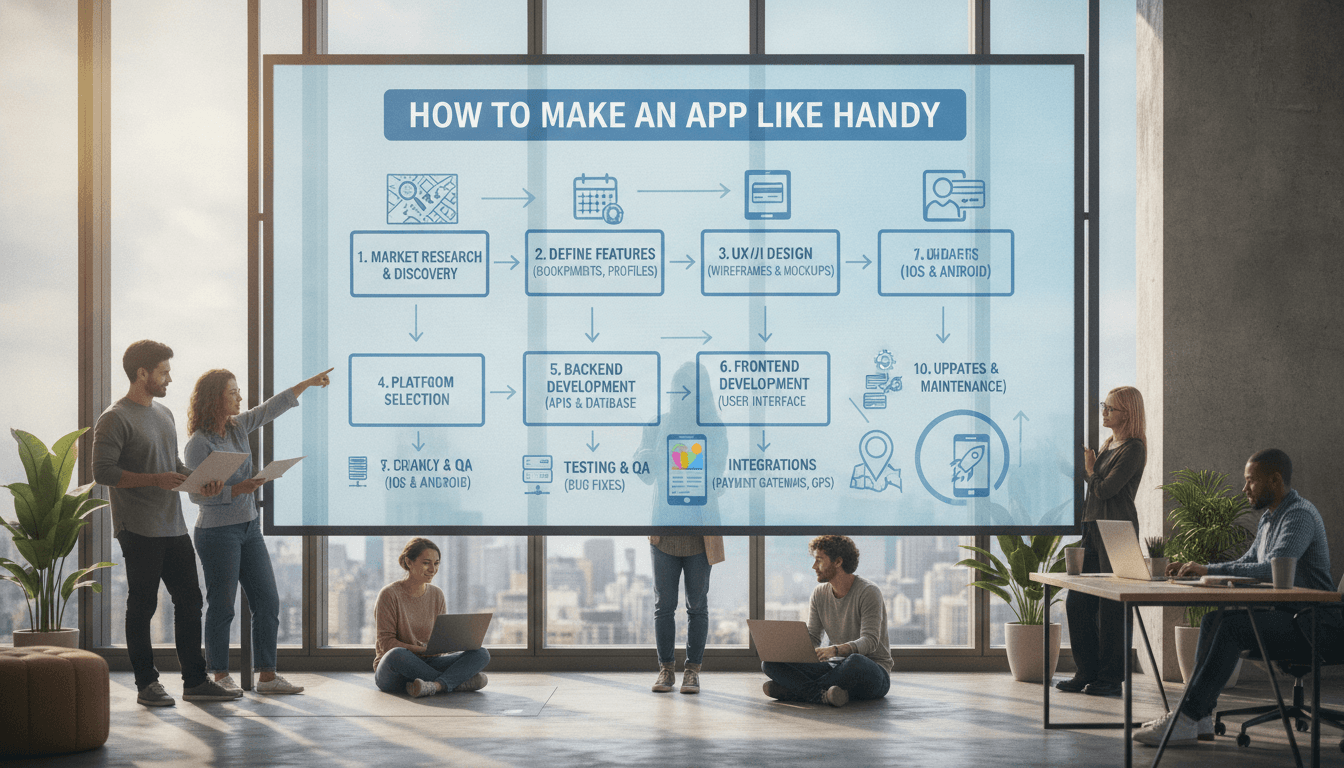
Phase 1 — Discovery and design (4–6 weeks) Market validation, service taxonomy, pricing model, user flows, and UI design.
Phase 2 — MVP build (12–20 weeks) One city, one to three services. Customer app, pro app, basic admin, payments, and manual dispatch with algorithmic assist.
Phase 3 — Launch and iterate (ongoing) Supply recruitment, liquidity tuning, retention experiments, and support process hardening.
Phase 4 — Scale Automated dispatch, dynamic pricing, recurring subscriptions, multi-city expansion, and ops automation.
A credible MVP with both apps and an admin console typically lands in the $60,000–$150,000 range depending on team location and scope. Full-featured platforms with sophisticated dispatch, dynamic pricing, and mature operations tooling run considerably higher. Budget at least 20–25% of build cost annually for maintenance, and remember that marketplace businesses spend far more on supply acquisition and customer acquisition than on engineering.
Common Mistakes to Avoid
Launching demand before supply. Nothing kills a marketplace faster than a customer booking a job no one accepts. Recruit pros first and over-index on supply density in a small area.
Over-engineering the algorithm too early. Manual dispatch works fine at low volume and teaches you the rules your algorithm will eventually encode.
Treating pros as interchangeable. Your best pros drive most of your five-star reviews and repeat bookings. Build retention features for them with the same care you build customer features.
Ignoring the unit economics of one-off jobs. Single bookings rarely pay back acquisition cost. Push recurring plans relentlessly.
Expanding cities too soon. Each new market restarts the liquidity problem. Prove profitability in one before spending on the second.
Final Thoughts
Building an app like Handy is genuinely achievable — the technology is well understood and the integrations are mature. The hard part is operational: recruiting reliable pros, pricing jobs accurately, guaranteeing quality in someone's home, and making the economics work on repeat business rather than one-off transactions.
Start narrow, instrument everything, and treat your professionals as your most important users. Build the software to support a real operating model, not the other way around, and you'll have a platform that can grow well beyond its first neighborhood.
Have a project in mind? Contact Sodio Technologies to discuss your requirements and explore the right technology solution for your business.
/// Work with us
Talk to the engineers who'd build it
You'll get a technical scope, timeline and cost estimate from the people doing the work, not an account manager. In-house team, no subcontracting, since 2016.