

How to Make an App Like Helpling
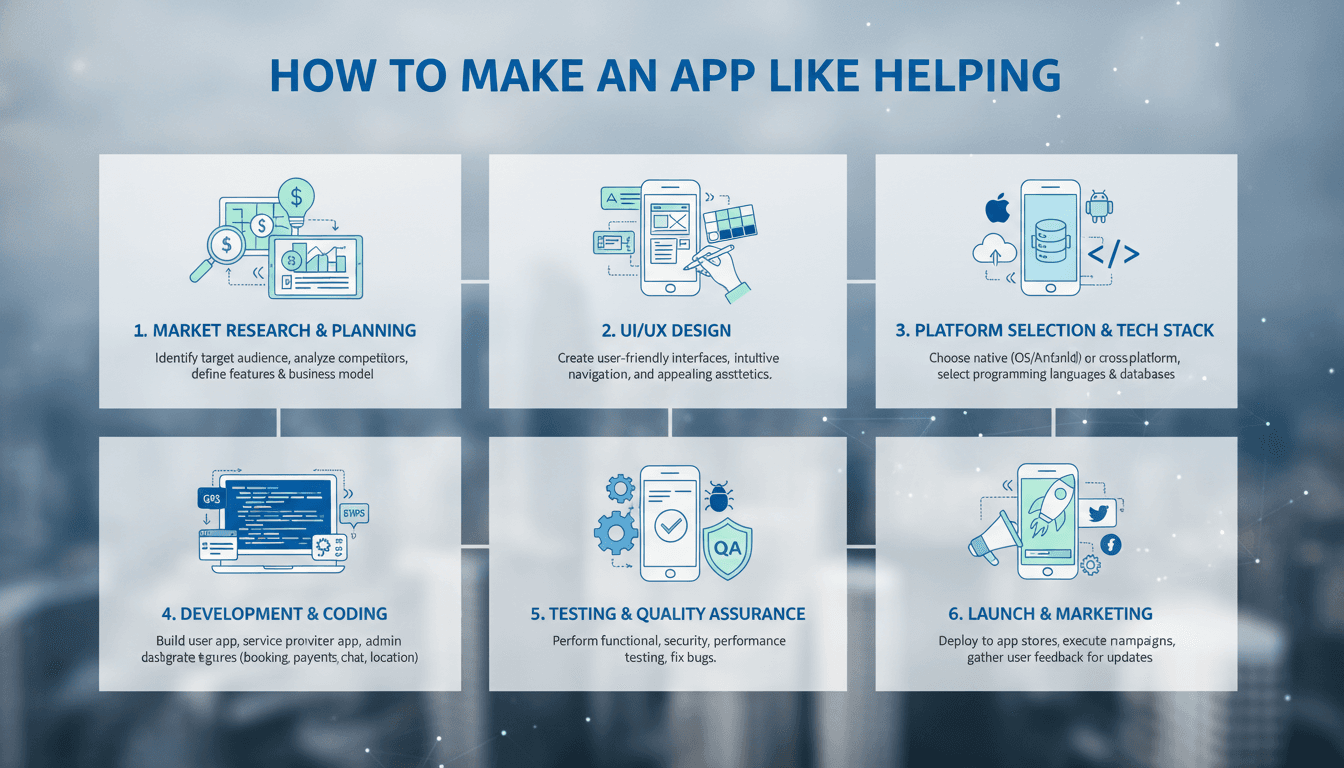
How to Make an App Like Helpling
The home services market has quietly become one of the most reliable digital businesses of the last decade. People who once flipped through classifieds to find a cleaner now open an app, pick a time slot, and pay before the doorbell rings. Helpling built a business on exactly that shift, connecting households across Europe with vetted cleaning professionals through a booking experience that feels closer to ordering a ride than hiring a contractor.
If you're planning to build something similar, the good news is that the model is proven. The harder truth is that the technology is only half the battle — supply, trust, and unit economics decide whether the app survives its first year. This guide walks through both sides.
If this is relevant to your project, check out How to Make an App Like Tidy.
What Helpling Actually Does
At its core, Helpling is a two-sided marketplace. Customers post a need (usually recurring home cleaning), and the platform matches them with independent cleaners in their area. Helpling handles discovery, scheduling, payments, insurance, and dispute resolution, then takes a commission on each booking.
We cover a closely related subject in How to Make an App Like Handy.
A few details make the model work:
- Recurring bookings. Weekly or biweekly cleaning creates predictable revenue and dramatically reduces customer acquisition cost over time.
- Vetted supply. Background checks and interviews keep quality consistent, which is the number one driver of retention in home services.
- Transparent pricing. Hourly rates are shown upfront, removing the negotiation friction that kills conversion.
- Insurance coverage. Liability protection makes customers comfortable letting a stranger into their home.
Understanding these mechanics matters because they shape nearly every product decision you'll make.
Pick Your Marketplace Model
Before writing a line of code, decide how your platform will match supply and demand.
Managed Marketplace
The platform assigns a professional to each booking based on availability, location, and rating. Customers don't browse profiles. This is Helpling's approach for recurring cleaning, and it's the simplest experience for users — but it puts the burden of good matching squarely on your algorithm.
Open Marketplace
Customers browse professional profiles, compare rates and reviews, and choose who to book. This gives users more control and suits services where the provider matters more (tutoring, specialized repairs), but it slows conversion.
Hybrid
Show a recommended match by default, with the option to browse alternatives. Most modern platforms land here.
Core Features to Build
Customer App
Onboarding and address setup. Keep it short. Phone or email signup, then location. Every extra field costs you signups.
Service selection and configuration. Let users specify home size, number of rooms, frequency, and add-ons like oven cleaning, laundry, or interior windows. This drives your pricing engine.
Instant pricing. Show a clear total before booking. Hidden fees at checkout are the fastest way to lose a first-time customer.
Scheduling. Calendar with real availability, recurring booking options, and easy rescheduling. Allow customers to set a preferred time window rather than an exact minute.
Professional profile view. Photo, rating, number of completed jobs, languages spoken, and a short bio. Even in a managed model, showing who's coming builds trust.
In-app messaging. Masked phone numbers or chat so customers and professionals can coordinate access details without exchanging personal contacts.
Payments and invoicing. Saved cards, automatic charging after service completion, downloadable invoices, and tipping.
Ratings and reviews. Prompt immediately after the job. Response rates drop off a cliff after a few hours.
Booking history and rebooking. One-tap rebooking of a favorite professional is a huge retention lever.
Professional App
Application and verification flow. Identity documents, work authorization, background check consent, and often an in-person or video interview. Build this as a status-driven pipeline so applicants always know where they stand.
Availability calendar. Professionals set recurring availability and block off time. This feeds directly into what customers can book.
Job offers and acceptance. Push notification with job details, pay, location, and travel time. A countdown timer keeps the queue moving.
Navigation and check-in/check-out. GPS-verified arrival and completion timestamps protect both sides in a dispute and support accurate hourly billing.
Earnings dashboard. Daily and weekly totals, payout schedule, and a breakdown of platform fees. Transparency here reduces churn among your best providers.
Support access. Providers face problems on-site — locked doors, missing supplies, unsafe conditions. Give them a fast escalation path.
Admin Panel
This is the piece most teams underbuild. You'll need:
- Provider vetting pipeline with document review
- Booking oversight, manual reassignment, and cancellation handling
- Dynamic pricing and promo code management
- Dispute and refund workflows
- Quality monitoring with automatic flags for low ratings or repeated no-shows
- City-level supply and demand dashboards
- Payout reconciliation
The Matching Engine
If you go with a managed model, matching is your product. A reasonable first version scores available professionals against each job using:
- Proximity — travel time, not straight-line distance
- Availability — full coverage of the requested window
- Rating and completion history — recent performance weighted heavier
- Continuity — strongly prefer the same professional for recurring bookings
- Workload balance — spread jobs so good providers don't burn out and new ones get a start
- Preference signals — language, pet-friendliness, equipment provided
Start with a weighted scoring function. You do not need machine learning on day one; you need enough booking data to know what actually predicts a five-star job. Once you have volume, you can train a model to predict cancellation risk and rating outcomes, then feed those predictions back into the score.
For a closer look at a related topic, read our guide on How to Make an App Like CleaningPros.
Pricing and Payments
Home services pricing is usually hourly, sometimes flat-rate per home size. Build a pricing engine that supports:
- Base hourly rate by city
- Duration estimates based on home size and rooms
- Add-on services with fixed or hourly pricing
- Surge or off-peak adjustments
- Subscription discounts for recurring bookings
- First-booking promotions and referral credits
On the payments side, use a provider that supports marketplace payouts — Stripe Connect, Adyen for Platforms, or a regional equivalent. Authorize the card at booking, capture after completion, and hold funds briefly to cover disputes. Handle VAT or sales tax correctly per jurisdiction, and generate compliant invoices automatically. In several European markets, household service payments qualify for tax deductions, and providing the right documentation is a genuine competitive advantage.
Trust and Safety
This is where home services apps live or die. A customer is handing over a house key.
- Identity verification for every professional, with periodic re-checks
- Background checks where legally permitted
- Liability insurance covering property damage during service
- Rating thresholds with automatic review or deactivation below a floor
- Key handling policy documented and enforced
- Incident reporting accessible from both apps with human follow-up
- Data protection — GDPR compliance if you operate in Europe, including addresses, access instructions, and payment data
Publish your safety standards prominently. It converts.
Tech Stack Recommendations
Mobile: React Native or Flutter for a shared codebase across iOS and Android. Both customer and professional apps can share a design system and much of the networking layer. Go native if you need deep background location tracking with aggressive battery optimization.
Backend: Node.js, Python, or Go. Start with a well-structured modular monolith rather than microservices — you'll move faster and split services later when scaling pressure is real.
Database: PostgreSQL with PostGIS for geospatial queries. Redis for caching availability and session data.
Real-time: WebSockets or a managed service for live job status, chat, and provider location.
Infrastructure: AWS or GCP, containerized, with CI/CD from day one.
Third-party services: Stripe or Adyen for payments, Twilio for masked calling and SMS, Firebase Cloud Messaging and APNs for push, Google Maps or Mapbox for geocoding and routing, Checkr or Onfido for background checks, and Segment plus Mixpanel or Amplitude for analytics.
Building an MVP
Resist the temptation to launch everywhere with every service. A focused MVP looks like this:
One city. One service. One booking type. Recurring home cleaning in a single metro area is enough to validate the model.
Manual matching. For your first few hundred bookings, have a human assign professionals. You'll learn more about what makes a good match in two weeks of doing it manually than in two months of designing an algorithm.
Lightweight admin tooling. Spreadsheets and an internal dashboard beat a polished back office you'll rebuild anyway.
Recruit supply first. Demand is easier to buy than supply. Have thirty to fifty vetted professionals ready before you spend a euro on customer acquisition. Nothing kills a marketplace faster than a customer who books and gets no one.
A realistic MVP timeline runs three to five months with a small team: two mobile developers, one or two backend developers, a designer, and a product owner who also does operations.
Solving the Cold Start Problem
Every marketplace faces it. Practical tactics:
Go hyper-local. Launch in a few postal codes, not a city. Density makes matching work and keeps travel times low.
Pay guarantees early. Offer professionals a minimum hourly guarantee for their first weeks so they don't abandon an empty platform.
Seed demand with offers. Discounted first cleans convert well, but tie them to a recurring plan so you're not buying one-off customers.
Partner with property managers. Apartment buildings, co-living operators, and short-term rental hosts deliver clustered, repeat demand.
Lean on referrals. Satisfied customers in a neighborhood are your cheapest acquisition channel, and professionals often recruit peers.
Unit Economics You Need to Watch
- Take rate — typically 15–30% of the booking value in this category
- Customer acquisition cost versus lifetime value, where LTV depends almost entirely on recurring booking retention
- Provider churn — replacing a professional is expensive once vetting and onboarding are counted
- Fill rate — the percentage of requested bookings you can actually staff
- Cancellation and no-show rates on both sides
- Repeat booking rate at 30, 60, and 90 days — the single best health indicator for this model
If recurring retention is strong, everything else is fixable. If it isn't, no amount of marketing spend saves the business.
Regulatory Considerations
Home services platforms sit in contested legal territory. Worker classification rules differ sharply between countries, and Helpling itself has faced court scrutiny over whether its cleaners are independent contractors or employees. Before launch:
- Get local legal advice on employment classification
- Understand minimum wage and social contribution obligations
- Confirm insurance requirements for both the platform and providers
- Check whether household service tax deductions apply and what documentation they require
- Plan for GDPR or equivalent data protection rules
Build your platform so the classification model is configurable by market. Hard-coding contractor assumptions into your payout and scheduling logic makes future pivots painful.
Ways to Differentiate
The cleaning marketplace is crowded. Consider:
- Vertical expansion into handyman work, gardening, pet care, or elderly assistance once cleaning density is established
- B2B offerings for small offices, clinics, and short-term rental operators — higher volume, lower acquisition cost
- Eco-friendly positioning with green supplies and carbon-neutral travel
- Better provider economics — a higher provider share is a real moat when supply is scarce
- Smart scheduling that learns household patterns and proactively suggests slots
- Property integrations with smart locks so access doesn't depend on key handoffs
Final Thoughts
Building an app like Helpling is an operations business wearing a software costume. The mobile apps, matching engine, and payment rails are all solvable engineering problems with well-trodden paths. The differentiator is how well you recruit, vet, and retain professionals, and how reliably you turn a booking into a genuinely good experience in someone's home.
Start narrow, do the unscalable things manually, and instrument everything. Once you know what a great job looks like in data, you can automate toward it — and that's when the platform starts to compound.
Have a project in mind? Contact Sodio Technologies to discuss your requirements and explore the right technology solution for your business.
/// Work with us
Talk to the engineers who'd build it
You'll get a technical scope, timeline and cost estimate from the people doing the work, not an account manager. In-house team, no subcontracting, since 2016.