

How to Make an App Like Cozi Family Organizer
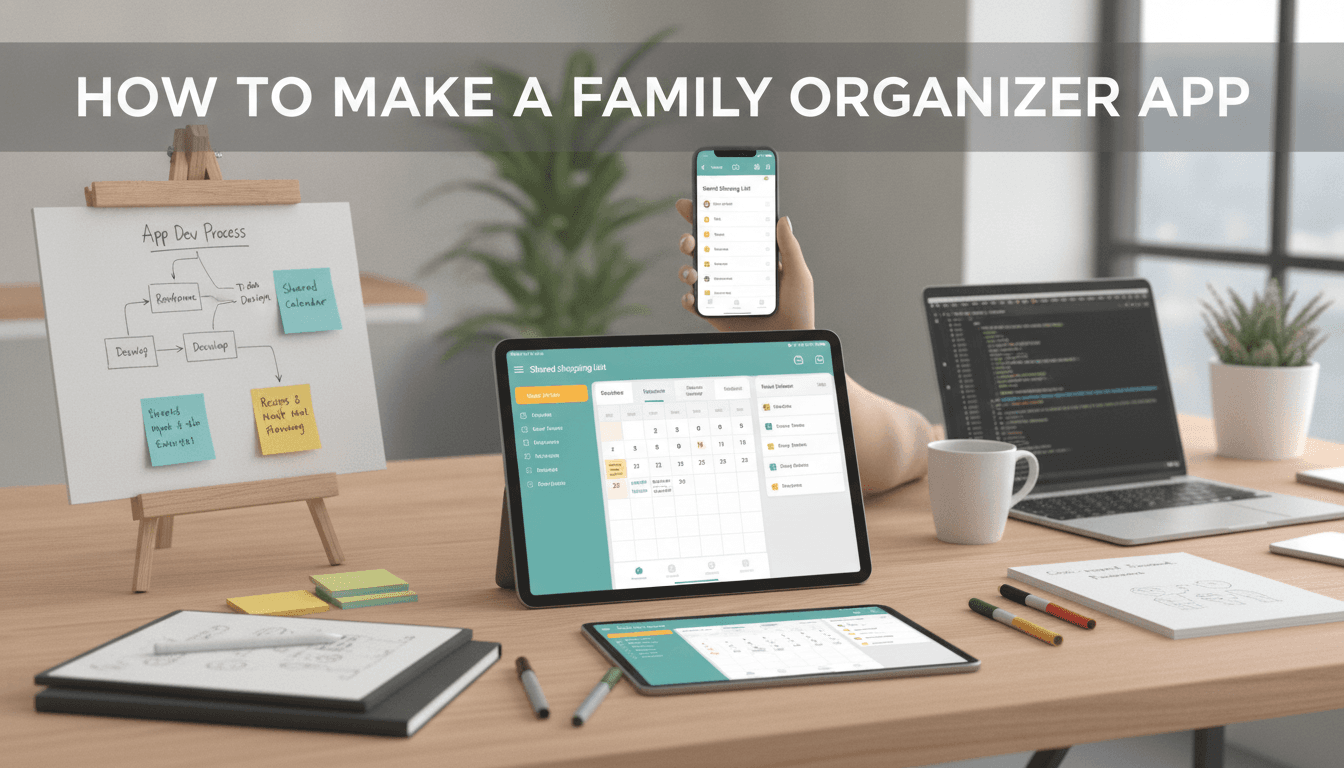
A practical breakdown of the architecture, features, and build decisions behind a family organiser app — from shared calendars and task lists to real-time sync and notification logic.
What Does a Family Organiser App Actually Need to Do?
The surface looks simple: a shared calendar, a grocery list, maybe some chore assignments. But the moment you add real-time sync across devices owned by different people, each with their own accounts, the complexity compounds quickly.
Cozi's core loop is: one family, multiple users, one shared data view. Every write from any member needs to propagate to every other member's device without conflicts, without delay, and without draining a phone battery. That's the engineering problem worth thinking about before you write a line of code.
The feature set breaks down into these primary surfaces:
- Shared family calendar with per-event ownership
- Shopping and to-do lists with simultaneous editing
- Meal planning and recipe storage
- Family journal or activity feed
- Push notifications tied to calendar events and list updates
- Role differentiation (organiser vs. member, adult vs. child)
Each of these has data model implications. Get the model wrong early and you'll refactor it three times.
What Tech Stack Should You Use?
There's no single right answer, but the decisions are easier once you frame them around your sync requirements.
Backend
A Node.js or Go service works well here. Go gives you better concurrency primitives if you expect high write throughput from large families or an enterprise version. Node is faster to iterate with if your team leans JavaScript.
For the database, the core tension is between relational and document stores. Family data has a natural hierarchy: Family > Members > Events/Lists/Items. PostgreSQL with JSONB columns handles this cleanly and still gives you full relational integrity for user accounts and permissions. MongoDB is a reasonable alternative if your team is more comfortable with it, though you'll need to manage referential integrity yourself.
Real-time sync is where most teams underestimate effort. WebSockets via Socket.io or a managed service like Firebase Realtime Database or Supabase Realtime are both viable. Firebase gets you to MVP faster. Supabase gives you a Postgres-backed alternative with row-level security, which maps well to the family permission model (a child account should not be able to see adult-only events).
If this is relevant to your project, check out How to Make an App Like Baby Tracker.
Mobile
React Native is the practical choice if you want one codebase for iOS and Android. Flutter is a strong alternative with better rendering consistency across platforms, though the Dart ecosystem is narrower. If your family app needs to feel native in animations and system integrations (widgets, Siri Shortcuts, live activities on iOS 16+), platform-specific code in Swift and Kotlin is worth the extra effort.
We cover a closely related subject in How to Make an App Like Kinedu.
Notifications
Push notifications in a family organiser carry more weight than in most apps. A reminder 15 minutes before a school pickup is load-bearing. Use APNs directly for iOS and FCM for Android, managed through a service like OneSignal or a custom implementation via Firebase Admin SDK. Build your notification scheduling logic server-side, not client-side. Clients go offline. Servers don't.
How Do You Handle Real-Time Sync Without Conflicts?
This is the hardest part of the build.
Shopping lists are the clearest example. Two people in the same house are editing the same list at the same time. One adds milk; the other removes eggs. If you handle this naively with last-write-wins, you'll drop data. Users will notice.
There are two serious approaches:
| Approach | How it works | Best for |
|---|---|---|
| Operational Transformation (OT) | Transforms concurrent edits to preserve intent | Collaborative text (Google Docs-style) |
| CRDTs | Data structures that merge automatically without coordination | Lists, counters, sets |
| Optimistic UI + server reconciliation | Client applies change immediately, server adjudicates | Simpler list structures |
For a shopping list, a CRDT-based approach (specifically a grow-only set or last-write-wins register per item) is the right fit. Libraries like Automerge or Yjs implement these and have good JS/TS bindings. For a calendar, optimistic UI with server reconciliation is usually sufficient because the conflict surface is smaller: two people rarely create an event at the exact same time for the exact same slot.
/// Not sure where to start?
Get the architecture before you commit
Tell us what you're building and we'll map the technical approach, stack, and rough timeline. No cost, no obligation, no sales call required.
Building the Permission Model for Families
A family is not a flat user group. There's typically one or two organisers (parents) and several members with varying permissions (children, co-parents, extended family). Your permission model needs to encode this from day one.
A workable structure:
family_idas the root entity, with its own settings and subscription statefamily_memberstable with arolefield:admin,member,viewer- Event and list records carry a
visibilityfield:family,adults_only,private - A child account with
memberrole cannot queryadults_onlyorprivaterecords
Row-level security in PostgreSQL makes this enforceable at the database layer, not just the application layer. That matters if you ever expose a direct API or add new surfaces later.
Age verification for child accounts is a compliance consideration if you're targeting US users. COPPA applies to children under 13 and has specific requirements around parental consent and data collection. If you're building for a UK or EU audience, check GDPR's requirements for children's data under Article 8.
Monetisation and Subscription Logic
Cozi runs a freemium model with a premium tier called Cozi Gold. The free tier is ad-supported. The paid tier removes ads and adds features like recipe organisation and priority support.
If you're replicating this, you need to decide early whether your subscription is processed through Apple/Google IAP or through your own billing provider like Stripe. IAP is mandatory if the purchase is made inside the app on iOS or Android. Stripe makes sense for web signups or B2B family plans. Running both adds complexity in entitlement sync: you need a single source of truth for subscription status that both paths write to.
Related reading: How to Make an App Like Glow Baby.
RevenueCat abstracts this well. It handles IAP receipts from both platforms, writes to a unified entitlements API, and has SDKs for React Native and Flutter. The trade-off is a cut of revenue and a dependency on a third-party service.
Conclusion
The architecture for a family organiser is tractable, but the details that matter most (real-time sync, permission modelling, notification reliability) are also the ones most likely to be underspecified in early planning. Start with a solid data model, choose your sync strategy before you choose your frontend framework, and build notification scheduling server-side from day one.
If you're evaluating whether to build this in-house or bring in a team that's worked through these decisions before, the honest answer is: the frontend is the easy part. The sync layer and permission model are where time goes.
Sodio has built systems with similar requirements across consumer and enterprise contexts. If you want to talk through your specific architecture before committing to a direction, reach out directly.
FAQ
How long does it take to build an app like Cozi? A production-ready MVP with shared calendar, shopping lists, push notifications, and basic user roles typically takes 4 to 6 months with a team of 3 to 4 engineers. Full feature parity with Cozi, including meal planning, a journal, and a premium tier, adds another 2 to 4 months depending on team size and scope changes.
How much does it cost to build a family organiser app? Costs vary significantly by region and team structure. A dedicated team of a backend engineer, two mobile engineers, and a designer in a market like India typically runs between $40,000 and $80,000 for an MVP. UK or US rates push that to $150,000 to $300,000 for the same scope.
Is Firebase good enough for real-time sync in a family app? Firebase Realtime Database or Firestore works well at moderate scale and gets you to a working real-time sync faster than building from scratch. The trade-off is vendor lock-in and limited query flexibility. For most family app use cases it is a reasonable choice; for complex querying or strict data residency requirements, consider Supabase or a custom WebSocket layer.
What are the main technical risks in this kind of build? Offline support and conflict resolution are the most common sources of rework. Teams often build assuming users are always online, then discover that list edits made offline need to merge cleanly when the device reconnects. Designing for offline from the start, even with a simple queue-and-replay model, avoids painful refactoring later.
Do you need separate apps for iOS and Android? Not necessarily. React Native and Flutter both produce high-quality cross-platform apps from a single codebase. The cases where you genuinely need platform-specific builds are narrow: deep integration with iOS-specific features like Live Activities, WidgetKit, or Siri Shortcuts, or Android-specific integrations like TaskStackBuilder or adaptive icons with complex behaviour.
Have a project in mind? Contact Sodio Technologies to discuss your requirements and explore the right technology solution for your business.
/// Work with us
Talk to the engineers who'd build it
You'll get a technical scope, timeline and cost estimate from the people doing the work, not an account manager. In-house team, no subcontracting, since 2016.