

How to Make an App Like Glow Baby
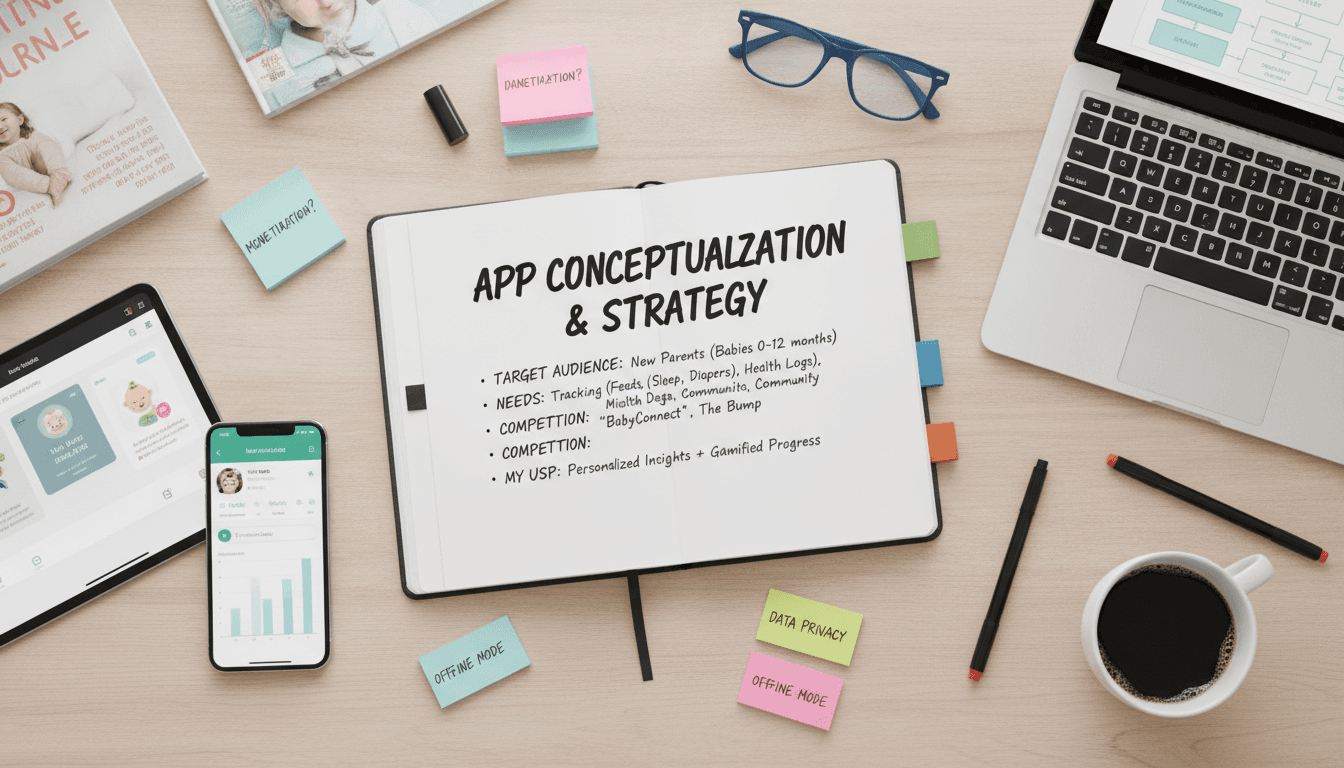
A practical breakdown of the architecture, feature set, and cost drivers behind building a baby tracking app — from data modelling to cross-platform delivery.
What Does Glow Baby Actually Do Under the Hood?
Glow Baby is a baby tracking app that lets parents log feeds, sleep, nappy changes, growth measurements, and developmental milestones. It also surfaces pattern analytics, supports multiple caregivers on a single profile, and syncs data across devices in real time. On the surface it looks simple. Under the hood, it has a few genuinely tricky problems.
Related reading: How to Make an App Like Baby Tracker.
The trickiest one is concurrent multi-caregiver writes. Two parents logging the same feed from different phones at the same time should not create duplicate records. That requires conflict resolution at the data layer, not just at the UI. Most teams underestimate this until they're deep in QA.
The second hard problem is time-series analytics over irregular event data. Feeds don't happen at fixed intervals. Sleep sessions overlap with wake windows in ways that depend on the baby's age. Generating a useful chart from that requires a proper event model, not a flat table of rows.
Core Feature Set and What Each One Costs You
Before writing a line of code, map features to engineering effort. Here's an honest breakdown:
| Feature | Complexity | Key decisions |
|---|---|---|
| Event logging (feed, sleep, nappy) | Low | Data model, offline-first or not |
| Multi-caregiver sync | High | Conflict resolution strategy |
| Push notifications (reminders) | Medium | FCM + APNs, notification scheduling |
| Growth charts | Medium | WHO growth standard data, chart rendering |
| Pattern analytics | High | Event aggregation, time-zone handling |
| Milestone tracking | Low–Medium | Structured content vs. user-defined |
| Paediatrician export (PDF) | Medium | Layout engine, data formatting |
| Subscription / paywall | Medium | RevenueCat or custom billing |
Pattern analytics and multi-caregiver sync together account for roughly 40% of total backend engineering effort on apps like this. If your roadmap has both, plan accordingly.
Related reading: How to Make an App Like The Bump.
Data Model First
Use an event-sourcing pattern rather than a mutable state table. Each log entry is an immutable event: {event_type, occurred_at, caregiver_id, baby_id, payload}. You never update or delete events; you append corrections as new events. This makes the audit trail trivial and simplifies sync.
For the database, PostgreSQL with a JSONB column for the payload works well at early scale. If you're expecting millions of events per baby per year across a large user base, consider TimescaleDB, which extends PostgreSQL with automatic time-series partitioning and compression.
Multi-Caregiver Sync
Operational Transformation and CRDTs (Conflict-free Replicated Data Types) are both valid approaches. For event-log data (append-only), CRDTs are simpler. Each event gets a UUID generated on the client. The server deduplicates by UUID. Last-write-wins works for mutable profile fields like weight. For event streams it's irrelevant because you never overwrite.
For a closer look at a related topic, read our guide on How to Make an App Like Cozi Family Organizer.
Real-time sync is most commonly handled with WebSockets or Firebase Realtime Database. Firebase is faster to ship but harder to migrate off. A WebSocket layer over your own PostgreSQL backend gives you more control and lower long-term cost at the expense of more setup work.
/// Not sure where to start?
Get the architecture before you commit
Tell us what you're building and we'll map the technical approach, stack, and rough timeline. No cost, no obligation, no sales call required.
What Stack Should You Build On?
For a consumer baby tracking app targeting iOS and Android simultaneously, React Native and Flutter are the two serious options. Here's the honest comparison:
| Dimension | React Native (0.73+) | Flutter (3.x) |
|---|---|---|
| UI fidelity | Native components, platform feel | Custom renderer, pixel-perfect but not platform-native |
| Performance | Good; JS bridge is a known bottleneck in heavy animation | Generally faster for animation-heavy UIs |
| Ecosystem | Larger; more third-party libraries | Growing fast, fewer mature libraries |
| Team availability | Easier to hire | Harder to hire outside major markets |
| Chart rendering | Victory Native, Recharts (web parity) | fl_chart, syncfusion_flutter_charts |
For Glow Baby-style apps, the UI is not animation-heavy. The bottleneck is data, not rendering. React Native is the pragmatic pick if your team already knows JavaScript. Flutter is worth the investment if you want a single codebase that also targets web cleanly.
Backend language is less critical than backend architecture. Node.js with Express or Fastify, Python with FastAPI, or Go with Gin all work. Pick what your team is fastest in. The architecture decisions (event sourcing, real-time sync, notification scheduling) matter far more than the language.
Offline-First Is Non-Negotiable
Parents log feeds at 3 AM in poor signal. If your app requires a network connection to save an event, you will get one-star reviews about lost data. Use a local SQLite store (WatermelonDB for React Native, Drift for Flutter) as the source of truth on device. Sync to the server when connectivity is available. Design the conflict resolution to handle gaps of hours, not seconds.
How Long Does It Take to Build, and What Does It Cost?
A realistic MVP, meaning event logging, single-caregiver, push notifications, and basic charts, takes a team of two engineers and one designer roughly 14 to 18 weeks. That assumes no scope creep and a well-defined spec before development starts.
Adding multi-caregiver sync, pattern analytics, and a subscription paywall pushes the timeline to 28 to 36 weeks for the same team size. These are not features you can stub out and add later cleanly; the data model needs to account for them from week one.
Cost ranges vary widely by geography and seniority. At Sodio's typical engagement size, a full-featured baby tracking app with both iOS and Android delivery, backend, and admin dashboard sits in the $80,000 to $150,000 range depending on the analytics depth and third-party integrations required.
Regulatory Considerations
If you plan to include any health-related features, even growth percentile charts, check whether HIPAA applies to your user base (US) or GDPR Article 9 applies (EU). Health data on minors is sensitive data under both regimes. Design your data storage and consent flows accordingly from the start. Retrofitting compliance is expensive.
Conclusion
The engineering of a baby tracking app is not exotic, but it has a few specific hard problems that catch teams off guard: multi-caregiver sync, time-series event modelling, and offline-first data handling. Get those three right in the design phase and the rest follows predictably.
If you're scoping a build and want a technical review of your architecture before you commit to a stack, that's a conversation worth having early. Reach out to the Sodio team with your requirements and we'll give you an honest read on timeline and trade-offs.
FAQ
How long does it take to build an app like Glow Baby? An MVP with core logging, push notifications, and basic analytics takes 14 to 18 weeks for a two-engineer team. A full-featured version with multi-caregiver sync, pattern analytics, and a subscription paywall typically takes 28 to 36 weeks. Timeline depends heavily on how well the spec is defined before development starts.
Should I build a baby tracking app in React Native or Flutter? For a data-driven app where the UI is not animation-heavy, both work well. React Native has a larger hiring pool and more mature third-party libraries. Flutter gives better cross-platform UI consistency and cleaner web targets. If your team already knows JavaScript, React Native is the faster path to market.
How do I handle two parents logging the same event simultaneously? Assign a client-generated UUID to every event at the point of creation. The server deduplicates on UUID. Because event logs are append-only, true conflicts are rare. Last-write-wins handles mutable fields like profile data. This approach is simpler than Operational Transformation and sufficient for this use case.
Is a baby tracking app subject to HIPAA or GDPR? Potentially yes. Growth charts and health logs involving minors are sensitive data under GDPR Article 9. HIPAA applies if you are a covered entity or business associate under US law, which most consumer apps are not, but the definition has nuance. Get a legal review before launching in the US or EU with health-adjacent features.
What database should I use for event logging in a baby tracking app? PostgreSQL with a JSONB payload column is a solid default. It handles early scale, supports complex queries, and is well-understood. If you expect high event volumes across a large user base, TimescaleDB adds time-series partitioning and compression on top of PostgreSQL without a full infrastructure change.
Have a project in mind? Contact Sodio Technologies to discuss your requirements and explore the right technology solution for your business.
/// Work with us
Talk to the engineers who'd build it
You'll get a technical scope, timeline and cost estimate from the people doing the work, not an account manager. In-house team, no subcontracting, since 2016.