

How to Make an App Like Fabulous
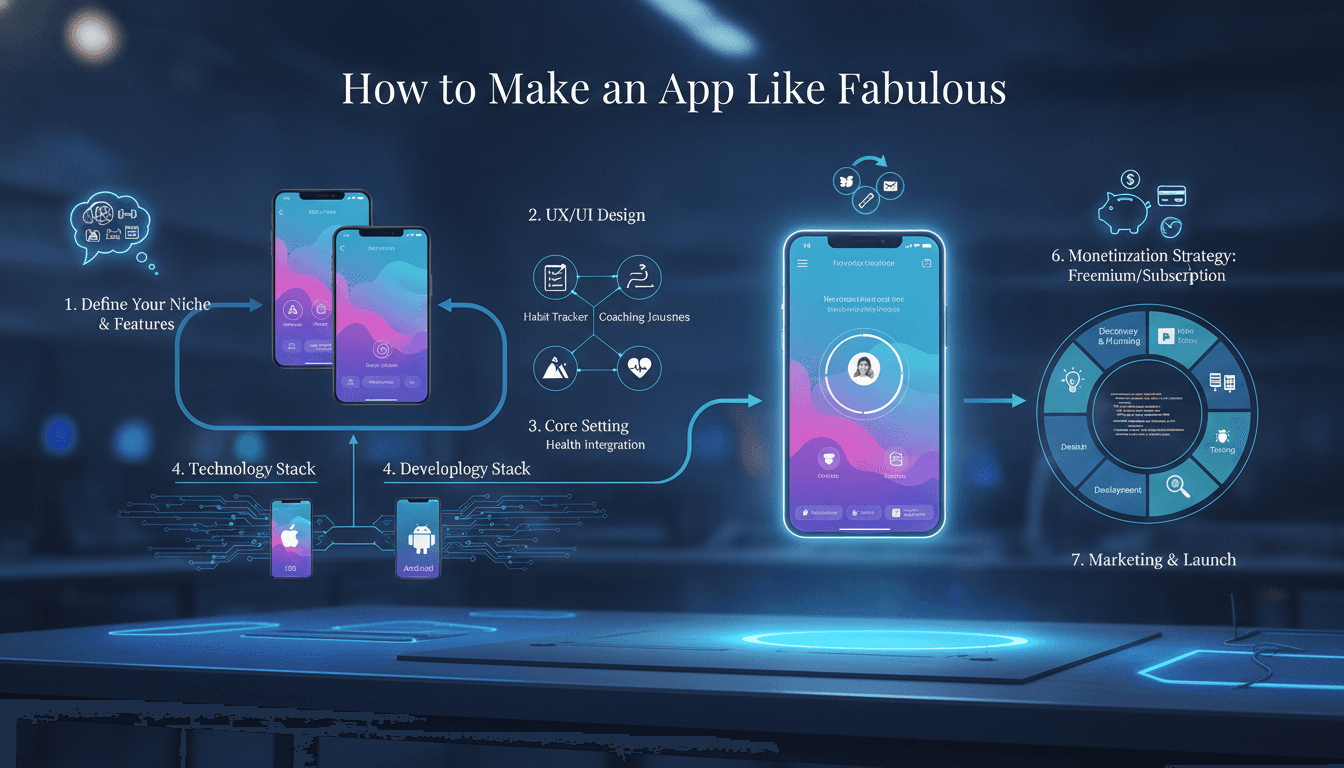
Building a habit-coaching app with the depth of Fabulous means solving a genuinely hard product engineering problem: behaviour change at scale, with personalisation that feels real rather than template-driven. Here is how the system actually comes together.
What Makes Fabulous Technically Different From a Simple Habit Tracker?
Most habit trackers are glorified checklists with push notifications. Fabulous is not that. It uses a structured behaviour change framework loosely derived from BJ Fogg's Tiny Habits methodology and implements it through a sequence engine, not a static feature list.
The core technical difference is that the app's content is dynamic and stateful. Your journey through the app depends on prior completions, self-reported mood inputs, and streak data. That means the backend is doing continuous state evaluation per user, not just serving static screens.
The other distinction is the audio-visual production layer. Fabulous invested heavily in guided sessions delivered as timed audio with synced UI animations. If you're replicating the product category, you need a content pipeline, not just a dev pipeline.
The Core Feature Set You Actually Need to Build
Before the architecture conversation, be clear about scope. A working v1 in this category needs:
- A routine builder with flexible scheduling (time-of-day anchoring, not just daily reminders)
- A journey or challenge system with unlockable steps gated on prior completions
- Push notification orchestration with intelligent timing (not batch sends)
- In-app guided sessions (audio + animated UI)
- Streak and progress tracking with recovery mechanics
- A subscription paywall, typically implemented as a free trial with auto-renewing subscriptions via Apple StoreKit 2 and Google Play Billing Library 6
Optional but high-retention: social accountability features, coach content delivered on a schedule, and adaptive difficulty.
What Tech Stack Should You Use?
The right stack depends on your team, timeline, and target platform mix.
| Layer | Options | Trade-off |
|---|---|---|
| Mobile | Flutter 3.x | Single codebase, good animation performance, smaller talent pool |
| Mobile | React Native (New Architecture) | Larger talent pool, JS thread limitations for heavy animations |
| Mobile | Swift + Kotlin (native) | Best performance, 2x build effort |
| Backend | Node.js / Go on Cloud Run | Fast to scale, stateless services easy to reason about |
| Backend | Django REST + Celery | Good if your team is Python-heavy; async task handling is mature |
| Database | PostgreSQL + Redis | PostgreSQL for user/content data, Redis for session state and notification queues |
| Notifications | Firebase Cloud Messaging + APNs | Standard; pair with a scheduling layer you build yourself |
| Content | CMS (Contentful or Sanity) | Separates content ops from deployments |
| Subscriptions | RevenueCat SDK | Abstracts StoreKit 2 and Play Billing; worth the fee |
For most teams building this for the first time, Flutter plus a Go or Node backend on GCP or AWS is the path with the fewest surprises.
The Notification Architecture Is Where Most Teams Get It Wrong
Batch-sending push notifications at the same time every day tanks your delivery quality and open rates. Fabulous-style apps need per-user scheduled notifications based on the user's configured routine times.
The architecture for this: each user's scheduled reminders are stored as jobs in a queue (BullMQ on Redis or Google Cloud Tasks). When a user updates their routine, you cancel existing jobs and enqueue new ones. At trigger time, the job resolves the current notification payload from the CMS, then dispatches via FCM or APNs.
This is stateful scheduling, not a cron job. Get it right early, because migrating notification infrastructure after you have 100,000 users is painful.
How Do You Build the Personalisation Engine?
Fabulous's personalisation is not ML-driven at the level most people assume. At its core, it is rule-based routing with user state as the input. The "science" is embedded in the content design and the sequencing logic, not in a model making predictions.
A practical v1 implementation:
- Define a graph of content nodes (challenges, sessions, tips) with prerequisite conditions
- Store each user's completed node IDs and relevant attributes (streak count, self-reported energy, days since install)
- At session start, evaluate which nodes are eligible based on the graph and user state
- Serve the highest-priority eligible node
If you want to graduate to ML-based recommendations later, you can replace step 4 with a collaborative filtering model or a contextual bandit. But most teams over-engineer this on day one. A well-designed content graph gets you further than a poorly-trained model.
/// Not sure where to start?
Get the architecture before you commit
Tell us what you're building and we'll map the technical approach, stack, and rough timeline. No cost, no obligation, no sales call required.
Subscription and Monetisation Architecture
Fabulous operates on a freemium subscription model. Free users get limited journeys; premium unlocks everything. The implementation via RevenueCat takes most of the pain away: it normalises entitlements across platforms and handles receipt validation.
What RevenueCat does not handle is your access control logic. That lives in your backend. On every authenticated request, your API checks the user's entitlement status (cached in Redis, refreshed via RevenueCat webhooks). Never trust the client alone for entitlement checks.
Pricing experiments (annual vs. monthly vs. lifetime) are worth running from week one. The standard pattern in this category is: 7-day free trial, then an annual plan at roughly USD 50–80, with a monthly fallback at USD 10–15.
What Does the Content Production Pipeline Look Like?
This is the part engineering teams routinely underestimate. The app's behavioural content, audio sessions, and illustrations need to ship independently of app releases. If your content team has to file a Jira ticket to publish a new meditation session, you've already built the wrong thing.
A workable pipeline:
- Content lives in a headless CMS (Sanity works well here because its structured content model maps cleanly to typed API responses)
- Audio assets go to S3 or GCS with CloudFront/Cloud CDN in front
- The mobile app caches content aggressively using a version hash; on launch it checks for updates and downloads deltas
- The content graph (which sessions unlock what) is also CMS-driven, not hardcoded
This means content editors can add a new 30-day challenge without a developer involved. That operational independence is what keeps a product like this alive post-launch.
Conclusion
The engineering work here is not exotic. It is careful state management, solid notification infrastructure, a clean content delivery layer, and subscription handling you do not rush. The teams that struggle are the ones that treat this as a simple CRUD app and hit the wall when personalisation, offline behaviour, and notification reliability all need to work together under load.
If you are planning to build in this space and want a second opinion on your architecture before you commit to a stack, Sodio has built systems in this category and can review what you have in a focused session.
FAQ
How long does it take to build an app like Fabulous? A production-ready v1 with core features (routine builder, guided sessions, push notifications, and a subscription paywall) typically takes 6 to 9 months with a team of four to six engineers. A stripped-down MVP scoped to a single platform can be done in 3 to 4 months, but expect significant rework when you add the second platform.
How much does it cost to build a habit app like Fabulous? Costs vary by geography and team structure. A dedicated team in India typically runs USD 80,000 to 180,000 for a full v1. A team in Western Europe or North America for the same scope would be USD 300,000 to 600,000. The variance is almost entirely in labour rates, not architectural decisions.
Is Flutter a good choice for this type of app? Flutter 3.x handles the animation-heavy UI that habit apps need reasonably well. The Impeller rendering engine, default on iOS from Flutter 3.10 and on Android from 3.16, removes most of the jank issues the framework had historically. The main risk is the smaller pool of experienced Flutter engineers compared to React Native.
Do you need machine learning for personalisation? No, not in v1. A rule-based content graph with user state evaluation delivers good personalisation for the first few hundred thousand users. ML becomes worth the investment when you have enough behavioural data to train on, typically north of 50,000 active users generating consistent session data.
What is the biggest technical mistake teams make when building apps in this category? Underbuilding the notification system. Most teams implement a simple scheduled push notification and discover too late that per-user timing, delivery reliability across iOS battery optimisation rules, and re-engagement logic need a proper job queue architecture. Retrofitting that after launch is expensive and disruptive to existing users.
Have a project in mind? Contact Sodio Technologies to discuss your requirements and explore the right technology solution for your business.
/// Work with us
Talk to the engineers who'd build it
You'll get a technical scope, timeline and cost estimate from the people doing the work, not an account manager. In-house team, no subcontracting, since 2016.