

How to Make an App Like Noom
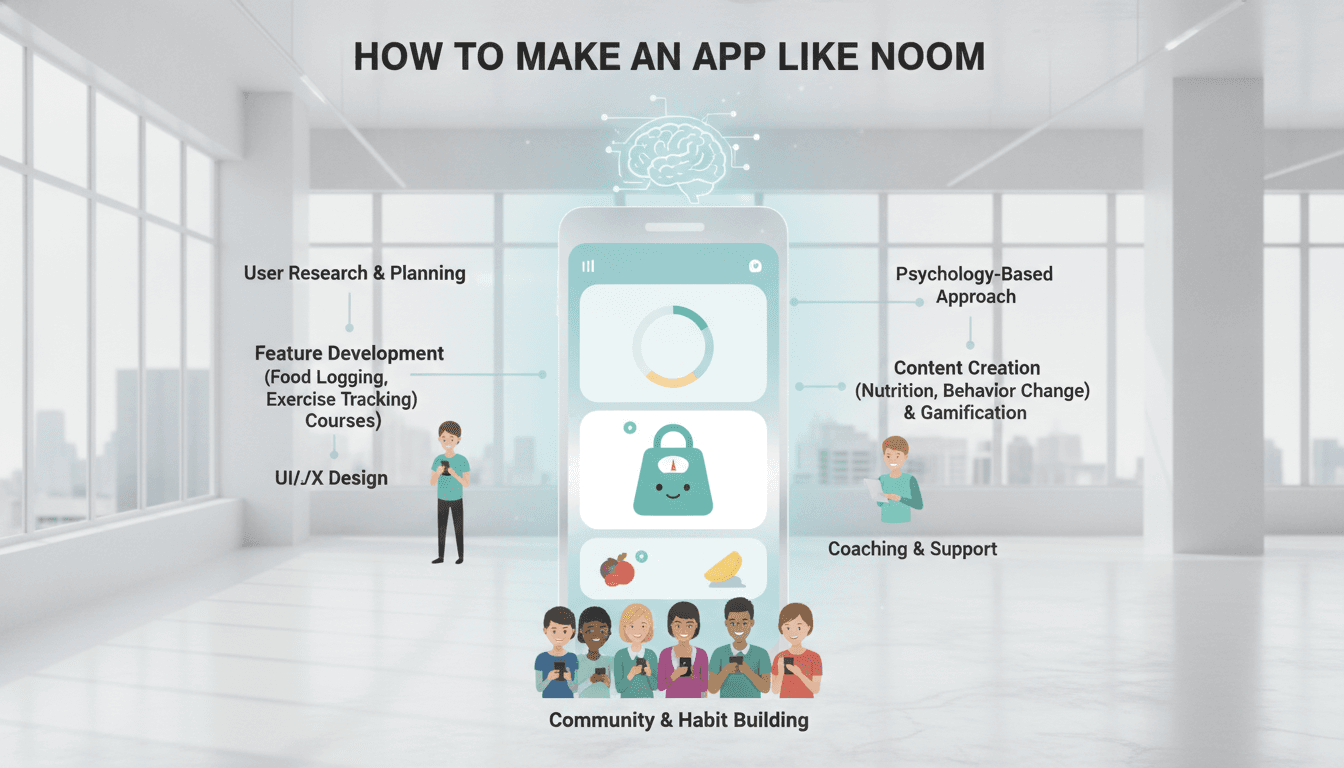
Building a weight-loss coaching app with Noom's depth means combining behavioural psychology, adaptive content delivery, and a data pipeline that actually moves. Here is what that looks like under the hood.
What Makes Noom Technically Different From a Generic Health App
Most fitness apps track calories or steps. Noom tracks behaviour. That distinction drives almost every architectural decision.
The core product loop is: collect user input, run it through a psychological framework (primarily Cognitive Behavioural Therapy and motivational interviewing principles), surface personalised content, and adjust the next day's plan based on engagement signals. Every screen is instrumented. Every article read, every log skipped, every coach message ignored feeds back into the model.
That means your stack has to be event-driven from day one. A REST-only backend where the app fires a POST when a user logs a meal will not scale to the behavioural analytics layer you need later. Plan for Kafka or a managed equivalent like AWS MSK from the start, even if early traffic doesn't justify it operationally.
The Content Engine
Noom's "lessons" are short, quiz-punctuated articles built on a curriculum. The curriculum is not static. It adapts based on where a user is in their journey, which modules they completed, and which psychological stage they appear to be in (pre-contemplation through maintenance, borrowing from the Transtheoretical Model).
Building this means you need:
- A content management system with structured metadata (category, psychological stage, prerequisite module IDs, estimated read time)
- A rules engine or lightweight ML model that selects the next content piece
- A/B testing infrastructure baked in, not bolted on
Contentful or Sanity work fine for the CMS layer. The selection logic can start as a decision tree and graduate to a recommendation model (collaborative filtering works well here once you have enough users) when you have the data volume to justify it.
How Does the Coaching Layer Actually Work?
At scale, Noom uses human coaches supported by tooling. Every coach handles hundreds of users simultaneously. The tooling surfaces users who are at risk of churning, who haven't logged in three or more days, or whose weight trend is moving in the wrong direction. The coach then sends a message, which looks personal but is informed by a dashboard the user never sees.
Building this requires two things most teams underestimate: a coach-facing web application and a notification system that is smarter than a cron job.
Coach Dashboard
The coach dashboard is a React or Next.js application that aggregates per-user signals. Think of it as a lightweight CRM with health data. You need role-based access control from day one because coaches should never see data outside their assigned user pool. Row-level security in PostgreSQL handles this cleanly if you structure your schema correctly.
Intelligent Notifications
Push notifications are not the hard part. The hard part is knowing when not to send one. Over-notification is the fastest way to drive uninstalls. The industry standard opt-out rate for push notifications sits around 40% on Android and 60% on iOS within the first 90 days when notifications are poorly timed.
Use a send-time optimisation model. Firebase Cloud Messaging handles delivery; you build the timing layer on top. Start with simple heuristics (send at the time the user historically opens the app), then move to a per-user model once you have 30+ days of engagement history per user.
What Does the Data Architecture Look Like?
Your data model has to serve three different consumers: the mobile app (low latency, user-specific), the coach dashboard (near-real-time, aggregated), and the ML pipeline (batch, historical). Trying to serve all three from a single PostgreSQL instance works until it doesn't, usually around 50,000 active users.
The pattern that holds up:
| Layer | Tool | Purpose |
|---|---|---|
| Operational DB | PostgreSQL (RDS or Supabase) | User profiles, logs, coach assignments |
| Event stream | Kafka / AWS MSK | Behavioural events, app telemetry |
| Analytics store | BigQuery or Redshift | Historical analysis, ML feature store |
| Cache | Redis | Session state, notification queues |
Keep your food and nutrition data separate from your user data in the schema. Food databases (USDA FoodData Central has over 600,000 items) are read-heavy and rarely updated. Cache aggressively and don't put food queries on the same connection pool as user writes.
/// Not sure where to start?
Get the architecture before you commit
Tell us what you're building and we'll map the technical approach, stack, and rough timeline. No cost, no obligation, no sales call required.
How Do You Handle Food Logging Without Building a Database From Scratch?
You don't build the food database. You license or integrate one.
The Edamam Food Database API covers around 900,000 foods and includes nutrient breakdowns. Nutritionix is another common choice with a strong barcode scanning index. Both have tiered pricing. For early stage, Nutritionix's free tier (500 requests/day) is enough for beta. Past 10,000 active users you will need a paid plan.
Barcode scanning uses the device camera via ML Kit (Google) or the Vision framework (Apple). ML Kit's barcode scanning runs on-device, which means no round trip and no cost per scan. Pair it with Open Food Facts for an open-source fallback when your licensed API returns nothing.
Calorie and Macro Calculation
This is deterministic code, not ML. Write it as a pure function, unit test it thoroughly, and keep it in a shared library accessible from both the mobile client and the backend. Do not calculate nutrition twice in different places. It will diverge.
Building for Compliance: Health Data Is Not Like Other Data
If you're targeting US users, HIPAA compliance is non-negotiable if you store health information and partner with healthcare providers. If you stay purely consumer-facing (no clinical claims, no provider relationships), HIPAA does not strictly apply, but your users will assume it does and your trust will take the hit if you have a breach.
Regardless of jurisdiction, encrypt data at rest (AES-256) and in transit (TLS 1.3). Use separate encryption keys per user for health logs. Audit logs on all health data access are not optional.
For EU users, GDPR requires explicit consent per data category, the right to erasure, and data portability. Build the deletion pipeline before you launch, not after a user requests it.
App store rules add another layer. Apple's HealthKit and Google's Health Connect both require privacy disclosures and restrict what you can do with synced health data. Read the entitlement requirements before you architect the integration, not after you submit for review.
Conclusion
A Noom-style app is a behavioural product that happens to have a mobile front end. The technical complexity is real but manageable if you sequence it correctly: event-driven data layer first, content engine second, coaching tooling third, ML on top once you have data. The mistakes that cost teams the most are building a monolithic backend that can't serve three different data consumers, skipping compliance architecture until after launch, and under-investing in the coach-facing tooling that makes the human layer actually work.
If you are at the architecture stage, the most useful next step is mapping your data consumers before writing a line of application code. What the coach dashboard needs and what the ML pipeline needs are often in direct tension, and resolving that tension on a whiteboard is far cheaper than resolving it in production.
Reach out to the Sodio team if you want a technical review of your current architecture or a second opinion on your stack choices.
FAQ
How long does it take to build an app like Noom? A minimal version with food logging, a content curriculum, push notifications, and basic coaching tooling takes 6 to 9 months with a team of 4 to 6 engineers. A feature-complete version with adaptive content selection, ML-driven notifications, and a full coach dashboard is closer to 14 to 18 months.
What tech stack should I use for a health coaching app? React Native or Flutter for the client, Node.js or Python (FastAPI) for the API layer, PostgreSQL for the operational database, and Kafka for the event stream. Use BigQuery or Redshift for analytics once you have meaningful data volume. Avoid over-engineering the stack in the first six months.
Do I need to be HIPAA compliant to build a weight-loss app? Not automatically. HIPAA applies when you are a covered entity or business associate handling protected health information in a clinical context. A consumer-facing app with no provider relationships typically falls outside HIPAA's scope. However, the moment you partner with an insurer or employer, the rules change. Get a legal opinion before you assume you're exempt.
How do I handle food data at scale? License a food database API (Edamam or Nutritionix) rather than building one. Use On-device barcode scanning via ML Kit to avoid per-scan API costs. Cache food lookups aggressively in Redis. Separate the food data read path from the user data write path in your database configuration.
What is the biggest technical mistake teams make building apps like Noom? Building a monolithic backend that cannot separate the operational, analytical, and ML data layers. This works fine at 1,000 users and becomes a major re-architecture at 50,000. The second most common mistake is leaving the coach-facing tooling as an afterthought, which makes it impossible to scale the human coaching layer efficiently.
Have a project in mind? Contact Sodio Technologies to discuss your requirements and explore the right technology solution for your business.
/// Work with us
Talk to the engineers who'd build it
You'll get a technical scope, timeline and cost estimate from the people doing the work, not an account manager. In-house team, no subcontracting, since 2016.