

How to Make an App Like FamilyWall
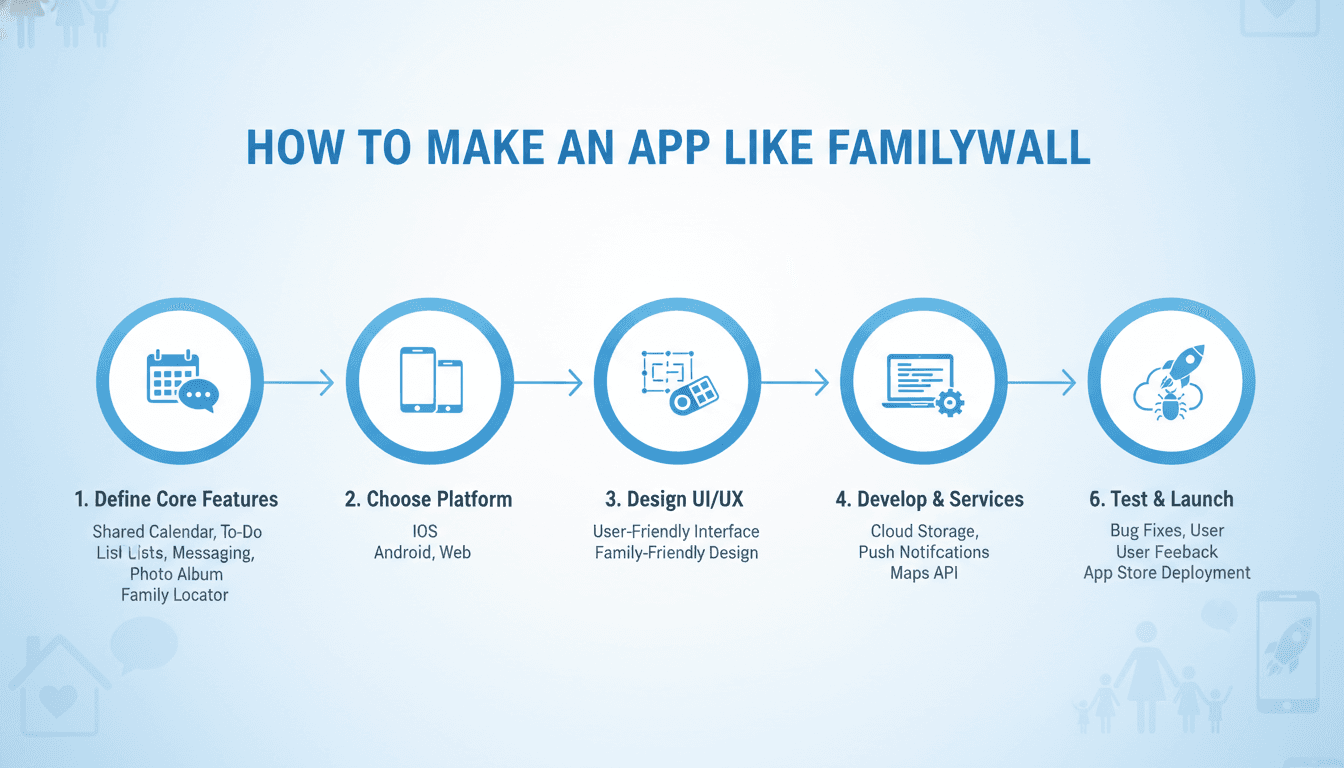
A practical breakdown of the technical architecture, feature set, and cost considerations for building a family organiser app — from someone who has actually built systems like this.
What Is FamilyWall and What Makes It Worth Studying?
FamilyWall is a private social network for families. It combines a shared calendar, task lists, a location-sharing map, a photo album, a messaging system, and a noticeboard into a single mobile-first product. The core problem it solves is coordination overhead in a household, specifically the gap between "everyone knows the plan" and "the plan actually happened."
What makes it interesting from an engineering standpoint is the breadth of features relative to the simplicity of the UX. Each feature is individually unremarkable. A shared calendar is not novel. Real-time location sharing is not novel. The product challenge is integrating all of them without the app feeling like a dashboard.
For a closer look at a related topic, read our guide on How to Make an App Like Life360.
If you are considering building something in this category, you are almost certainly looking at a React Native or Flutter codebase, a Node.js or Go backend, and WebSockets for real-time sync. The rest of this post covers the pieces that actually take time to get right.
What Does the Core Technical Architecture Look Like?
Client layer
FamilyWall-type apps are inherently mobile-first. Web is secondary. The decision between React Native and Flutter comes down to your team's existing skills and your tolerance for platform-specific quirks.
React Native gives you a larger hiring pool and better access to native modules. Flutter gives you better rendering consistency and typically faster cold-start times on Android. Either is a reasonable choice. The mistake is choosing one and then fighting it to do things it was not designed for.
For a family organiser, offline-first behaviour matters more than people initially assume. Family members check plans in basements, on aeroplanes, and in areas with poor signal. Build for offline from day one using something like WatermelonDB (React Native) or Hive (Flutter) for local persistence. Adding offline support later is painful.
For a closer look at a related topic, read our guide on How to Make an App Like Todoist.
Backend layer
The backend is where the interesting decisions live.
A family group is a bounded context. Almost everything in the app is scoped to a family ID. This makes the data model relatively clean, but it also means your access control logic needs to be tight from the start. A user should never be able to read data from a family group they do not belong to. That sounds obvious, but it requires explicit row-level security or equivalent in every query path.
To explore this further, see How to Make an App Like Microsoft To-Do.
For the real-time features (location sharing, chat, calendar updates), you need persistent connections. WebSockets over Socket.io or a managed service like Ably or Pusher are the practical options. If you expect fewer than 10,000 concurrent users at launch, a managed service is almost always cheaper and faster than rolling your own Socket.io infrastructure.
For the REST surface (creating events, uploading photos, managing tasks), a standard Node.js/Express or Go/Gin setup is fine. Keep the real-time and REST surfaces separate at the service level if you can. They have different scaling characteristics.
Data storage
| Data type | Storage choice | Reason |
|---|---|---|
| User profiles, family groups, tasks | PostgreSQL | Relational data with clear foreign keys |
| Chat messages | PostgreSQL or MongoDB | High write volume; schema flexibility helps |
| Location history | TimescaleDB or Redis + periodic flush | Time-series data; hot reads needed |
| Photos and media | S3-compatible object storage | Binary data; CDN delivery |
| Push notification state | Redis | Ephemeral; fast reads |
How Does Real-Time Location Sharing Actually Work?
Location sharing is the feature that looks simple and is not.
The naive implementation is: client sends GPS coordinates every N seconds, backend stores them, other clients poll. This works at low scale and ruins battery life. Android and iOS both have background location APIs with strict constraints on update frequency and accuracy modes. If you push updates too aggressively, the OS will kill your background process or the user will uninstall the app because the battery drain is visible.
The practical approach is adaptive polling. When a family member is stationary, reduce the update frequency. When they are moving, increase it. On iOS, use CLLocationManager with distanceFilter and desiredAccuracy set to kCLLocationAccuracyHundredMeters for background updates. On Android, use the Fused Location Provider from Google Play Services with a PRIORITY_BALANCED_POWER_ACCURACY setting.
On the backend, store location updates in a time-series structure. You do not need the full history for the live map, only the latest position per user. Cache the latest position in Redis with a TTL of around 30 seconds. Serve the live map from Redis. Write the history to TimescaleDB or a similar time-series store asynchronously.
Geofencing, which FamilyWall supports for location alerts, requires a different approach. You need to evaluate each incoming location update against a set of stored geofence polygons or radii. For small numbers of geofences per family, a simple Haversine distance check in your application layer is fast enough. Beyond a few hundred geofences per user, you want a spatial index, PostGIS being the most common choice.
/// Not sure where to start?
Get the architecture before you commit
Tell us what you're building and we'll map the technical approach, stack, and rough timeline. No cost, no obligation, no sales call required.
Building the Calendar and Task System
The calendar is the most-used feature in apps like this, which means it also has the highest expectations around correctness.
Recurring events are the hard part. A recurring event is not a set of discrete database rows. It is a rule (an iCalendar RRULE string, for example) plus a set of exceptions. If someone moves a single occurrence of a weekly event, you need to store that exception without touching the other occurrences. Most teams underestimate this complexity and build a naive implementation that creates one row per occurrence. That works until someone creates a daily event for the next five years.
Use a proper RRULE implementation. The rrule.js library on the client and a server-side equivalent (e.g., python-dateutil or ical.js) handles the expansion logic. Store the RRULE string, the start date, the list of exception dates, and a separate table of modified occurrences.
Tasks are simpler but have their own edge cases. Assignment, completion tracking, and recurring tasks (taking out bins every Tuesday) follow similar patterns to calendar events.
Notifications: Where Most Teams Cut Corners
Push notifications in a family app are high-stakes. If a notification about a child's school pickup fires 20 minutes late, it erodes trust in the entire product.
The standard stack is APNs for iOS and FCM for Firebase Cloud Messaging on Android, with a service like Firebase or Amazon SNS aggregating both. The part teams get wrong is delivery guarantees. FCM and APNs are best-effort. A notification can be dropped if the device is offline when it is sent, and the message TTL expires.
For time-sensitive notifications, you need a fallback. One approach: if a push notification does not result in an app open within a certain window, send an SMS via Twilio. This adds cost but dramatically improves reliability for genuinely important alerts.
In-app notification state (the red badge, the unread count) needs its own data model, separate from push delivery. Do not conflate the two.
What Does It Cost to Build an App Like FamilyWall?
This depends on the team, the feature scope, and the market you are building for. A rough breakdown for a two-platform MVP with the features described above:
| Phase | Duration | Scope |
|---|---|---|
| Design and architecture | 4 weeks | Wireframes, data model, API contracts |
| Core mobile (iOS + Android) | 12–16 weeks | Auth, family groups, calendar, tasks |
| Real-time features | 6–8 weeks | Location sharing, chat, notifications |
| Backend and infrastructure | Parallel with above | APIs, storage, WebSocket infra |
| QA and launch prep | 4 weeks | Device testing, store submissions |
Total elapsed time for a first release: roughly 6 to 9 months with a team of four to five engineers. If you compress that with a larger team, you trade coordination overhead for speed, and the returns diminish quickly past eight engineers on a codebase this size.
Ongoing costs are dominated by infrastructure (S3, compute, managed databases), third-party services (maps API, push notification aggregation, SMS fallback), and maintenance. A family app has relatively low compute costs compared to, say, a video streaming product. The main cost variable is the maps API. Google Maps Platform charges per map load and per geocoding request. At scale, that adds up. OpenStreetMap with a self-hosted Nominatim instance is a reasonable alternative if you have the engineering bandwidth to maintain it.
Conclusion
Building an app like FamilyWall is a meaningful engineering effort, not because any single feature is unusually hard, but because the integration surface is wide and the user tolerance for errors is low. Families use these apps for things that matter to them.
The next step is to define which features are core to your value proposition and which are table stakes. Start with a calendar, a shared task list, and push notifications. Ship that. Then layer in location sharing and chat once you understand how your users actually coordinate.
If you want to talk through the architecture for your specific use case, the Sodio team is happy to get into the details.
FAQ
How long does it take to build a family organiser app? A two-platform MVP covering calendar, tasks, chat, and location sharing typically takes 6 to 9 months with a team of four to five engineers. That assumes design is happening in parallel with early development and that you are not building major infrastructure from scratch.
What is the best tech stack for a FamilyWall-type app? React Native or Flutter on the client, Node.js or Go on the backend, PostgreSQL for relational data, Redis for real-time state, and an S3-compatible store for media. For WebSockets, a managed service like Ably is faster to get right than a self-hosted Socket.io cluster at early scale.
How do you handle offline mode in a family app? Use a local database on the device, WatermelonDB for React Native or Hive for Flutter, and queue mutations locally when the device is offline. Sync when connectivity is restored. Design your conflict resolution strategy before you build, not after. Last-write-wins works for most task and calendar edits.
Is background location sharing hard to implement correctly? It is more constrained than most engineers expect. Both iOS and Android impose strict limits on background location access. The key is using adaptive polling, reducing update frequency when the user is stationary, and using the platform's native low-power location APIs rather than polling on a fixed timer.
What are the main ongoing running costs? The largest variables are maps API fees, object storage for photos, and push notification services. At low scale these are negligible. At tens of thousands of active users, the maps API becomes a real line item. Evaluate OpenStreetMap alternatives early if cost control matters at scale.
Have a project in mind? Contact Sodio Technologies to discuss your requirements and explore the right technology solution for your business.
/// Work with us
Talk to the engineers who'd build it
You'll get a technical scope, timeline and cost estimate from the people doing the work, not an account manager. In-house team, no subcontracting, since 2016.