

How to Make an App Like Hound
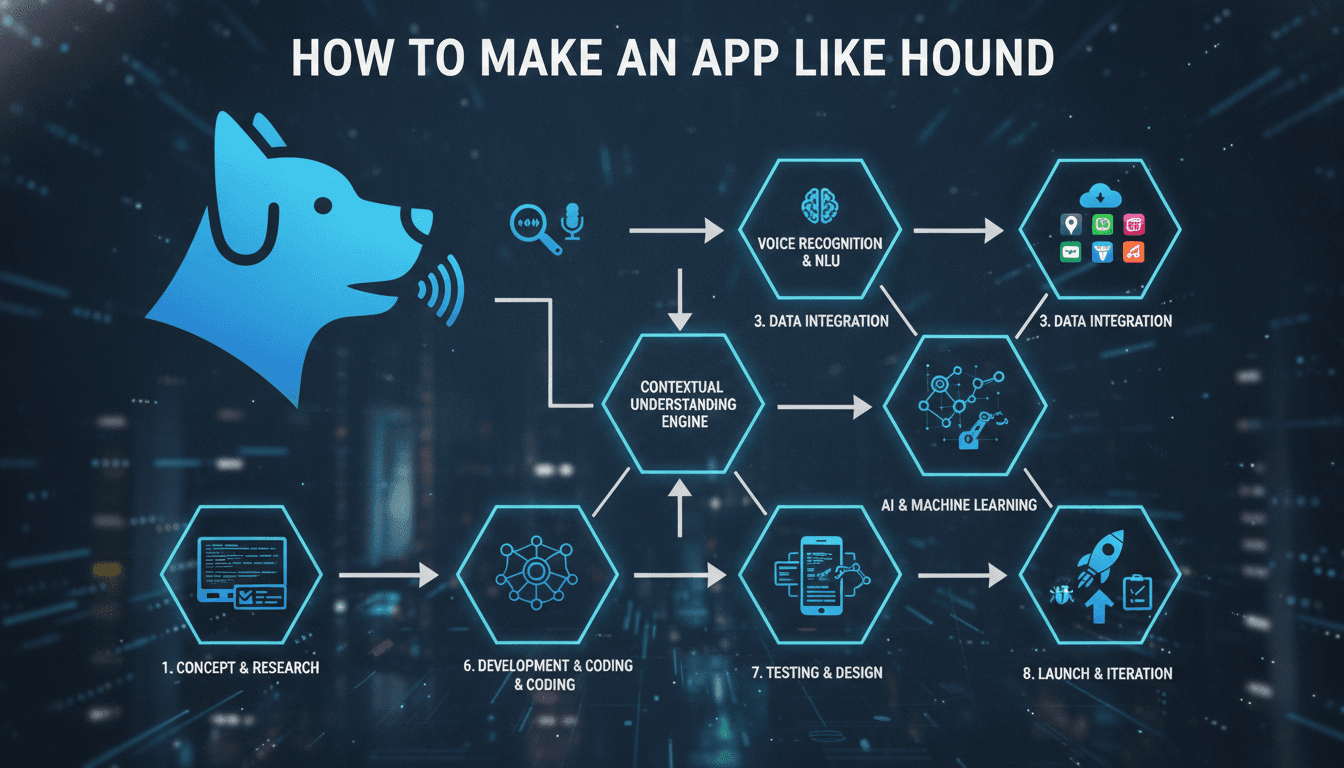
How to Make an App Like Hound
Voice assistants have moved from novelty to necessity. Hound, the voice search and assistant app built on SoundHound's Houndify platform, made waves by handling long, complex, conversational queries that most assistants choked on — questions like "Show me hotels in Chicago for Friday to Sunday, under $200 a night, excluding motels, with a pool and free Wi-Fi."
If you're planning to build something similar, this guide walks through what Hound actually does under the hood, the tech stack you'll need, the feature roadmap, and realistic expectations on cost and timeline.
You may also find our article on How to Make an App Like Mycroft useful.
What Makes Hound Different
Most voice assistants follow a two-step process: convert speech to text, then interpret the text. Hound's core innovation was Speech-to-Meaning — processing audio and extracting intent simultaneously, which dramatically reduces latency and improves accuracy on complex sentences.
To explore this further, see How to Make an App Like Microsoft Cortana.
The second differentiator is Deep Meaning Understanding — the ability to parse compound queries with multiple filters, nested conditions, and follow-up context. Users can say "What about next weekend?" and the assistant remembers everything from the previous query.
If you want to compete in this space, these two capabilities are your bar for entry:
- Sub-second response times on conversational queries
- Context retention across a multi-turn conversation
- Natural language flexibility — no rigid command syntax
- Domain breadth — weather, navigation, local search, math, sports, stocks, music, knowledge lookups
Core Feature Set
Must-Have Features (MVP)
| Feature | Description |
|---|---|
| Voice input & wake word | Hands-free activation plus tap-to-talk |
| Speech recognition | Real-time transcription with streaming results |
| Natural language understanding | Intent classification and entity extraction |
| Text-to-speech output | Natural-sounding spoken responses |
| Conversation history | Scrollable log of past queries and answers |
| Core domains | Weather, time, calculations, unit conversion, web search |
| Offline fallback | Basic commands without a network connection |
Phase Two Features
- Follow-up questions with pronoun resolution ("Who directed it?" after asking about a film)
- Third-party integrations — ride-hailing, food delivery, calendar, smart home
- Multilingual support and accent adaptation
- Personalization — learned preferences, favorite locations, saved searches
- Hands-free driving mode with large-target UI and auto-read responses
- Widget and lock-screen access for instant invocation
- Cross-device sync so conversations follow users between phone, tablet, and car
Technical Architecture
A voice assistant is a pipeline. Each stage needs to be fast, and failures need to degrade gracefully.
1. Audio Capture Layer
Runs on-device. Handles microphone access, voice activity detection (VAD), noise suppression, echo cancellation, and wake-word spotting. Wake-word detection should be a small, quantized on-device model — sending raw audio to the cloud constantly is both a privacy problem and a battery killer.
2. Speech Recognition (ASR)
You have three realistic paths:
Use a managed API. Google Cloud Speech-to-Text, Azure Speech, AWS Transcribe, Deepgram, or AssemblyAI. Fastest to ship, predictable per-minute pricing, minimal ML expertise required.
Use an open-source model. Whisper (or faster variants like faster-whisper and distil-whisper), NVIDIA NeMo, or Wav2Vec2. More control, no per-request fees at scale, but you own the infrastructure and tuning.
Build on a voice platform. Houndify itself, Picovoice, or Rasa give you ASR plus NLU in one package with domain support already built.
For an MVP, start with a managed API. Migrate to self-hosted models once query volume makes the economics obvious.
3. Natural Language Understanding
This is where your product lives or dies. Two broad approaches:
Intent + slot filling. Classify the query into an intent (get_weather, find_restaurant) and extract slots (location, date, cuisine, price range). Fast, cheap, predictable, and easy to debug. Weak on genuinely novel phrasing.
LLM-based interpretation. Send the transcript to a large language model with a tool/function-calling schema. The model decides which API to call and with what parameters. Far more flexible on complex queries, handles context naturally, but adds latency and per-token cost.
The pragmatic answer in 2025 is hybrid routing: match high-frequency queries against fast intent classifiers, and fall back to an LLM for anything ambiguous or compound. This keeps your median latency low and your costs manageable while still handling the hard queries that make your app feel smart.
We cover a closely related subject in How to Make an App Like Braina.
4. Domain & Knowledge Layer
Your assistant is only as useful as the data it can reach. Plan integrations early:
- Weather — OpenWeather, Tomorrow.io
- Maps & local search — Google Places, Mapbox, Foursquare
- Knowledge — Wikipedia/Wikidata, Wolfram Alpha
- Sports, finance, news — vertical API providers
- Music — Spotify, Apple Music
- Smart home — Matter, Home Assistant, vendor APIs
Wrap each one in a normalized internal adapter so you can swap providers without touching your NLU layer.
5. Response Generation & TTS
Build responses as structured objects containing both a spoken string and a visual card. Use neural TTS (ElevenLabs, Google WaveNet, Azure Neural, or Piper for on-device) and stream audio as it generates rather than waiting for the full clip.
6. Orchestration Backend
Handles session state, conversation context, user profiles, auth, rate limiting, caching, and analytics. Microservices or serverless functions both work — what matters is that context lookups are fast (Redis) and that you're logging every query for quality analysis.
Recommended Tech Stack
Mobile front end
- Flutter or React Native for cross-platform speed
- Swift + AVAudioEngine and Kotlin + AudioRecord for native audio paths
Backend
- Python (FastAPI) for the ML-adjacent services
- Node.js or Go for the API gateway and orchestration
- gRPC or WebSockets for low-latency streaming
Data & infrastructure
- PostgreSQL for user data, Redis for session context
- A vector database (Pinecone, Qdrant, pgvector) for semantic search and retrieval
- Kubernetes or a serverless platform, with GPU nodes if self-hosting models
- CDN edge deployment to shave round-trip latency
ML tooling
- PyTorch, Hugging Face Transformers
- ONNX Runtime or TensorFlow Lite for on-device inference
- MLflow or Weights & Biases for experiment tracking
Latency: The Feature Nobody Mentions
Users forgive a wrong answer faster than a slow one. Budget your pipeline aggressively:
- Wake word detection: on-device, under 100ms
- Streaming ASR first partial: under 200ms
- NLU + API call: 200–500ms
- TTS first audio byte: under 300ms
Tactics that actually help: stream ASR results instead of waiting for the final transcript, start speculative API calls on partial transcripts, cache frequent query results, deploy inference at the edge, and pre-warm TTS with common response prefixes.
UX Design Considerations
Voice-first doesn't mean voice-only. The best assistants pair spoken answers with glanceable visual results.
- Show live transcription while the user speaks so they trust they're being heard
- Display the interpreted query so misunderstandings are obvious and correctable
- Offer tappable refinements — chips for "cheaper," "closer," "tomorrow instead"
- Make errors recoverable — "I didn't catch that" with a one-tap retry, never a dead end
- Suggest capabilities on the empty state so users learn what's possible
- Design for noisy environments — cars, streets, gyms
Privacy & Compliance
Voice data is biometric data in several jurisdictions. Get this right from day one:
- Keep wake-word detection entirely on-device
- Make recording state visually unmistakable
- Give users a clear way to view and delete their voice history
- Encrypt audio in transit and at rest; minimize retention windows
- Ask explicit consent before using recordings for model training
- Map your obligations under GDPR, CCPA, and biometric laws like Illinois' BIPA
- Add parental controls and COPPA handling if minors may use the app
Development Roadmap
Weeks 1–3: Discovery Define target domains, success metrics, and competitive positioning. Choose your ASR and NLU approach. Write out 200+ representative user queries as your test set.
Weeks 4–7: Prototype Build the end-to-end pipeline for two or three domains. Prove your latency budget is achievable. Validate accuracy against your query set.
Weeks 8–16: MVP Build Full mobile app, backend orchestration, five to eight domains, conversation history, accounts, analytics.
Weeks 17–20: Testing & Hardening Accent and noise testing with real users, load testing, security review, accessibility audit, app store prep.
Post-launch: Iterate Mine query logs for failures, expand domains based on actual demand, add follow-up context, tune your models on real data.
Cost Expectations
| Scope | Timeline | Typical Range |
|---|---|---|
| Prototype / proof of concept | 4–8 weeks | $20,000 – $45,000 |
| MVP (single platform) | 3–4 months | $50,000 – $110,000 |
| Full cross-platform product | 5–8 months | $120,000 – $280,000 |
| Enterprise-grade with custom models | 9–14 months | $300,000+ |
Ongoing operating costs deserve their own line item. ASR runs roughly $0.006–$0.024 per minute on managed APIs. LLM calls cost fractions of a cent each but multiply fast. Neural TTS is priced per character. Budget for cloud hosting, third-party data APIs, and a meaningful chunk for continuous model improvement.
Monetization Options
- Freemium — free tier with query limits, paid tier for unlimited use and premium domains
- Subscription — monthly or annual access, often bundled with cross-device sync
- B2B licensing — white-label your voice engine for automotive, appliance, or retail partners
- API access — sell your NLU pipeline to other developers, the Houndify model
- Affiliate revenue — commissions on bookings, rides, and orders placed through the assistant
Common Pitfalls
Trying to cover every domain at launch. Depth beats breadth. Ten domains that work flawlessly are worth more than fifty that half-work.
Ignoring accents and dialects. Test with diverse speakers early, not during QA. Accuracy that collapses outside standard American English will tank your retention.
Treating latency as a later optimization. Architecture decisions made in month one determine whether sub-second responses are even possible.
No fallback strategy. Every query that fails should produce something useful — a web result, a clarifying question, a suggestion. Never a shrug.
Skipping analytics on failed queries. Your query logs are the single most valuable asset you'll build. Instrument them from day one.
Final Thoughts
Building an app like Hound is genuinely hard engineering, but it's dramatically more achievable than it was when SoundHound started. Streaming ASR, function-calling LLMs, and cheap neural TTS are now commodity building blocks. The differentiation is no longer in having a voice interface — it's in being fast, being accurate in a specific domain, and being reliable enough that users build a habit.
Pick a narrow vertical where voice genuinely beats tapping, nail the latency, and expand from there.
Have a project in mind? Contact Sodio Technologies to discuss your requirements and explore the right technology solution for your business.
/// Work with us
Talk to the engineers who'd build it
You'll get a technical scope, timeline and cost estimate from the people doing the work, not an account manager. In-house team, no subcontracting, since 2016.