

How to Make an App Like Inkhunter
How to Make an App Like Inkhunter
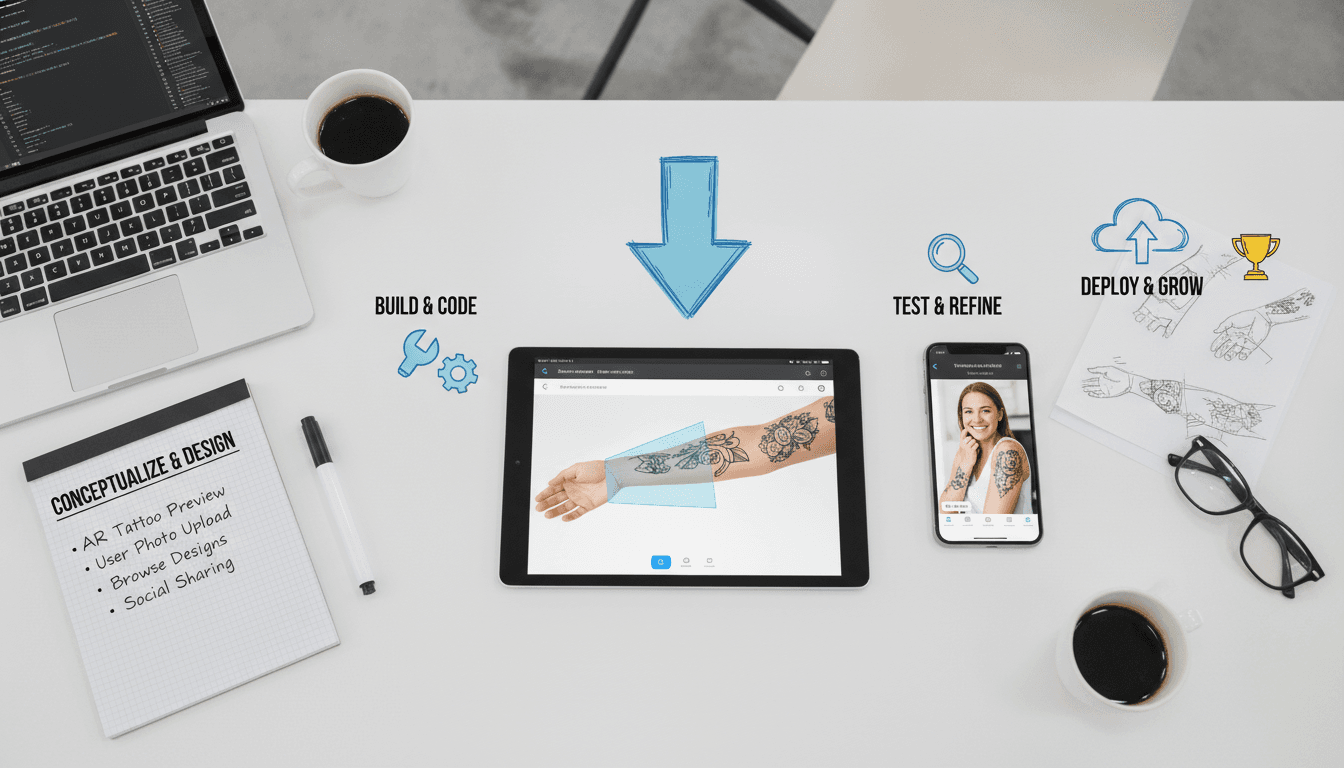
Tattoos are permanent. Regret, unfortunately, is too. That simple tension is exactly why InkHunter became a breakout hit: it lets people project a tattoo design onto their skin in real time using augmented reality, so they can see how the artwork looks on their forearm, wrist, or shoulder before a needle ever touches them.
If you're planning to build an app like InkHunter, this guide walks through the product thinking, the technology stack, the development process, and the realistic costs involved.
We cover a closely related subject in How to Make an App Like SketchAR.
What Exactly Does InkHunter Do?
At its core, InkHunter is an AR try-on app for tattoos. The workflow is deceptively simple for the user:
- Draw a small reference marker (traditionally a smiley face) on your skin with a pen.
- Open the app and point your camera at the marker.
- Browse a library of tattoo designs or upload your own.
- Watch the design appear on your skin, anchored to the marker, scaled and rotated in real time.
- Capture a photo or video and share it with friends or your tattoo artist.
Everything else — design galleries, artist profiles, saved favourites, social sharing — is built around that single moment of "wow."
Related reading: How to Make an App Like Prisma.
Modern versions of this concept can skip the hand-drawn marker entirely, using markerless tracking and body-part detection to place artwork directly on a recognised limb.
Why Build a Tattoo Try-On App?
A real, expensive problem. Tattoo removal costs far more than the tattoo itself and takes multiple painful sessions. Reducing regret has genuine value.
A visual, shareable product. AR try-on results are inherently social. Users generate marketing content for you every time they post a preview.
A two-sided marketplace opportunity. Tattoo artists want visibility and bookings. Clients want confidence. An app that serves both sides can monetise far beyond a simple download.
Transferable technology. The same AR pipeline powers try-on for jewellery, watches, makeup, nail art, and temporary tattoos. Your core engine has multiple exits.
Core Feature Set
Must-Have Features (MVP)
Onboarding and Authentication Keep it light. Social login, Apple/Google sign-in, and a guest mode so users can try the AR experience before committing to an account. Friction at this stage kills conversion.
AR Camera and Placement Engine The heart of the product. Users need to:
- Position a design anywhere on visible skin
- Pinch to scale, twist to rotate, drag to reposition
- See realistic occlusion (the design should wrap and disappear around the curve of an arm)
- Maintain stable tracking as they move
Design Library A searchable, filterable catalogue organised by style (traditional, blackwork, fine-line, watercolour, tribal, script), body placement, and size. Strong categorisation is what keeps users browsing.
Custom Upload Let users import their own artwork from the camera roll. Automatic background removal and edge detection turn a photo of a sketch into a usable transparent PNG.
Capture and Share Photo and video capture with a subtle watermark, plus native share sheets to Instagram, TikTok, and messaging apps.
Favourites and Collections Saved designs, mood boards, and comparison views so users can shortlist options over days or weeks.
Features That Differentiate
Skin-Tone Aware Rendering Tattoo ink reads differently on different skin tones. Sampling the user's skin and adjusting opacity, saturation, and blending mode produces dramatically more believable previews.
Aging Simulation Show how a fine-line design might blur or fade after five, ten, or twenty years. This is genuinely useful and almost nobody does it well.
Artist Marketplace Profiles, portfolios, pricing, availability calendars, and in-app booking with deposits. This is where the revenue lives.
AI Design Generation Text-to-image generation tuned for tattoo styles lets users describe an idea — "a minimalist mountain range with a crescent moon, fine-line style" — and get original artwork they can immediately preview on skin.
Body Mapping Detect which body part the camera is looking at and suggest designs that suit that placement and proportion.
Cover-Up Mode Help users with existing tattoos visualise how a new design could conceal the old one. A niche feature with an intensely motivated audience.
Community Feed User previews, finished tattoos, artist showcases, and a follow graph. Retention is hard for a single-use utility app; community solves that.
Technology Stack
Augmented Reality
ARKit (iOS) and ARCore (Android) provide native tracking, plane detection, and lighting estimation. ARKit's body tracking and depth API on LiDAR-equipped devices give you superior occlusion.
Unity with AR Foundation is the pragmatic middle ground — write your AR logic once and deploy to both platforms, with mature tooling for 3D rendering and shaders.
8th Wall or Niantic Studio enables web-based AR if you want a no-install try-on experience for marketing or artist embeds.
Computer Vision and ML
- MediaPipe for hand, pose, and body segmentation
- OpenCV for marker detection, edge finding, and image preprocessing
- Core ML / TensorFlow Lite for on-device inference, keeping latency low and privacy intact
- Segment Anything–style models for precise skin masking and background removal on uploads
Frontend
- Swift / SwiftUI for iOS
- Kotlin / Jetpack Compose for Android
- React Native or Flutter for the non-AR portions of the app (browse, profile, booking, chat), with a native AR module bridged in
Backend
- Node.js or Python (FastAPI) for APIs
- PostgreSQL for relational data; MongoDB for flexible design metadata
- Redis for caching hot catalogue queries
- AWS S3 or Cloudflare R2 plus a CDN for serving design assets fast and cheap
- Stripe for deposits and marketplace payouts
- Firebase for push notifications, analytics, and crash reporting
The Hard Part: Making It Look Real
Anyone can composite a PNG onto a camera feed. Making it look like ink in skin is where apps win or lose.
Tracking stability. Nothing breaks immersion faster than a design that jitters or slides. Combine visual tracking with device motion data, and smooth the result with a filter that suppresses noise without introducing lag.
Surface conformance. Skin is curved. A flat decal on a forearm reads as a sticker. Project the artwork onto a mesh that approximates the limb's geometry so it bends convincingly.
Blending, not overlaying. Real tattoos sit under the skin's surface. Use multiply or soft-light blend modes, reduce pure black to a dark blue-grey, and let skin texture show through at low opacity.
Lighting response. Sample ambient light from the AR session and adjust the design's brightness and contrast so it doesn't glow in a dim room.
Occlusion. When the user rotates their arm, the design should disappear around the edge rather than floating over the background. Depth-based occlusion is the cleanest solution on supported hardware; segmentation masks work elsewhere.
Development Process
1. Discovery and Validation (2–3 weeks)
Interview tattoo artists and prospective clients. Audit competitors. Define which single feature will make your app worth switching to.
2. UX and UI Design (3–5 weeks)
AR apps need a distinct design language. The camera view should be nearly chrome-free, with controls that are reachable one-handed while the other hand holds a pose. Prototype the gesture system early.
3. AR Prototype (3–4 weeks)
Build the tracking and rendering pipeline before anything else. If the core experience doesn't feel magical in a rough prototype, no amount of polish will save it.
4. MVP Build (10–16 weeks)
Backend, catalogue, authentication, capture, sharing, and the production AR module.
5. Testing (3–4 weeks)
Test across a wide device matrix, in varied lighting, on varied skin tones, on varied body parts. AR failures are highly device- and environment-dependent.
6. Launch and Iterate
Ship, instrument everything, and let usage data dictate the roadmap. Watch time-to-first-preview obsessively — it's your key activation metric.
Monetisation Models
Freemium. Free previews with a watermark and a limited catalogue; subscription unlocks HD capture, unlimited uploads, premium artwork, and AI generation.
Marketplace commission. Take a percentage of bookings or deposits made through artist profiles. The highest-ceiling model.
Artist subscriptions. Charge studios a monthly fee for enhanced profiles, analytics, and placement in search.
Design licensing. Sell individual pieces from independent artists with a revenue split.
White-label licensing. License your AR engine to studios, chains, and temporary-tattoo brands.
Brand partnerships. Sponsored design packs from apparel, music, or entertainment brands.
Cost and Timeline
Ballpark figures for a professionally built product:
| Scope | Timeline | Indicative Cost |
|---|---|---|
| Single-platform MVP | 3–4 months | $35,000 – $60,000 |
| Cross-platform MVP | 4–6 months | $60,000 – $95,000 |
| Full marketplace + AI features | 7–10 months | $100,000 – $180,000+ |
Costs vary substantially with team location, AR sophistication, and whether you build a native AR module per platform or use a shared Unity layer. Budget an additional 15–25% of build cost annually for maintenance, OS updates, and infrastructure.
Related reading: How to Make an App Like Wanna Kicks.
Common Pitfalls
Over-indexing on the catalogue. A thousand mediocre designs is worse than two hundred great ones. Curation is a feature.
Ignoring skin tone diversity. If your previews only look convincing on light skin, you've excluded most of your potential market and invited well-deserved criticism.
Neglecting the artist side. Consumers download, but artists drive supply, credibility, and revenue. Build for them from day one.
Shipping unstable tracking. Users will forgive a sparse catalogue. They will not forgive a design that slides off their arm. Set a high quality bar for the AR core and hold it.
No retention loop. People choose a tattoo a few times in their life. Without community, saved collections, notifications, or artist discovery, you'll have brutal churn.
Final Thoughts
An app like InkHunter is a deceptively deep technical product wrapped in a simple promise: see it before you commit. The winners in this space aren't those with the biggest design libraries — they're the ones whose AR preview is so convincing that users trust it enough to walk into a studio.
Start with the rendering quality. Build the marketplace around it. Everything else is iteration.
Have a project in mind? Contact Sodio Technologies to discuss your requirements and explore the right technology solution for your business.
/// Work with us
Talk to the engineers who'd build it
You'll get a technical scope, timeline and cost estimate from the people doing the work, not an account manager. In-house team, no subcontracting, since 2016.