

How to Make an App Like Pluralsight
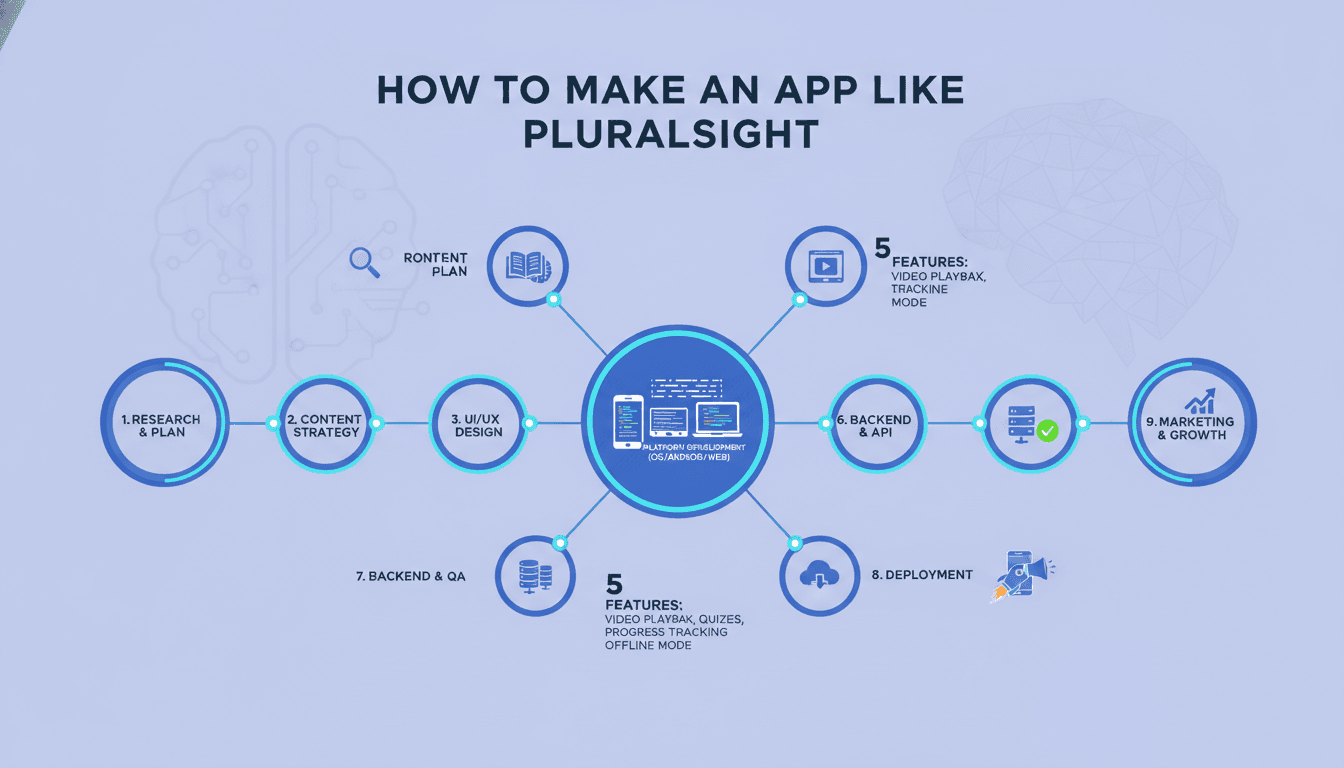
How to Make an App Like Pluralsight
The online learning market has exploded over the last decade, and platforms like Pluralsight have shown just how profitable a well-executed skill-development product can be. Pluralsight built its reputation on deep, role-based technology training, skill assessments, and analytics that help teams close capability gaps. If you're considering building something similar, this guide walks you through the features, architecture, tech stack, timeline, and costs involved.
What Makes Pluralsight Work
Before writing a single line of code, it's worth understanding why Pluralsight succeeded where countless other course platforms stalled.
If this is relevant to your project, check out How to Make an App Like Udacity.
It sells outcomes, not videos. Pluralsight doesn't just host content — it measures skill through Skill IQ assessments, maps learners to role-based paths, and gives managers dashboards showing where their teams stand. That data layer is the moat.
It targets teams, not just individuals. B2B subscriptions carry higher contract values, lower churn, and predictable renewal cycles. The consumer tier is largely a funnel into enterprise deals.
It curates aggressively. Rather than opening the floodgates to any instructor, Pluralsight vets authors and maintains editorial standards. Quality consistency is a differentiator in a market flooded with mediocre content.
Any app you build in this space needs a point of view on all three of these dimensions.
Core Feature Set
For Learners
- Onboarding and role selection — Ask new users about their current role, target role, and experience level so the platform can recommend relevant paths immediately.
- Skill assessments — Adaptive tests that place a learner on a proficiency scale in 10–15 questions. This is the signature feature and the hardest to get right.
- Learning paths — Curated sequences of courses that move a learner from novice to proficient in a specific discipline.
- Video player — Adaptive bitrate streaming, playback speed control, closed captions, transcripts, bookmarks, and resume-where-you-left-off across devices.
- Hands-on labs and sandboxes — Browser-based coding environments or cloud sandboxes where learners practice instead of just watching.
- Offline downloads — Essential for mobile. Learners consume content on commutes and flights.
- Progress tracking and certificates — Streaks, completion percentages, badges, and shareable credentials.
- Search and discovery — Full-text search across course titles, descriptions, and transcripts, with filters for level, duration, and technology.
- Notes and bookmarks — Timestamped notes tied to specific moments in a video.
For Instructors and Content Teams
- Authoring portal — Upload video, attach exercise files, write descriptions, tag skills.
- Content review workflow — Draft, review, approve, publish states with editorial feedback.
- Performance analytics — Views, completion rates, ratings, and revenue share reporting.
- Version management — Technology content ages fast. Authors need to update modules without breaking learner progress.
For Business and Enterprise Admins
- Team management — Invite users, assign licenses, create groups by department.
- Skill gap analytics — Aggregate assessment results into a heat map of organizational strengths and weaknesses.
- Assigned learning — Push mandatory paths to specific teams with due dates.
- SSO and SCIM provisioning — SAML, OAuth, and automated user lifecycle management are table stakes for enterprise sales.
- Reporting and exports — CSV and API access to engagement data for HR systems.
Admin and Platform
- Content catalog management — Taxonomy, tagging, curation rules.
- Subscription and billing — Plan tiers, seat management, proration, dunning.
- Moderation and support tooling — Handle flagged content, refund requests, and account issues.
Architecture Overview
A platform like this is really several systems working together.
Video Pipeline
This is where most teams underestimate the effort. The pipeline looks roughly like this:
- Author uploads a source file to object storage via a signed URL.
- An event triggers a transcoding job that produces multiple renditions (1080p, 720p, 480p, 360p) plus HLS and DASH manifests.
- Audio is extracted and sent to a speech-to-text service to generate captions and a searchable transcript.
- Thumbnails and sprite sheets are generated for scrubbing previews.
- Outputs land in a CDN-backed bucket with signed playback URLs and DRM or token-based protection.
You can build this on AWS MediaConvert and CloudFront, or lean on a managed provider like Mux or Cloudflare Stream to compress months of work into weeks. For a first version, managed is almost always the right call.
If this is relevant to your project, check out How to Make an App Like Lynda.com.
Backend Services
A modular monolith is usually the right starting point, with clean service boundaries you can split later:
- Identity service — Auth, sessions, SSO, roles, and permissions.
- Catalog service — Courses, modules, paths, taxonomy, and search indexing.
- Progress service — High-write-volume playback events, completion state, and streaks.
- Assessment service — Item bank, adaptive test engine, and scoring.
- Billing service — Subscriptions, invoices, entitlements.
- Analytics service — Event ingestion, aggregation, and reporting.
Data Layer
- PostgreSQL for transactional data — users, courses, subscriptions, enrollments.
- Redis for sessions, rate limiting, and hot catalog caching.
- Elasticsearch or OpenSearch for full-text search across transcripts and metadata.
- A columnar warehouse (BigQuery, Snowflake, ClickHouse) for behavioural analytics and reporting.
- Object storage (S3 or equivalent) for video masters, renditions, and exercise files.
Event Streaming
Playback heartbeats, quiz submissions, and page views should flow through a queue (Kafka, Kinesis, or a simpler SQS setup early on) rather than hitting your primary database directly. A single learner watching a one-hour course can generate hundreds of progress events.
To explore this further, see How to Make an App Like Skillshare.
The Assessment Engine
If you want to genuinely compete, this deserves dedicated attention.
Pluralsight's Skill IQ uses adaptive testing based on Item Response Theory. Each question in the bank has calibrated difficulty and discrimination parameters. The engine selects the next question based on the learner's estimated ability after each answer, converging on an accurate score in far fewer questions than a fixed-length test.
Building this requires:
- An item bank with hundreds of calibrated questions per skill.
- Calibration data — you need real response data to estimate item parameters, which creates a chicken-and-egg problem at launch. Many teams start with expert-assigned difficulty and recalibrate as data accumulates.
- A scoring model — typically a 2-parameter or 3-parameter logistic model with maximum likelihood or Bayesian ability estimation.
- Item exposure controls — prevent the same questions appearing repeatedly and getting leaked.
- Security measures — time limits, randomization, question pools, and anti-cheating heuristics.
A simplified version for MVP: fixed-length tests with weighted scoring, upgraded to full adaptive logic once you have response data.
Recommended Tech Stack
Mobile
- React Native or Flutter for a shared codebase across iOS and Android
- Native modules for video playback (ExoPlayer on Android, AVPlayer on iOS) and secure offline storage
- Native Swift/Kotlin if you need maximum playback control and DRM fidelity
Web
- Next.js or React with server-side rendering for SEO on course landing pages
- Video.js, Shaka Player, or a vendor SDK for playback
Backend
- Node.js with NestJS, Python with Django/FastAPI, or Go for high-throughput services
- GraphQL or REST with a well-versioned API contract
Infrastructure
- Kubernetes or a managed container platform (ECS, Cloud Run)
- Terraform for infrastructure as code
- CI/CD via GitHub Actions or GitLab
Third-Party Services
- Stripe or Chargebee for subscriptions and enterprise invoicing
- Auth0, WorkOS, or Okta for enterprise SSO
- Mux, Cloudflare Stream, or AWS Elemental for video
- Segment or RudderStack for analytics plumbing
- Algolia if you want search quality without operating a cluster
Monetization Models
Individual subscriptions — Monthly and annual tiers. Annual plans dramatically improve cash flow and reduce churn.
Team and enterprise plans — Per-seat pricing with volume discounts. This is where the revenue concentrates. Expect a sales-assisted motion with procurement, security reviews, and custom contracts.
Freemium content — A limited free catalog or free skill assessments as a lead generation tool.
Certification and credentials — Paid proctored exams that carry industry weight.
B2B content licensing — Selling your catalog into other LMS platforms via SCORM or xAPI packages.
Development Roadmap
Phase 1 — Discovery and Design (4–6 weeks) Market research, competitor teardown, feature prioritization, information architecture, wireframes, and a design system. Define your niche narrowly — "cloud security for mid-market IT teams" beats "all of tech."
Phase 2 — MVP Build (14–20 weeks) Auth, catalog, video playback, basic progress tracking, subscriptions, and a minimal admin panel. Ship web first if your audience is desktop-heavy; ship mobile first if they learn on the go.
Phase 3 — Assessments and Paths (8–12 weeks) Skill assessment engine, learning path builder, recommendation logic.
Phase 4 — Enterprise Layer (10–14 weeks) SSO, team management, admin analytics, assigned learning, and reporting APIs.
Phase 5 — Scale and Optimize (ongoing) Hands-on labs, AI-driven recommendations, localization, advanced personalization, and performance tuning.
Cost Expectations
Costs vary widely by region and team composition, but here's a realistic range:
| Scope | Estimated Cost |
|---|---|
| MVP (web or mobile, core features) | $70,000 – $130,000 |
| Full platform (web + mobile + enterprise) | $180,000 – $400,000+ |
| Assessment engine (standalone effort) | $40,000 – $90,000 |
| Annual infrastructure and third-party services | $25,000 – $150,000 |
Video bandwidth is the variable that surprises people. At scale, CDN egress can become one of your largest line items, so model it early using expected watch hours multiplied by bitrate.
Ongoing maintenance typically runs 15–25% of the initial build cost annually, plus content production, which is a separate and substantial budget line.
Content Strategy Is Half the Battle
A flawless app with a thin catalog will fail. Plan for content from day one.
- Decide on your model — in-house production, contracted expert authors, revenue-share marketplace, or licensed third-party content.
- Set production standards — audio quality, screen resolution, pacing, module length. Short modules (5–12 minutes) consistently outperform hour-long lectures.
- Build a refresh cadence — technology content has a shelf life of 12–24 months. Budget for continuous updates, not just new courses.
- Start narrow and go deep — 40 excellent courses in one discipline will beat 400 shallow courses across twenty.
Where AI Fits
Modern learning platforms are using AI in ways that meaningfully improve outcomes:
- Personalized path generation based on assessment results and career goals
- Automatic transcript, summary, and chapter generation from uploaded video
- Conversational tutors that answer questions in the context of the current lesson
- Question generation to seed and expand assessment item banks
- Churn prediction that flags disengaged learners for intervention
- Semantic search so learners find the exact three-minute clip that answers their question
These features are increasingly expected rather than differentiating, but they're far cheaper to implement now than they were two years ago.
Common Pitfalls
Building the video pipeline from scratch. Unless streaming is your core differentiator, use a managed provider for v1.
Ignoring enterprise requirements until late. SSO, audit logs, SOC 2, data residency, and accessibility compliance (WCAG 2.1 AA) are deal-blockers. Retrofitting them is painful.
Treating mobile as an afterthought. Offline playback with encrypted local storage and background download queues is genuinely hard. Scope it properly.
Underestimating content operations. The tooling authors need — upload, review, versioning, analytics — is a real product that requires real investment.
Competing on breadth. You will not out-catalog Pluralsight, Udemy, or LinkedIn Learning. Win by going deeper in a domain they treat superficially.
Final Thoughts
Building an app like Pluralsight is less about replicating a feature list and more about deciding which part of the learning problem you'll solve better than anyone else. The video infrastructure is largely a solved problem you can buy. The assessment engine, the content quality, and the enterprise analytics layer are where defensible value lives.
Start with a tightly scoped MVP aimed at a specific audience, validate that people will pay for your content quality, then layer on assessments and enterprise features as demand pulls you forward. The platforms that win in this space are the ones that prove measurable skill improvement — not the ones with the biggest catalogs.
Have a project in mind? Contact Sodio Technologies to discuss your requirements and explore the right technology solution for your business.
/// Work with us
Talk to the engineers who'd build it
You'll get a technical scope, timeline and cost estimate from the people doing the work, not an account manager. In-house team, no subcontracting, since 2016.