

 Food Delivery
Food Delivery App Development
Delivery marketplaces, direct ordering platforms, grocery and quick commerce, built around the two numbers that decide the business: cost per order and on-time rate.
 Message on WhatsApp
TRUSTED BY TEAMS






Sodio builds food delivery app development across marketplaces, direct restaurant ordering, grocery delivery, quick commerce and cloud kitchen software.
A delivery platform is four applications — customer ordering, restaurant console, rider app and dispatch engine — and the business is decided by two numbers: cost per order and on-time delivery rate. Batching, ETA accuracy and kitchen prep prediction move both. Menu design and app polish move neither.

/// What decides a delivery business
Delivery Is Won on Cost Per Order
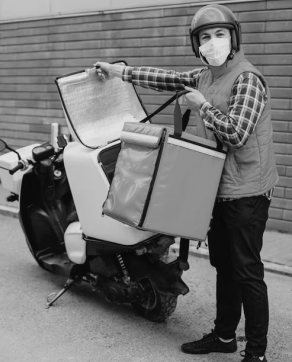
Cost Per Order and On-Time Delivery Decide the Business
Almost every food delivery business has the same two problems, and neither is solved in the app design. The first is cost per order. The second is whether the food arrives when it was promised.
Batching Is the Largest Unit-Economics Lever
Batching is the largest lever on the first. Combining two orders into one rider trip changes the economics of the whole business, but only if it can be done without making either delivery late. That is a live optimisation problem involving prep times, rider position, route overlap and customer tolerance, and it runs thousands of times an hour.
ETA Accuracy Is More Than Distance
ETA accuracy decides the second, and it is not a distance calculation. It depends on kitchen prep time for the specific dishes ordered, the current backlog in that kitchen, rider availability in that area, traffic and weather. A slightly longer promised time that is met beats a shorter one that is missed — customers forgive a wait they were told about.
Peak Load Is Predictable
Peak load is the third constraint and the most predictable. Demand concentrates into the same two hours every evening, so the order and dispatch path has to be tested under concurrency rather than at three in the afternoon.
Restaurant Onboarding Can Cap Growth
And restaurant onboarding is the quiet one. If it takes a week to get a menu live, growth is capped by an operations team typing menus, not by demand.
/// FOOD DELIVERY SOLUTIONS
Food and Grocery Delivery Platforms We Build

Food Delivery App Development

Online Food Ordering Systems

Food Ordering App for Restaurants

Grocery Delivery App Development

Grocery & Supermarket Shopping Apps

Milk & Daily Essentials Delivery

Cloud Kitchen Management Software

Restaurant Delivery Apps

Quick Commerce & Dark Stores

Courier & Rider Apps

Meal Kit & Subscription Food Apps

///AI FOR DELIVERY
AI for Delivery Operations
Every model here attaches to a number a delivery operator already reports daily: cost per order, on-time rate, basket size, refund rate, food waste.

Delivery Time Prediction
ETA accuracy drives repeat ordering and support volume. Models trained on your own trip data.

Order Batching & Rider Allocation
Combining two orders into one trip is the clearest unit-economics lever in the category. Batching without lengthening either delivery.
Demand Forecasting for Kitchens
Prep-ahead prediction by dish and hour, cutting both food waste and ticket times during peak.
Menu & Dish Recommendations
Basket size uplift through cross-sell, reorder prediction and time-of-day relevance rather than generic upsell prompts.

Dynamic Delivery Pricing
Delivery fee and surge modelling that protects margin on long trips without collapsing conversion on short ones.

Fraud & Refund Abuse Detection
Repeat "order never arrived" claims, rider collusion and promo abuse. A known, costly issue in every delivery business.

Food Image Recognition & Menu Digitisation
Turning a PDF or photographed menu into structured items, prices and modifiers, with imagery. Removes restaurant onboarding friction.
Rider Safety & Route Risk AI
Risk scoring by route, time and weather, with interventions before incidents rather than reporting after them.
ETA accuracy drives repeat ordering and support volume. Models trained on your own trip data.
Learn MoreCombining two orders into one trip is the clearest unit-economics lever in the category. Batching without lengthening either delivery.
Learn MorePrep-ahead prediction by dish and hour, cutting both food waste and ticket times during peak.
Learn MoreBasket size uplift through cross-sell, reorder prediction and time-of-day relevance rather than generic upsell prompts.
Learn MoreDelivery fee and surge modelling that protects margin on long trips without collapsing conversion on short ones.
Learn MoreRepeat "order never arrived" claims, rider collusion and promo abuse. A known, costly issue in every delivery business.
Learn MoreTurning a PDF or photographed menu into structured items, prices and modifiers, with imagery. Removes restaurant onboarding friction.
Learn MoreRisk scoring by route, time and weather, with interventions before incidents rather than reporting after them.
Learn More///RELATED SECTORS
Related Sectors


Supermarket apps, click and collect, in-store systems
Learn MoreRestaurant POS, kitchen workflows and table management
Learn MoreDispatch engines, matching and two-sided marketplace architecture
Learn MoreFleet management, route optimisation and last-mile delivery
Learn More///TECHNOLOGY
Technology and Integrations


/// HOW WE WORK
How We Work on Delivery Projects
Unit economics discovery
We start with the numbers rather than the features: current or target cost per order, average basket, delivery radius, rider model and commission structure. Those decide the architecture.
Free solution architecture
All four applications scoped, dispatch and batching strategy, POS and courier integrations, payments model and a costed delivery plan. Yours to keep whether or not you build with us.
MVP in 30 days
One city, one category, a working order-to-delivery path with real riders. Enough to see what the model does under real conditions rather than in a demo.
Production build in 90 days
Full platform with operations tooling, batching, fraud controls, payouts and peak load testing. Multi-city expansion is phased after the first market holds.
///FEATURED CASES
Future-Proof Software for Your Business
At Sodio, we deliver mobile apps, web apps, blockchain (DApps), AI integrations, SaaS platforms, and custom software development. Our innovative solutions are scalable, secure, and user-friendly, designed to drive growth and efficiency, keeping you ahead in the competitive landscape. Trust Sodio for your digital transformation needs.

ShopDee
ShopDee is a leading e-commerce platform in Thailand, that connects buyers and sellers through a comprehensive online marketplace
ShopDee
ShopDee is a leading e-commerce platform in Thailand, that connects buyers and sellers through a comprehensive online marketplace
/// FAQ
Frequently Asked Questions
More than a single app, because a marketplace is four applications: customer ordering, restaurant console, rider app and the dispatch engine. A focused MVP covering one city and one service model is achievable in weeks. Costs rise with multi-city operation, own-fleet logistics, complex commission structures and the fraud controls that become necessary once volume attracts abuse. We give a costed breakdown during the free solution architecture.
They are different businesses. A marketplace needs supply on both sides and competes with established platforms on selection and delivery speed. A direct ordering app serves customers a restaurant group already has, and its value is avoiding 20 to 30 percent marketplace commission on orders that would have happened anyway. The direct app is usually the faster route to positive economics; the marketplace is the larger prize and the harder build.
Good models get materially closer than a static estimate, because they account for kitchen prep time by dish, current order backlog, rider availability, traffic and weather rather than distance alone. The value is not just accuracy but honesty — a slightly longer promised time that is met beats a shorter one that is missed. Accuracy improves as your own trip data accumulates.
Yes. Common integrations include restaurant POS systems, kitchen display systems, third-party courier networks and aggregator APIs. The engineering questions are which system owns the order at each stage, how status updates propagate, and what happens when a partner API is unavailable mid-order. We establish that during discovery, because it is where most delivery integrations fail.
By testing under concurrency before the peak rather than during it. Food delivery load is extreme and predictable — the same two hours every evening, so the order and dispatch path has to be tested under concurrency rather than at three in the afternoon. It also means a code freeze policy around peak trading periods.
For a defined scope we target a working MVP in 30 days and a core production build in 90. Food delivery extends when payment licensing, own-fleet operations or multi-city launch are involved. We flag which apply during the solution architecture so the timeline is realistic from the start.
/// RELATED SERVICES
Related Services
Internal linking back into the main service tree.
/// GET STARTED
Start With the Unit Economics
Tell us your target cost per order, delivery radius and rider model. We will prepare a free solution architecture covering all four applications, dispatch and batching strategy, integrations and delivery phases, so you can judge the approach before committing.