

 Retail
Retail Software Development Services
Custom retail software for point of sale, in-store operations, stock accuracy and omnichannel trading, built for stores that cannot stop selling when the network drops.

TRUSTED BY TEAMS






Sodio builds custom retail software development for point of sale, store operations, inventory accuracy, loyalty and omnichannel trading, plus retail AI for demand forecasting, shelf monitoring and footfall analytics.
Retail software has a constraint most business systems do not: it runs in a shop, on a shift, often on unreliable connectivity, and it cannot stop working.
That shapes how we build — offline-first transaction handling, reconciliation that resolves conflicts cleanly, and interfaces designed for someone standing up rather than sitting down.
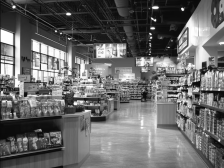
/// WHAT MAKES RETAIL DIFFERENT
Retail Software Runs on the Shop Floor

Downtime Stops Trade
Retail systems fail differently from other business software. A finance system that goes down for an hour causes inconvenience. A till that goes down for an hour stops trade, in front of customers.
Offline Capability Is a Design Decision
That makes offline capability a design decision rather than a feature. Transactions have to be written locally, payment has to keep working through the terminal, and reconciliation has to resolve conflicts cleanly when connectivity returns. Systems designed cloud-first without offline handling fail in exactly the situation where failure costs the most.
Stock Accuracy Drives Every Decision
Stock accuracy is the second constraint. Once the system and the shelf disagree, every downstream decision inherits the error: replenishment orders the wrong quantity, the website sells something the store does not have, and colleagues stop trusting the screen. Accuracy is an operational discipline that software either supports or quietly undermines.
Interfaces Must Work on the Shop Floor
The third is the user. Retail software is used standing up, one-handed, mid-conversation, by someone who was trained for twenty minutes and may be on their second shift. Interfaces built for a seated head-office user do not survive that.
Rollout Is Its Own Project
And rollout is its own project. Getting software right in one store proves very little about eighty. We plan pilot sites and phased deployment rather than switching an estate at once.
/// RETAIL SOLUTIONS
Retail Software We Build

Custom Retail Software Development

Retail App Development

POS System Development

Grocery & Supermarket Apps

Loyalty & Rewards Apps

Omnichannel Retail Platforms

Retail Inventory & Stock Management

Store Operations & Workforce Software

Self-Checkout & Kiosk Systems

Retail IoT Solutions

AR in Retail

///AI FOR RETAIL
AI for Retail Operations
Retail AI is worth building where it attaches to a number the business already reports weekly: stock accuracy, shrinkage, markdown spend, labour cost, conversion by store.

Computer Vision for Stores
Shelf monitoring, planogram compliance and out-of-stock detection from existing camera feeds, without new hardware.

Retail Demand Forecasting
SKU and store-level forecasting that reduces stockouts and markdowns using your own sales, seasonality and local signals.

Footfall Analytics & Heatmaps
Where customers walk, where they stop and where they leave, turned into layout and staffing decisions.

Loss Prevention AI
Shrinkage detection at self-checkout and on the shop floor, flagged for colleague review rather than automated accusation.

Dynamic Pricing & Markdown Optimisation
When to discount, by how much and in which stores, with margin floors the commercial team controls.

Assortment & Planogram Optimisation
What to stock in which store, based on local demand rather than a national plan applied everywhere.

Customer Segmentation & LTV
Behavioural segmentation and lifetime value modelling that feeds loyalty offers, campaigns and clienteling.

AI Staff Scheduling
Rosters built against forecast footfall and task load, so labour spend matches the hours that actually need cover.
Shelf monitoring, planogram compliance and out-of-stock detection from existing camera feeds, without new hardware.
Learn MoreSKU and store-level forecasting that reduces stockouts and markdowns using your own sales, seasonality and local signals.
Learn MoreWhere customers walk, where they stop and where they leave, turned into layout and staffing decisions.
Learn MoreShrinkage detection at self-checkout and on the shop floor, flagged for colleague review rather than automated accusation.
Learn MoreWhen to discount, by how much and in which stores, with margin floors the commercial team controls.
Learn MoreWhat to stock in which store, based on local demand rather than a national plan applied everywhere.
Learn MoreBehavioural segmentation and lifetime value modelling that feeds loyalty offers, campaigns and clienteling.
Learn MoreRosters built against forecast footfall and task load, so labour spend matches the hours that actually need cover.
Learn More///SYSTEMS & HARDWARE
Retail Systems and Hardware We Integrate With


/// HOW WE WORK
How We Work on Retail Projects
Store and systems discovery
We spend time in the store as well as in the systems. What colleagues actually do, where the current process breaks, what hardware is on the counter and what the existing POS and ERP genuinely expose.
Free solution architecture
Components, integration map, offline strategy, hardware compatibility and a costed delivery plan including rollout phasing. Yours to keep whether or not you build with us.
Pilot in one store
A working system in a single site, used on real shifts by real colleagues. Every assumption about training time, hardware and edge cases gets tested here rather than across the estate.
Phased rollout
Deployment by store group with a rollback path, training material and support cover. Estates are never switched over in one release.
///FEATURED CASES
Future-Proof Software for Your Business
At Sodio, we deliver mobile apps, web apps, blockchain (DApps), AI integrations, SaaS platforms, and custom software development. Our innovative solutions are scalable, secure, and user-friendly, designed to drive growth and efficiency, keeping your business ahead in the competitive landscape. Trust Sodio for your digital transformation needs.
Nestle
Partnered with Nestlé to develop ClubWS, a solution designed to streamline vendor management, ensure accurate sales tracking, and optimize target monitoring.
TATA Tiscon
When Tata Tiscon sought to transform the home-building experience for its customers, they partnered with Sodio, leveraging our proven track record in technology innovation.
JWS Cement
Developed a dedicated loyalty application for JSW Cement, empowering its dealer network to track and manage sales performance across masons and contractors efficiently.
Nestle
Partnered with Nestlé to develop ClubWS, a solution designed to streamline vendor management, ensure accurate sales tracking, and optimize target monitoring.
TATA Tiscon
When Tata Tiscon sought to transform the home-building experience for its customers, they partnered with Sodio, leveraging our proven track record in technology innovation.
JWS Cement
Developed a dedicated loyalty application for JSW Cement, empowering its dealer network to track and manage sales performance across masons and contractors efficiently.
/// FAQ
Frequently Asked Questions
Ecommerce software runs the online store: catalogue, cart, checkout and fulfilment. Retail software runs the physical business: point of sale, in-store stock, colleague tasks, rostering and store operations. Omnichannel work sits between the two, keeping stock, price, customer and order consistent across both. Most retailers need all three and the failure point is usually the join.
It has to, and this is the question worth asking any POS vendor first. A store cannot stop selling because a line went down. That means transactions written locally, payment has to keep working through the terminal, and a reconciliation process that resolves conflicts cleanly when connectivity returns. Systems designed cloud-first without offline handling fail in exactly the situation where failure is most expensive.
Usually yes. Most shelf monitoring, footfall and loss prevention work runs on existing CCTV feeds rather than requiring new hardware, provided the angles and resolution are adequate. We assess the current camera estate during discovery. Processing at the edge in-store rather than streaming video to the cloud is generally cheaper and avoids moving footage off site.
Through whatever the systems genuinely expose — APIs, event streams, database interfaces or scheduled file exchange for older platforms. The important decisions are which system owns each data field, how conflicts resolve when two systems disagree about stock, and what happens when one is unavailable. We establish that ownership model during discovery, because it is where most retail integrations fail later.
Both, though the problems differ. A single store or small group usually needs a workable POS, stock control and a loyalty mechanism without enterprise complexity. Chains need consistency across sites, central control with local flexibility, and integration with existing ERP and workforce systems. The engineering discipline is shared; the scale of the integration surface is not.
For a defined scope we target a working MVP in 30 days and a core production build in 90. Retail extends when payment certification, hardware integration or a phased store rollout is involved. Rolling out to stores is its own project — we plan pilot sites before a full estate deployment rather than switching everything at once.
/// RELATED INDUSTRIES & SERVICES
Related Industries and Services
Internal linking. Routes visitors to the correct page where scope overlaps.
/// GET STARTED
Start in One Store
Tell us where the current process breaks and which systems are on the counter. We will prepare a free solution architecture covering integrations, offline strategy, hardware compatibility and rollout phasing, so you can judge the approach before committing.