

 Events
Event Management Software Development
Ticketing, registration, check-in and hybrid event platforms for organisers, venues and conference teams, built for the one day a year when everything has to work at once.

TRUSTED BY TEAMS






Sodio builds event software: ticketing and registration platforms, check-in and badging apps, hybrid and virtual event platforms, conference and venue management, and event apps, plus AI for attendee matchmaking, bot detection and session recommendations. Event software is judged on two days a year.
The day tickets go on sale, when checkout has to survive more traffic in ten minutes than the rest of the year combined. And the day of the event, when check-in has to work even after the venue wi-fi has failed.

/// WHAT MAKES EVENT SOFTWARE DIFFERENT
Judged on Two Days a Year
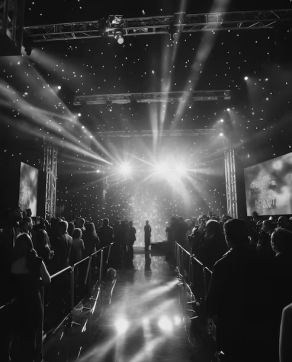
The Established Platforms
Eventbrite, Cvent and the established platforms handle standard ticketing and registration well, and for most events they are the right answer. We will say so during discovery rather than quote for a build nobody needs. Custom work earns its place where the event model does not fit, or where an organiser wants to own the attendee relationship rather than rent it.
Release Day
The first day that matters is release day. More traffic arrives in ten minutes than across the rest of the year, and most ticketing failures are not servers running out of capacity — they are inventory race conditions, where the same seat sells twice because two checkouts reached it at once. Queueing, inventory locking and load testing against realistic release traffic are designed in, not added after the first sell-out goes wrong.
Event Day
The second is event day. Venue wi-fi is the least reliable thing at most events, and a check-in system that depends on it creates exactly the queue it was bought to prevent. Scanning apps have to validate tickets offline, and still stop the same ticket being used at two different doors.
The Date Does Not Move
And the date does not move. Everything is planned backwards from it, and load testing happens well before tickets go on sale rather than the week before.
/// EVENT SOLUTIONS
Event Software We Build

Event Check-In Apps

Hybrid Event Platforms

Event Ticketing Platforms

Event App Development

Sports Event Management

Event Registration Software

Event Management Software

Virtual Event Platforms

Conference Management Software

Venue Management Software

Exhibitor & Sponsor Management

Badging & Access Control

///AI FOR EVENTS
AI for Events
Most people attend events to meet someone they have not met yet. The AI worth building here helps that happen, protects the release from bots, and keeps the venue moving on the day.
Attendee Matchmaking & Networking
Connecting attendees who should meet, by stated interests and behaviour, when none of them have met before.

Ticket Fraud & Bot Detection
Stopping scalping bots and fake tickets before release day, not investigating them afterwards.

Dynamic Ticket Pricing
Demand-based pricing with caps and clear rules, rather than leaving the margin to resale markets.

Session Recommendations
Personalised agendas across multi-track conferences, so attendees find the sessions worth their time.
Crowd Flow & Capacity Prediction
Entry queues and room overcrowding predicted from registration and scan data before they happen.

AI Event Assistant
Attendee questions answered from the event's own agenda, venue and policy information.

Post-Event Content Generation
Session summaries, highlights and follow-up content produced from recordings, reviewed before publishing.
Connecting attendees who should meet, by stated interests and behaviour, when none of them have met before.
Learn MoreStopping scalping bots and fake tickets before release day, not investigating them afterwards.
Learn MoreDemand-based pricing with caps and clear rules, rather than leaving the margin to resale markets.
Learn MorePersonalised agendas across multi-track conferences, so attendees find the sessions worth their time.
Learn MoreEntry queues and room overcrowding predicted from registration and scan data before they happen.
Learn MoreAttendee questions answered from the event's own agenda, venue and policy information.
Learn MoreSession summaries, highlights and follow-up content produced from recordings, reviewed before publishing.
Learn More///EVENT TECH STACK
Systems We Work With


/// HOW WE WORK
How We Work on Event Projects
Event and date discovery
We start from the event date and the ticket release date, and work backwards. Then we map ticket rules, attendee types and what happens on the day at the door.
Free solution architecture
Inventory model, release-day load strategy, offline check-in, integrations and a costed plan dated backwards from the event. Yours to keep — including if the recommendation is to use an existing platform.
MVP in 30 days
The path that matters first — usually ticketing and checkout — working end to end and load tested against realistic release traffic.
Production build in 90 days
Full build with check-in, badging and attendee features, plus a rehearsal on real devices at the venue before the doors open.
///FEATURED CASES
Future-Proof Software for Your Business
At Sodio, we deliver mobile apps, web apps, blockchain (DApps), AI integrations, SaaS platforms, and custom software development. Our innovative solutions are scalable, secure, and user-friendly, designed to drive growth and efficiency, keeping your business ahead in the competitive landscape. Trust Sodio for your digital transformation needs.
Horizon
Community platform connecting people through shared interests, clubs, and real-world experiences.

Aloomah
A digital platform built to deliver modern and user-focused online experiences.
Horizon
Community platform connecting people through shared interests, clubs, and real-world experiences.
Aloomah
A digital platform built to deliver modern and user-focused online experiences.
/// FAQ
Frequently Asked Questions
Usually you should not, and we will say so. The established platforms handle standard ticketing and registration well. Custom work earns its place when the event model does not fit — unusual ticket rules, recurring event series with their own data, venues running hundreds of events a year, or organisers who want to own the attendee relationship rather than rent it from a platform. That last reason is the most common.
It has to, and that is designed for rather than hoped for. Ticket releases produce more traffic in ten minutes than the rest of the year combined. Queueing, inventory locking so the same seat cannot sell twice, and load testing against realistic release traffic are built in before launch. Most ticketing failures are an inventory race condition rather than a server running out of capacity.
Check-in keeps working. Scanning apps hold the attendee list on the device, validate tickets offline, and sync when connectivity returns — without allowing the same ticket through two different doors. Venue wi-fi is the least reliable thing at most events, and a check-in system that depends on it creates the queue it was bought to prevent.
This is the hard part of event networking and we have built for it directly. There is no history between attendees, so matching relies on stated interests, role, goals and behaviour during the event. We built interest-based matchmaking for Horizon, a community platform whose entire premise was connecting people outside their existing network — the same cold-start problem an event faces.
You can make it expensive enough that most stop. Bot detection at the queue, purchase limits tied to verified identity, named tickets and controlled transfer rules together reduce scalping substantially. No system eliminates it entirely, and anyone promising that is overselling.
For a defined scope we target a working MVP in 30 days and a core production build in 90. Events have one constraint almost nothing else shares: the event date does not move. We plan backwards from it, and we schedule load testing well before tickets go on sale rather than the week before.
/// RELATED SERVICES
Related Industries and Services
Industries and services that complement event software development.
/// GET STARTED
Start From the Event Date
Tell us when tickets go on sale, when the doors open, and what has gone wrong at past events. We will prepare a free solution architecture planned backwards from your date, with release-day load and offline check-in designed in.